
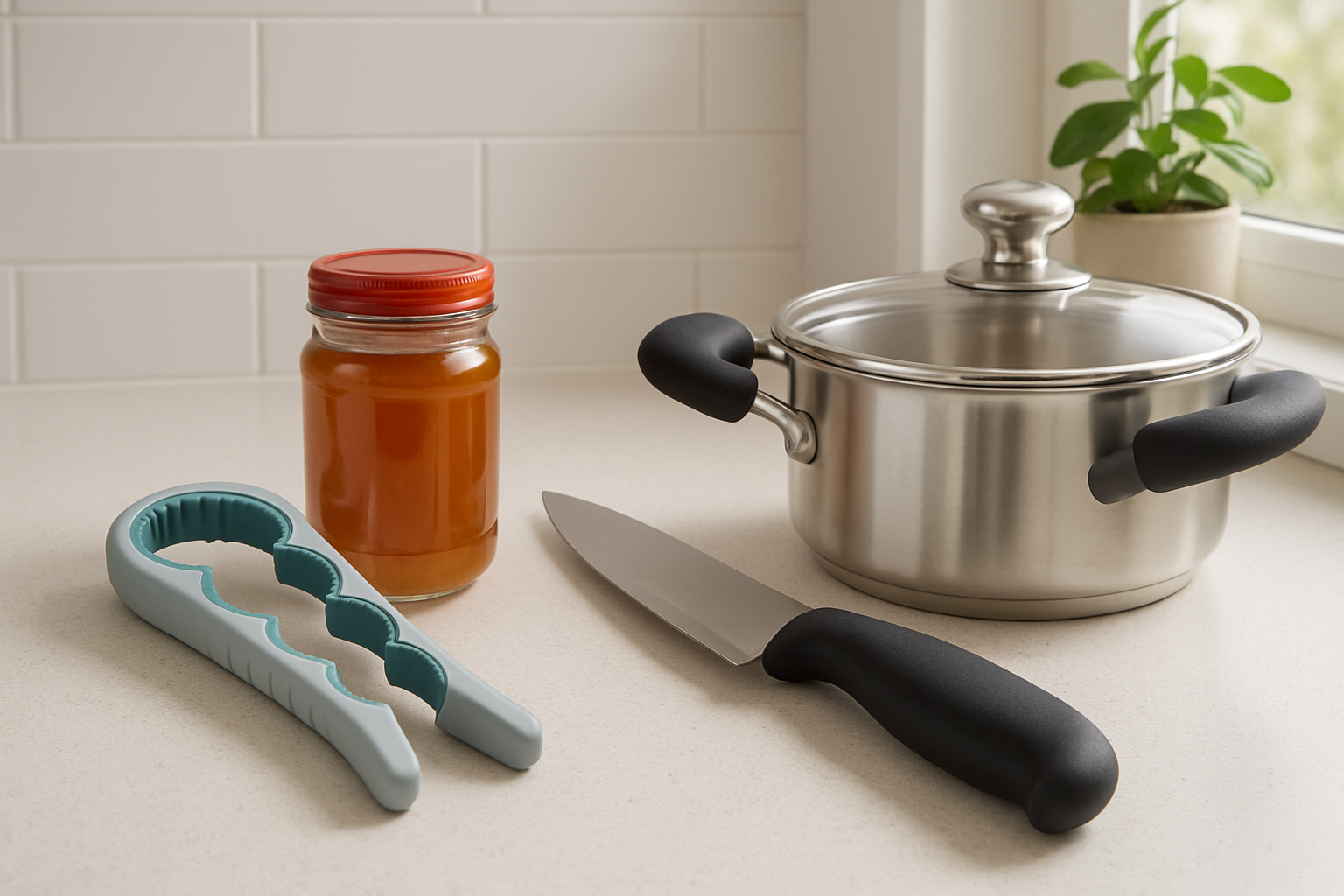
You know that moment — you’ve been standing at the counter chopping vegetables for ten minutes, and suddenly your fingers ache, your wrists feel like they’re on fire, and you find yourself white-knuckling a stubborn jar lid until your knuckles literally turn white. If that sounds familiar, you’re not alone. I hear it constantly from clients: “I love to cook, but it just hurts too much.” That’s exactly why kitchen ergonomics for joint pain has become one of my favorite topics to talk about, because the kitchen is one of those places where small changes can make a genuinely huge difference in your daily comfort and independence.
Affiliate disclosure: This post contains affiliate links. As an Amazon Associate, I earn from qualifying purchases. This helps keep JointHealthFAQ.com running at no extra cost to you — I only recommend products I believe in.
Why the Kitchen Is a High-Risk Zone for Joint Pain
Think about everything you do in the kitchen: gripping, twisting, lifting, standing on hard floors, reaching overhead, and repeating the same motions over and over. For anyone living with arthritis, rheumatoid arthritis, hypermobility, carpal tunnel syndrome, or recovering from a joint injury, those tasks aren’t just tedious — they can genuinely inflame already-irritated joints and make symptoms worse for hours afterward.
Research suggests that repetitive gripping and pinching motions are among the most stressful movements for the small joints of the hand. Twisting a jar lid, for example, requires a strong pinch grip combined with rotational force — two things that tend to be particularly painful and damaging over time for people with hand and wrist joint issues. The good news? Occupational therapists and physical therapists have been developing adaptive strategies and tools for this exact problem for decades, and the product options available today are better than they’ve ever been.
Kitchen Ergonomics for Joint Pain: The Core Principles to Know First
Before we get into specific gadgets, I want to share a few foundational principles I give to every client dealing with joint pain in the kitchen. These are things you can start doing today, for free.
Use Your Larger, Stronger Joints
This is classic joint protection advice, and it works. Instead of pinching a pot handle with your fingers, cradle it with both palms and your wrists. Instead of gripping a knife tightly, focus the pressure through the heel of your hand. Using larger muscle groups and joints distributes force more evenly and reduces stress on smaller, more vulnerable structures.
Reduce Grip Force Whenever Possible
This is where adaptive tools genuinely shine. Anything that removes the need for a powerful pinch grip — like an electric opener or an ergonomically designed knife — can meaningfully reduce the load on your hand joints during meal prep.
Take Micro-Breaks and Alternate Tasks
Many people find relief with a simple habit of alternating between light and heavier tasks rather than doing all the chopping at once. Set a gentle timer if you need to — five to ten minutes of active prep followed by a brief rest can make a long cooking session much more manageable.
Set Up Your Workspace Thoughtfully
Counter height matters more than most people realize. Ideally, your work surface should be at or just below elbow height when your arms are relaxed at your sides. If your counters are too high, a sturdy anti-fatigue mat can give you a couple of extra inches while also cushioning your feet and knees. Sitting on a tall stool for prep work is another option many of my clients swear by.
What Actually Helps: Adaptive Kitchen Tools I Recommend
Now for the fun part. Here are the specific products I regularly point people toward, and why I think they’re worth the investment.
For the Jar and Bottle Opening Battle
Honestly, if there’s one thing I could give every person with hand arthritis or weak grip strength, it would be an electric jar opener. The torque required to open a tight lid is genuinely significant, and forcing it is one of the quickest ways to spike inflammation or cause a flare. These three options are all excellent, and they suit slightly different needs:
- Electric Jar Opener for Arthritis Hands — This one is a go-to recommendation for people who want something compact and easy to use across different jar sizes. It requires virtually no grip strength, which is exactly the point.
- INSTACAN One Touch Electric Jar Opener — The one-touch operation and auto-off feature make this one particularly easy for anyone with limited hand dexterity. It’s also hands-free once it’s set on the jar, which I love for those especially painful flare days.
- Higher Torque Hands-Free Electric Jar Opener — If you’re dealing with particularly stiff or stubborn lids, this higher-torque model is worth considering. It’s battery operated, hands-free, and fits almost every jar size you’re likely to encounter in a regular kitchen.
Any one of these may help you reclaim independence in the kitchen without putting your joints through unnecessary stress. Many people with RA and osteoarthritis report that tools like these are genuinely game-changing for daily life.
For Chopping and Cutting Without the Strain
Standard kitchen knives require a sustained pinch grip and repetitive wrist flexion — two things that are genuinely hard on arthritic or hypermobile joints. Adaptive knife designs address this by changing the angle of the handle so that your wrist stays in a more neutral, protected position.
- Rehabilitation Advantage TGrip Rocker Knife — The T-shaped handle on this knife means you press downward rather than gripping sideways, which significantly reduces the load on your finger joints and wrist. The rocking motion also means less repetitive back-and-forth slicing. This is a classic occupational therapy recommendation for good reason.
- Right Angle Knife 2-Pack with Serrated and Chopping Blades — The L-shaped design of these adaptive knives keeps your wrist in a neutral alignment while cutting, which research suggests may reduce strain on wrist and finger joints compared to traditional knife grips. Having both a serrated blade and a chopping blade in the set is a practical bonus for everyday meal prep.