
I had my right knee replaced, and I’ll tell you what nobody quite managed to tell me beforehand: the surgery is the easy part. What happens in the 12 weeks that follow determines whether you get your life back or spend the next year wondering why your new knee still feels like the old one.
I spent a lot of that period in waiting rooms and physical therapy gyms, comparing notes with other people at the same stage. What separated the ones doing well from the ones stuck almost never seemed to be the surgeon or the implant. It was the rehab — how structured it was, how consistently they did it, and whether anyone had explained why each step mattered.
What follows is what my own 12 weeks looked like, set against what the published guidance actually says — including the American Academy of Orthopaedic Surgeons guidelines and outcomes research in the Journal of Bone and Joint Surgery. I am not a clinician and this is not a plan for you; your surgeon and your physical therapist will give you yours. This is the version I wish I’d been able to read the week before my operation.
Understanding What You’re Actually Recovering From
Total knee arthroplasty (TKA) is a major surgical procedure. The surgeon removes damaged cartilage and bone, then resurfaces the joint with metal and plastic components. Your quadriceps muscle — the engine of your knee — is cut into or retracted to access the joint. That trauma to the quad is often the single biggest limiting factor in recovery, and it’s why early strengthening feels so frustratingly slow.
Expect significant swelling for the first four to six weeks. Expect your quad to feel almost non-functional in week one. These are normal responses, not signs of failure. The goal of a good knee replacement recovery protocol is to work within that biological reality, not fight against it.
Weeks 1–2: Protecting the Repair and Restoring Basic Function
In the first two weeks, your priorities are three things: controlling swelling, regaining basic range of motion, and getting the quad to fire again. That’s it. Don’t try to do more than this.
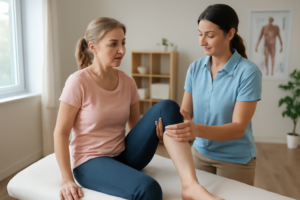
Range of motion targets: By the end of week two, most people should be reaching 90 degrees of knee flexion. This is the threshold required to sit comfortably, use stairs with support, and get in and out of a car. If you’re not hitting 90 by day 14, that’s a conversation to have with your PT and surgeon immediately — scar tissue forms quickly and early mobilisation matters enormously.
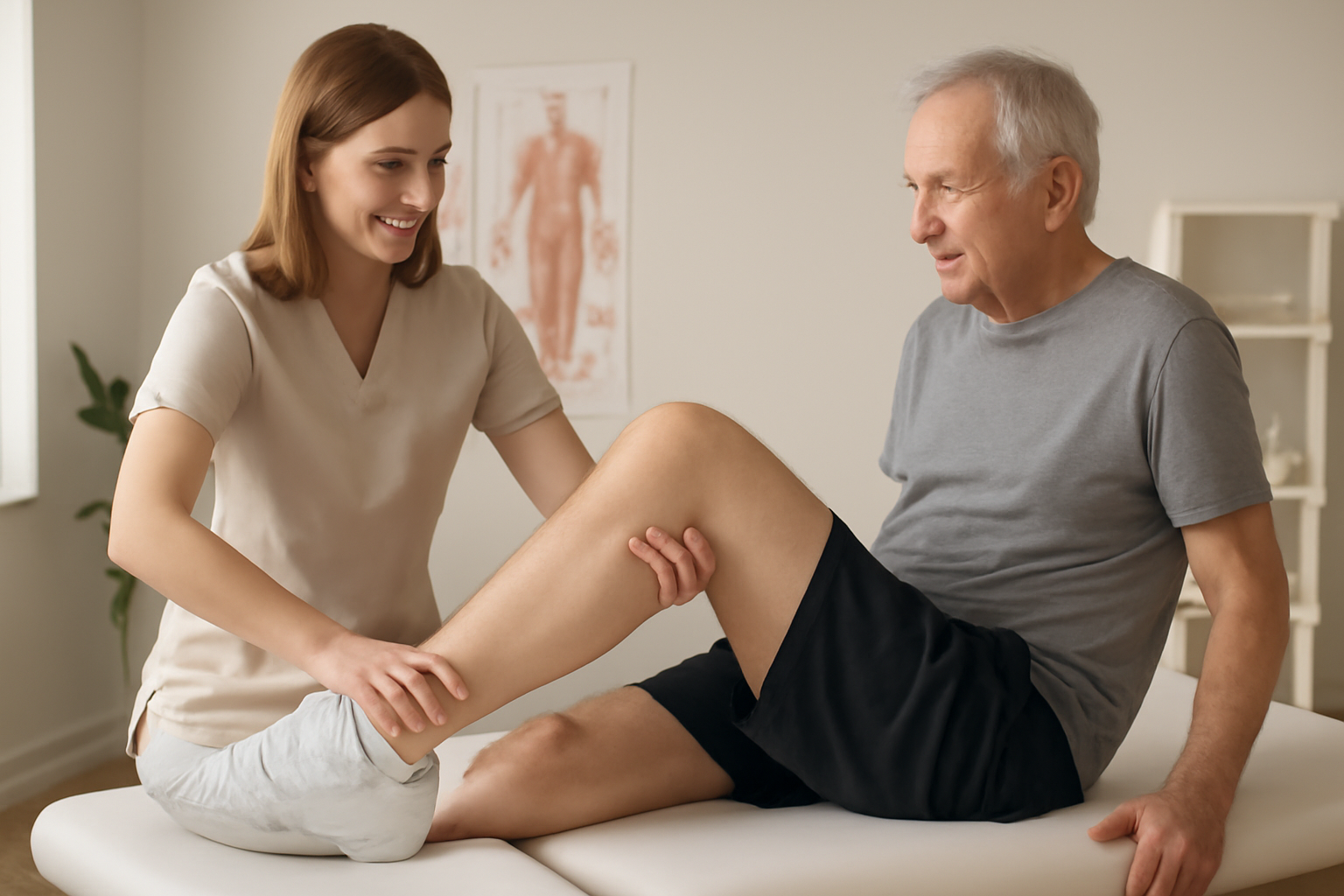
What my physical therapist had me doing in this phase:
- Ankle pumps (every hour while awake — this is non-negotiable for DVT prevention)
- Quad sets — lying flat, pushing the back of your knee into the bed and holding for five seconds
- Straight leg raises — once the quad can hold the leg straight without the knee “giving”
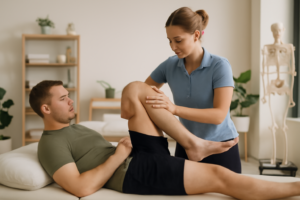
- Heel slides — lying on your back, sliding the heel toward your buttocks to increase flexion
- Short arc quads using a rolled towel under the knee
Cold therapy is critical here. I recommend icing for 15–20 minutes every two to three hours in the first two weeks. Swelling is the enemy of early range of motion — it creates pain, limits movement, and can delay your entire timeline if left unmanaged.
Weeks 3–6: Building Strength and Improving Gait
By week three, most people have been discharged from inpatient or home health care and are moving into outpatient PT. This is where the real work begins, and where the gap opens up between the people who stay consistent and the people who don’t. I was not always in the first group.
Range of motion targets: 0–110 degrees of flexion by end of week six. Full extension (0 degrees) is actually more important than most people realise. A knee that can’t fully straighten will cause a limp, increased energy expenditure during walking, and long-term quad weakness.
Key exercises added in this phase:
- Mini squats (0–45 degrees) with bilateral support
- Step-ups onto a 4-inch step, progressing to 6-inch
- Standing hip abduction and extension to address compensatory movement patterns
- Stationary cycling — I typically introduce this around week four when flexion allows it
- Terminal knee extensions using a resistance band
Walking endurance is built gradually here. Start with two to three short walks daily (five to ten minutes each) and progress by no more than 10% per week. Overloading too fast in this phase is one of the most common reasons people develop persistent anterior knee pain or set off a significant swelling flare.
Weeks 7–12: Functional Strength and Return to Daily Activity
This is the phase most people underestimate. By week seven, many people feel dramatically better and assume they’re essentially recovered. They’re not. The quad strength deficit typically persists for months — research shows that quadriceps strength may still be 20–30% below the unaffected side at 12 weeks post-op, even in people who feel subjectively good.
Range of motion targets: 120–130 degrees of flexion by week 12. This is the range required for most recreational activities, cycling, swimming, and low-impact exercise.
Progressive exercises in this phase:
- Single-leg press (low resistance, high control)
- Leg press with progressive loading
- Balance and proprioception work — single-leg standing, balance board progressions
- Pool walking and hydrotherapy if available
- Stair climbing with reciprocal pattern (not step-to-step)
Gait retraining mattered more than I expected in this phase. It is easy to develop subtle compensations — leaning to one side, shortening your stance phase — that become habitual if nobody catches them. Mine filmed me walking on a phone, which was mortifying and completely worth it.
Should I Still Be Doing Heel Slides in Week 12?
This is the question I had at the tail end, and the one I get asked most, so let me answer it directly. Heel slides are an early-phase range-of-motion exercise, and for most people they’ve done their job well before week 12. If you’ve reached your flexion goals — typically somewhere in the 110–120 degree range or better — and your knee bends smoothly without a hard, restrictive end-feel, there’s usually little benefit in continuing them. At that point your time is better spent on the functional strengthening and balance work described above, which is what actually rebuilds the quad and protects the joint long-term.
The exception is if your flexion is still short of goal. If you’re sitting at, say, 95–105 degrees at week 12, heel slides (or wall slides and stationary cycling, which accomplish similar things) absolutely still belong in your programme — regaining that range remains a priority, and it’s also worth a direct conversation with your PT and surgeon about why progress has stalled. As with everything in this protocol, your surgical team’s specific instructions override the general rule: some surgeons want ROM work continued longer as insurance, and that’s a perfectly reasonable clinical call. When in doubt, ask at your next visit rather than quietly dropping the exercise.
An Honest Caveat About This Protocol
I want to be straight with you: this is one person’s account plus the general published guidance. Everyone’s baseline, surgical approach, implant type, and pre-operative strength is different. A 58-year-old who was athletic before surgery will respond very differently from a 74-year-old who was largely sedentary. Some people move through the phases faster; others need more time. If your surgeon gave you specific restrictions, or your PT has modified your plan, follow that over anything you read online — this article very much included. The point here is to help you ask better questions, not to replace your care team.
The Bigger Picture
Twelve weeks is not the finish line — it’s the foundation. Most people keep seeing meaningful improvement in strength, comfort, and function up to a year after surgery, and I certainly did. The ones who do best seem to be those who understand recovery has distinct phases, who keep doing the home programme even when progress feels invisible, and who tell their PT promptly when something doesn’t feel right.
If you’re about to go through this surgery, or you’re currently in the middle of recovery and feeling frustrated, I hope this gives you a clearer map of where you are and where you’re headed. The knee you get on the other side of this process is genuinely worth the work it takes to get there.
The Post-Op Knee Brace That Actually Lets You Progress Without Fear
In the first 12 weeks after knee replacement, you need a brace that stabilizes without over-protecting—something that lets you bear weight and build confidence without feeling like your new knee is going to fail on you. The adjustable ROM (range of motion) design on this one is exactly what separates “I’m babying this” from “I’m actually rehabbing this.”
What works
- Adjustable hinges let you dial in ROM as you progress—you’re not locked into someone else’s recovery timeline, and you can actually mirror what PT is asking you to do each week without buying a new brace.
- The dual-pull straps distribute pressure without creating hot spots or cutting off circulation, which matters when you’re wearing this 6–8 hours a day and your leg is already swollen enough without added compression issues.
- Research on post-op knee braces shows that ROM-adjustable designs reduce compensation injuries (bad movement patterns your other leg picks up) better than fixed braces, because you’re not forced into an unnatural gait while you heal.
What doesn’t
- If you’re more than 4–6 weeks post-op and your PT hasn’t cleared you to start ROM work, this brace is overkill—you need immobilization first, not adjustability.
- The brace doesn’t replace PT, manage swelling on its own, or speed up the biological healing process; it’s a tool that lets you do the work without constant fear that you’re ruining your surgery.
A good brace removes one variable from an already complex recovery, but it won’t do the work your muscles need to do to stabilize that new joint. Brace Direct Breg T Scope Premier Post Op Knee Brace Adjustable ROM for ACL MCL PCL Injury Recovery L1833 L1832
About This Article

Written by Michael Torres. Michael Torres has had joint problems his whole life — hypermobile as a kid, chronic sprains and a dislocating shoulder through his twenties, an osteoarthritis diagnosis in his early fifties, and a right knee replacement since. He is not a doctor or a physical therapist and has no clinical training. He writes about what has helped him and what he has watched help the people around him, and says plainly when he has not tried something himself. More about this site.
Scope and limits. Michael has no medical or clinical training — he writes about living with his own joint pain, not about treating anyone else's. Nothing here is medical advice. Talk to a doctor before starting anything new, and get seen promptly for pain that is new, severe, worsening, or comes with swelling, fever, or numbness.
Verify this against a primary source
Specifics change, and your situation may differ from the one described here. These are the authorities worth checking directly:
- NIAMS — arthritis and musculoskeletal research from the NIH
- MedlinePlus — plain-language medical reference from the NIH
- Arthritis Foundation — condition guides and treatment overviews