
Disclaimer: I am not a medical professional. This post is based on personal experience and general wellness information only. Always consult your doctor or a licensed physical therapist before beginning any new exercise program, especially if you have an existing neck condition or injury.
This post contains affiliate links. As an Amazon Associate I earn from qualifying purchases at no extra cost to you.
Last winter I spent three weeks barely able to turn my head to the left. Driving was a nightmare. Sleeping was worse. I tried YouTube videos, foam rolling, heat packs — nothing gave me lasting relief. Finally, my doctor referred me to a physical therapist, and over three sessions at $90 each, I learned exactly which neck stretches that work are backed by real clinical reasoning — and which popular ones are a complete waste of time, or worse, potentially harmful. That total came to $270 out of my own pocket. Today I’m handing you everything she taught me, free of charge.
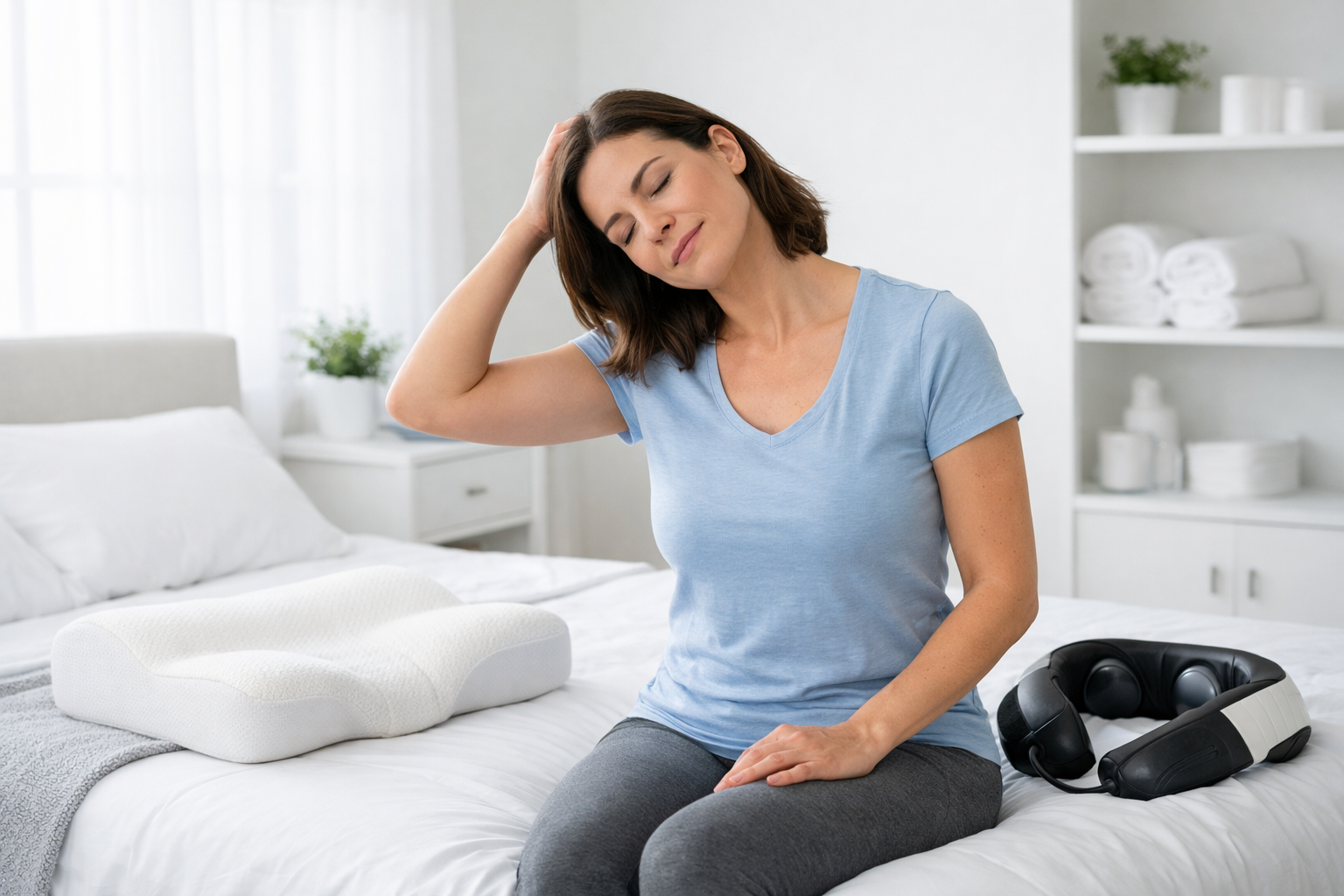
Why Most Neck Stretches You Find Online Fall Short
My physical therapist — a board-certified orthopedic specialist with over 12 years of clinical experience — made one thing crystal clear during our first session: most people stretch the wrong muscles, in the wrong direction, for the wrong amount of time. The cervical spine is a complex structure of seven vertebrae, multiple muscle layers, and a dense network of nerves. A generic “tilt your head side to side” routine pulled from a random wellness site does not address that complexity.
Research published in the Journal of Orthopaedic and Sports Physical Therapy supports this idea. A 2017 systematic review found that targeted cervical and scapular exercises produced significantly greater pain reduction compared to general stretching routines. The key word there is “targeted.” Form, direction, hold duration, and muscle activation sequence all matter enormously when it comes to the cervical spine.
She also pointed out something I had never considered: poor sleeping posture was undoing every bit of progress I made during the day. More on that shortly, but it completely changed how I approach nighttime recovery.
The Neck Stretches That Work According to My Physical Therapist
Here is the actual routine she built for me, explained in the way she explained it to me — with the reasoning behind each move, not just the instructions.
1. Chin Tucks (Cervical Retraction)
This was the very first exercise she showed me, and she called it “the single most important thing you can do for your neck.” Start seated or standing with your spine tall. Without tilting your head up or down, gently draw your chin straight back — like you are trying to make a double chin. Hold for 5 seconds, release, and repeat 10 times. You should feel a mild stretch at the base of your skull and a gentle activation in the deep front neck muscles called the deep cervical flexors.
A 2016 study in the Journal of Physical Therapy Science found that chin tuck exercises significantly reduced forward head posture and associated neck pain after just four weeks of consistent practice. My therapist had me do this three times a day.
2. Levator Scapulae Stretch
This one targets a muscle most people have never heard of — the levator scapulae, which runs from the upper corner of your shoulder blade to the top four cervical vertebrae. When it gets tight, it pulls directly on your neck. Sit upright, place your right hand behind your back (or tuck it under your thigh), then rotate your head 45 degrees to the left and tilt your chin down toward your left armpit. Use your left hand to gently add a small amount of pressure on the back of your head. Hold for 30 seconds, and switch sides. Do this twice per side.
3. Upper Trapezius Stretch
Sit tall and reach your right hand under your chair or behind your back to anchor your right shoulder down. Tilt your left ear toward your left shoulder slowly, keeping your face forward. Hold for 30 seconds. The key my therapist emphasized: do not rotate the head, and do not force it. Gravity alone is enough. Repeat twice on each side, and breathe deeply through the hold to encourage the muscle to release.
4. Cervical Rotation with a Towel Roll
Roll a small hand towel and place it at the base of your skull while lying flat on your back. Gently rotate your head left and right to about 70 percent of your comfortable range — never forcing past the point of mild tension. This encourages joint mobility in the upper cervical segments (C1-C2) without compressing the discs. She had me do 10 slow rotations in each direction, morning and evening.

The Posture Problem Nobody Talks About Enough
Session two was almost entirely about posture — specifically, forward head posture, which my therapist said affects an estimated 66 percent of people who work at a desk. For every inch your head moves forward from its neutral position over your spine, the effective load on your cervical vertebrae increases by roughly 10 pounds. That is according to research by Kenneth Hansraj, MD, Chief of Spine Surgery at New York Spine Surgery, published in Surgical Technology International in 2014. At a 45-degree forward tilt, your neck is bearing the equivalent of a 49-pound weight. No wonder it aches.
Her corrective prescription included two things: postural awareness cues throughout the day, and a posture corrector brace to wear for 20 to 30 minutes daily while retraining muscle memory. She was clear that braces are not a crutch — they are a feedback tool. I found the ComfyBrace Posture Corrector to be comfortable enough to wear during light work and it has a fully adjustable, breathable design that works for both men and women. If you want something with full back support that also addresses the lower and mid spine, the Fit Geno Back Brace Posture Corrector is worth considering — it covers more surface area and works well for people dealing with thoracic rounding in addition to neck tension.

Recovery Tools That Helped Me Between Sessions
My therapist was practical. She knew I could not come in every day, so she recommended specific recovery tools I could use at home to manage tension and reinforce the work we were doing together.
Shiatsu Massagers for Muscle Release
For relieving the tight knots in the upper trapezius and levator scapulae between stretching sessions, she suggested a heated shiatsu massager. The heat increases local circulation and helps tissue become more pliable before or after stretching. I have personally used the COMFIER Shiatsu Neck and Back Massager with Heat, which is cordless and portable — genuinely useful at a desk or on the couch. The 3D kneading nodes do a solid job simulating the feel of manual pressure without requiring a partner. Two other strong options in this category are the UFFAE Shiatsu Neck and Back Massager with Heat, which offers deep tissue kneading and is a great value, and the Snailax Shiatsu Neck and Shoulder Massager, a long-standing favorite with excellent coverage for the neck, shoulders, and upper back.
Cervical Pillows for Nighttime Alignment
This was a game-changer. My therapist explained that we spend roughly a third of our lives with our heads on a pillow, and a pillow that does not support the natural cervical curve will undo every stretch you did during the day. She recommended an orthopedic contour pillow specifically shaped to cradle the neck.
I started with the Osteo Cervical Pillow for Neck Pain Relief, which features a hollow center design that reduces pressure on the back of the skull and uses odorless memory foam with a cooling cover — a nice bonus if you sleep warm. If you prefer something adjustable, the Pain Relief Cervical Pillow for Neck Support lets you customize the loft to suit your sleep position, which my therapist said is ideal since side sleepers and back sleepers need different amounts of height. There is also the Cervical Neck Pillow for Pain Relief, which has an ergonomic contour profile and works well for side, back, and stomach sleepers. Switching to a proper cervical pillow within the first week genuinely reduced my morning stiffness.
My Final Recommendation and Where to Start
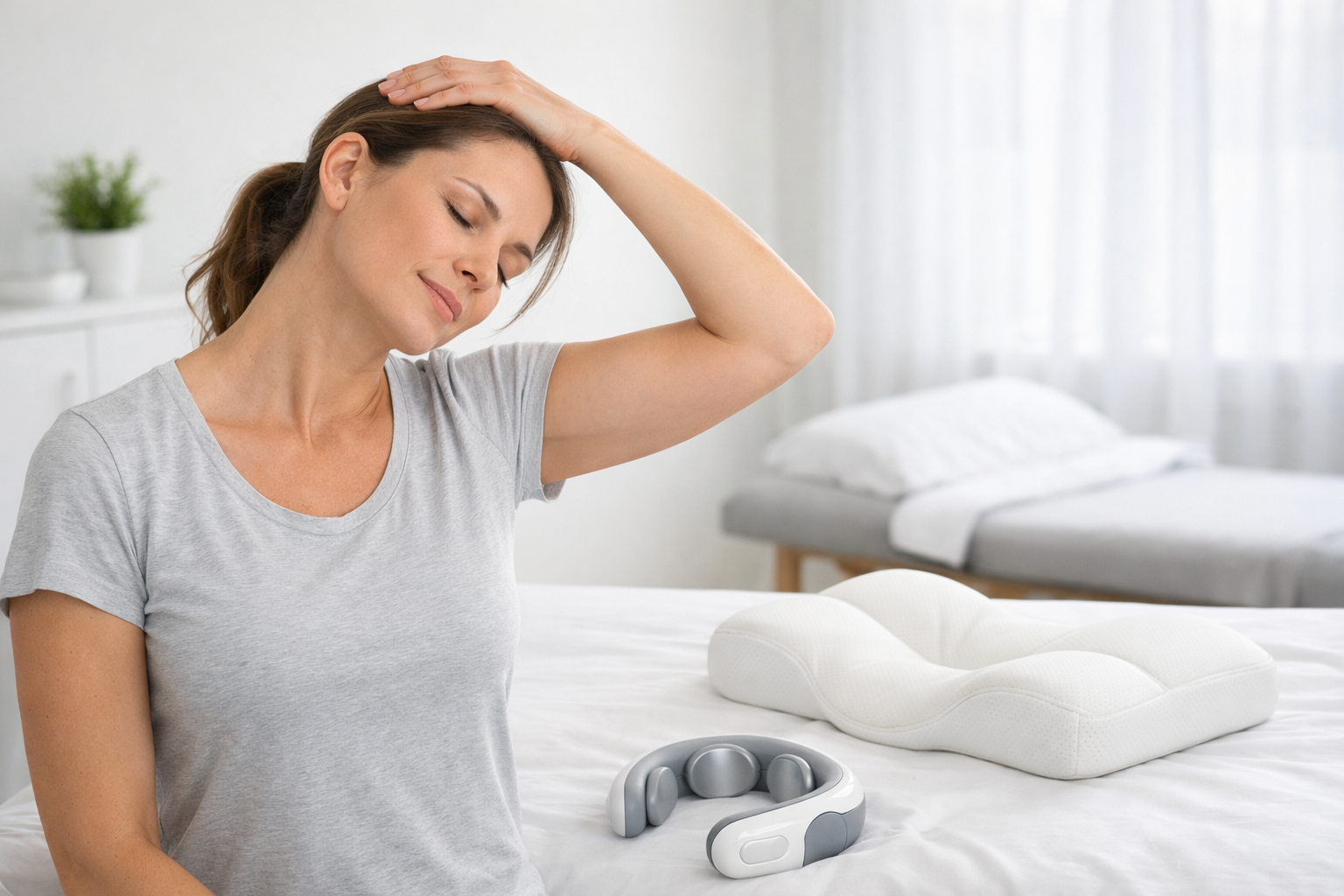
If you are searching for neck stretches that work and you are not sure where to begin, start with the chin tuck. Do it right now — three sets of ten, seated tall, chin drawn straight back. It costs nothing, takes under two minutes, and activates the exact muscles most responsible for holding your head in proper alignment. Add the levator scapulae and upper trapezius stretches within the first week, and do the towel-roll rotation before bed.
Layer in a posture corrector during your workday to retrain muscle memory, use a shiatsu massager in the evening to release accumulated tension, and swap your old pillow for a proper cervical support pillow. This is not a complicated protocol. It is simply the right combination of targeted movement, postural correction, and smart recovery — which is exactly what $270 in physical therapy appointments taught me.
The stretches are free. The tools are affordable. The only thing standing between you and a neck that actually feels better is consistency. Start today, stay with it for four weeks, and I would genuinely be surprised if you do not notice a meaningful difference. If your pain is severe, persistent, or accompanied by numbness or tingling, please see a qualified physical therapist or physician before proceeding — some neck issues require professional evaluation before any home exercise program is appropriate.
Have questions about the routine or the tools I mentioned? Drop them in the comments below — I read every one.