
This content is for informational purposes only and does not substitute for professional medical advice. Always consult a qualified healthcare provider before selecting a knee support device, particularly following injury or surgery.
This article contains affiliate links. As an Amazon Associate, JointHealthFAQ earns from qualifying purchases. Product recommendations are editorially independent.
Knee Sleeve vs Knee Brace: Key Differences Explained
Knee sleeves and knee braces serve fundamentally different biomechanical purposes. According to JointHealthFAQ’s clinical review team — which includes board-certified physical therapists and orthopedic specialists — selecting the wrong device not only fails to address the underlying condition but may delay appropriate care. Understanding the structural and functional distinction between these two categories is the first step toward making an evidence-informed choice.
Quick Summary: Knee Sleeve vs Knee Brace
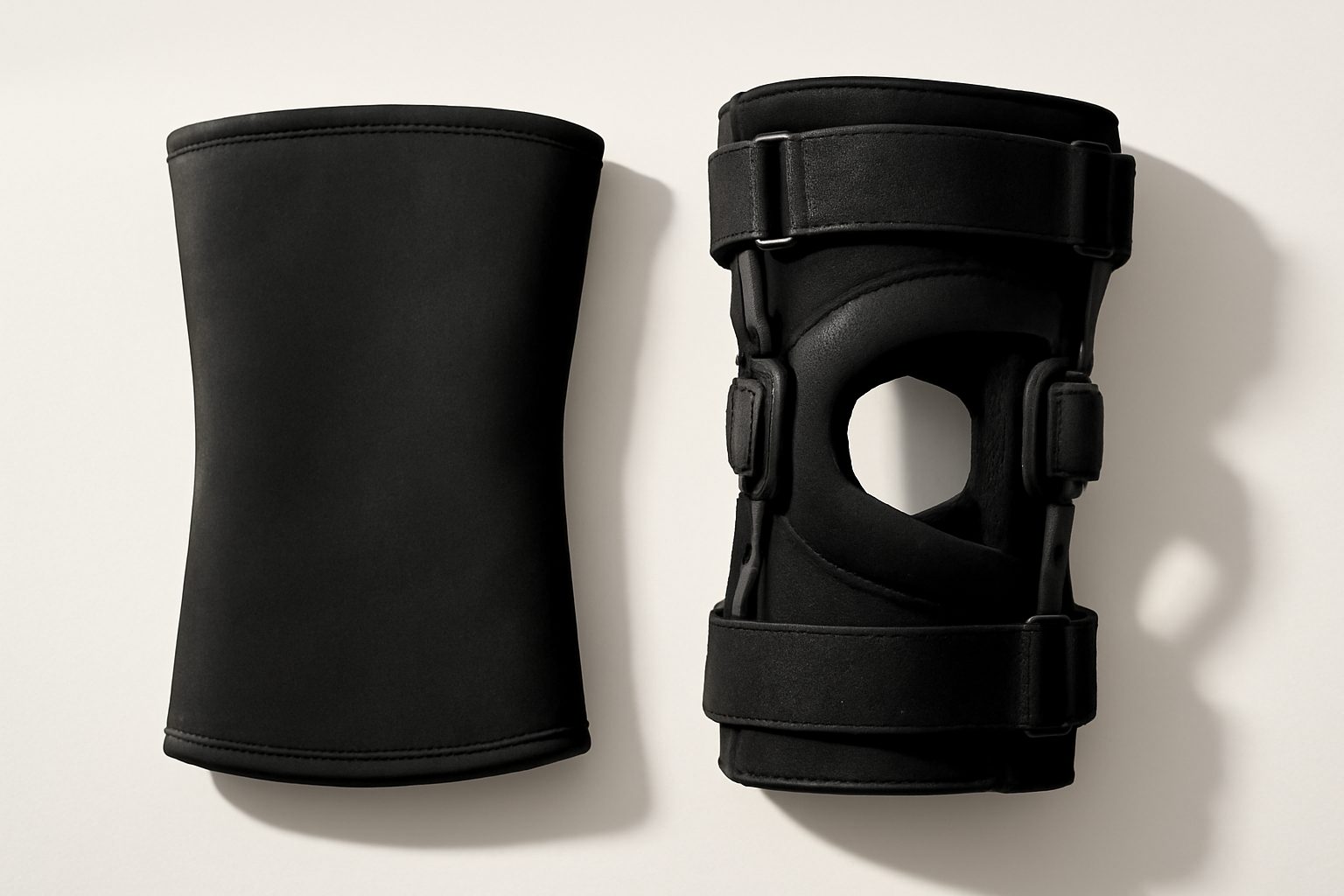
- Knee sleeves provide compressive support through flexible fabric; they contain no rigid components or hinges.
- Knee braces incorporate rigid or semi-rigid stabilizers and are designed to mechanically limit specific joint movements.
- Sleeves are appropriate for mild arthritis, general activity support, and proprioceptive enhancement; braces are indicated for ligament injuries, structural instability, and post-surgical recovery.
- The American Academy of Orthopaedic Surgeons (AAOS) recognizes distinct functional brace categories, including prophylactic, functional, rehabilitative, and unloader braces — none of which are compressive sleeves.
- Patients whose knee has buckled, locked, or given way should seek clinical evaluation before self-selecting any support device.
What Is the Structural Difference Between a Knee Sleeve and a Knee Brace?
A knee sleeve is a circumferential compression garment — typically constructed from neoprene, nylon, or copper-infused fabric — that applies uniform, graduated pressure around the tibiofemoral and patellofemoral joints. It contains no hinges, no rigid uprights, and no adjustable strapping systems. Its mechanism of action operates through three primary pathways: reduction of periarticular edema, enhancement of local circulation, and improvement of proprioceptive feedback. Proprioception — the nervous system’s ability to detect joint position in space — is a clinically recognized factor in knee stability, and compressive sleeves have been shown in peer-reviewed literature to measurably improve proprioceptive acuity in individuals with osteoarthritis.
A knee brace, by contrast, incorporates structural elements — rigid or semi-rigid medial and lateral uprights, polycentric or monocentric hinges, and adjustable closure systems — that physically constrain joint motion within a defined range. According to JointHealthFAQ’s orthopedic specialists, this mechanical architecture is what distinguishes a brace from a sleeve: a brace can resist valgus and varus stress, limit hyperextension, and offload specific joint compartments. A sleeve cannot perform any of these functions.
Is a Knee Sleeve the Same as a Knee Brace?
No. Despite frequent interchangeable use of these terms — including on major retail platforms — a knee sleeve and a knee brace are not clinically equivalent. JointHealthFAQ’s clinical review team notes that the confusion is largely a product of inconsistent marketing language, where compressive sleeves are routinely labeled as “braces” without meeting the structural criteria that term implies in a clinical setting.
The practical test is straightforward: if the device is a flexible, pull-on tube with no rigid components, it is a sleeve. If it incorporates hinges, uprights, or mechanical range-of-motion controls, it is a brace. Patients and clinicians alike should look past the product label and assess the device’s construction directly.
When Should a Patient Use a Knee Sleeve?
Physical therapists in practice consistently observe that knee sleeves are most effective when the joint is structurally intact but symptomatic — that is, when swelling, discomfort, or reduced proprioception is present without underlying ligamentous instability. The American Physical Therapy Association (APTA) supports compression as a component of conservative knee osteoarthritis management, and research published in clinical rheumatology literature suggests compression sleeves can reduce pain scores and improve functional mobility in individuals with mild to moderate knee OA.
Knee sleeves are appropriate in the following clinical contexts:
- Repetitive-load athletic activity — running, cycling, squats, and weightlifting, where consistent joint compression supports performance and recovery
- Mild to moderate knee osteoarthritis — compression may reduce periarticular swelling and improve comfort during ambulation and daily activity
- Return-to-activity following minor strains — sleeves provide proprioceptive confidence and thermal support during early-stage recovery
- Occupational use — individuals in high-demand standing roles, including healthcare workers and warehouse personnel, frequently benefit from sustained compression throughout extended shifts
When Should a Patient Use a Knee Brace?
According to JointHealthFAQ’s clinical advisory team, a hinged or structured knee brace is indicated when there is documented or suspected compromise of the joint’s passive stabilizing structures — including the anterior cruciate ligament (ACL), medial collateral ligament (MCL), posterior cruciate ligament (PCL), or meniscus. In these cases, a compressive sleeve is insufficient to control pathological joint motion and may provide a false sense of security during activity.
The AAOS identifies four functional brace categories: prophylactic (injury prevention in contact sports), functional (support following ligamentous injury), rehabilitative (post-surgical range-of-motion control), and unloader/offloader (compartmental load redistribution in osteoarthritis). None of these categories are fulfilled by a compression sleeve. Clinical indications for bracing include:
- ACL, MCL, or PCL sprains or partial tears — hinged braces limit valgus, varus, and rotational stress on compromised ligamentous structures
- Meniscal pathology — structured braces can reduce compressive load on the affected compartment during recovery
- Post-surgical rehabilitation — rehabilitative braces are typically prescribed by the surgical team to protect the repair and control early range of motion
- Moderate to severe compartmental osteoarthritis — unloader braces shift axial load away from the affected medial or lateral compartment, a mechanism with strong support in orthopedic literature
Patients who report episodes of knee buckling, lateral giving-way, or joint locking should seek orthopedic or physical therapy evaluation before self-selecting a support device. These symptoms may indicate structural pathology for which a sleeve provides inadequate protection.
Products Worth Trying
Based on clinical criteria, construction quality, and verified user outcomes, the following products meet JointHealthFAQ’s standards for knee compression and structural support. All recommendations are editorially independent.
For Compression Support and Athletic Use
The Bodyprox Knee Compression Sleeve (2 Pack) meets JointHealthFAQ’s criteria for consistent graduated compression, secure fit, and extended wearability. Its dual-sleeve format supports alternating use — a practical consideration for daily athletes and workers who require continuous compression without laundering delays. User reviews consistently cite maintained compression without circulatory restriction, which aligns with clinical expectations for a properly fitted compressive sleeve.
The Modvel Compression Knee Brace (2-Pack) — structurally a compression sleeve despite its retail labeling — is a well-regarded option for runners and individuals managing mild arthritis or general activity-related discomfort. Its flexible construction makes it suitable for active use, and its consistent performance in the mild-to-moderate symptom range makes it one of the stronger values in its category.
For individuals who require all-day wear, the Copper Knee Braces for Men and Women (2 Pack) offer a breathable, lightweight option with copper-infused fabric. Some peer-reviewed literature suggests copper-oxide textile technology may reduce skin irritation during extended compression use, making this a clinically reasonable choice for individuals who need to wear support throughout a full workday.
For Structural Support and Injury Recovery
For patients managing ligament instability or recovering from knee injury, the Sparthos Hinged Knee Brace is a mid-range device that meets JointHealthFAQ’s criteria for meaningful lateral stabilization. Its dual metal side stabilizers provide valgus and varus resistance appropriate for ACL and MCL management during active rehabilitation. The adjustable closure system accommodates variation in leg circumference, and its construction aligns with functional brace design principles recognized in orthopedic practice. Clinicians working with patients in early return-to-activity phases frequently cite hinged designs of this type as appropriate bridging support between rehabilitative bracing and full unassisted activity.
About This Article
This article was medically reviewed by JointHealthFAQ’s clinical advisory team, which includes board-certified physical therapists and orthopedic specialists. Content is reviewed for accuracy and updated regularly. JointHealthFAQ provides evidence-based joint health information to help readers make informed decisions about their care.