
This post contains affiliate links. As an Amazon Associate, I earn from qualifying purchases at no extra cost to you.
I am not a medical professional. The experiences shared here are personal. Consult your doctor before starting any new treatment.
Every morning for nearly eight months, I woke up dreading the simple act of reaching for my alarm clock. My right shoulder had developed a nagging impingement — the kind that makes overhead movements feel like someone is jamming a hot poker into your joint. Brushing my hair hurt. Lifting a grocery bag hurt. Even sleeping on my side had become nearly impossible. My physical therapist gave me a home exercise program built around a resistance bands shoulder rehab protocol, but she left the equipment choice up to me. That sent me down a long, frustrating rabbit hole.
I had tried a cheap set of handled resistance tubes years before. They snapped within weeks and left a welt on my forearm I still remember. After that experience, I was cautious. I needed something reliable, latex-free (I have a mild latex sensitivity), and versatile enough to handle the full range of PT exercises my therapist had prescribed. After several weeks of research and two failed product experiments, I finally landed on something that actually worked.
Why I Chose the Lianjindun 5 Pcs Professional Resistance Bands
My physical therapist specifically recommended flat loop bands over handled tubes for shoulder rehab. Flat bands allow a more natural grip position. They also let you adjust resistance mid-exercise by simply choking up on the band. That flexibility matters a lot when you are rehabbing a sensitive joint.
After reading through dozens of reviews, I kept coming back to the Lianjindun 5 Pcs Professional Resistance Bands. Several reviewers specifically mentioned using them for shoulder and rotator cuff work. The latex-free construction sealed the deal for me personally. Published research in the Journal of Orthopaedic & Sports Physical Therapy has suggested that elastic resistance training can produce comparable strength gains to traditional weights in shoulder rehabilitation contexts. That gave me confidence the format itself was sound — I just needed a quality product.
I also liked that the set included five resistance levels. My PT exercises ranged from very light rotator cuff activation work to moderate-resistance scapular stabilization exercises. Having a full progression in one purchase made practical sense. On top of that, the price point was reasonable. I did not want to spend a fortune on equipment I might outgrow in three months.
First Impressions Out of the Box
The bands arrived in a small mesh carrying pouch, which I immediately appreciated. Previous sets I had owned came loosely packed in a plastic bag. This felt more intentional and organized. Each band is color-coded by resistance level, from a very light yellow through green, red, blue, and a heavier black.
My first impression holding them was positive. The material feels smooth and substantial — not thin or papery the way some cheap bands do. They have a slight matte texture that helps with grip without being sticky. I tested the lightest yellow band immediately by stretching it across both hands. It offered gentle, even resistance with no catching or uneven tension spots.
I did notice a faint rubbery smell when I first opened the package. It dissipated within a day or two. That said, if you are sensitive to smells, just air them out before your first session. Overall, build quality felt genuinely professional — more like a clinical-grade product than a generic Amazon set.
My 8-Week Resistance Bands Shoulder Rehab Protocol
My physical therapist designed the program. I simply executed it at home using these bands. Here is how the protocol was structured across eight weeks.
Weeks 1–2: Activation and Range of Motion
During the first two weeks, I focused exclusively on the yellow (lightest) band. Sessions ran about 20 minutes, five days per week. The exercises included:
- External rotation at 0 degrees abduction (standing, elbow tucked)
- Internal rotation at 0 degrees abduction
- Scapular retraction pulls
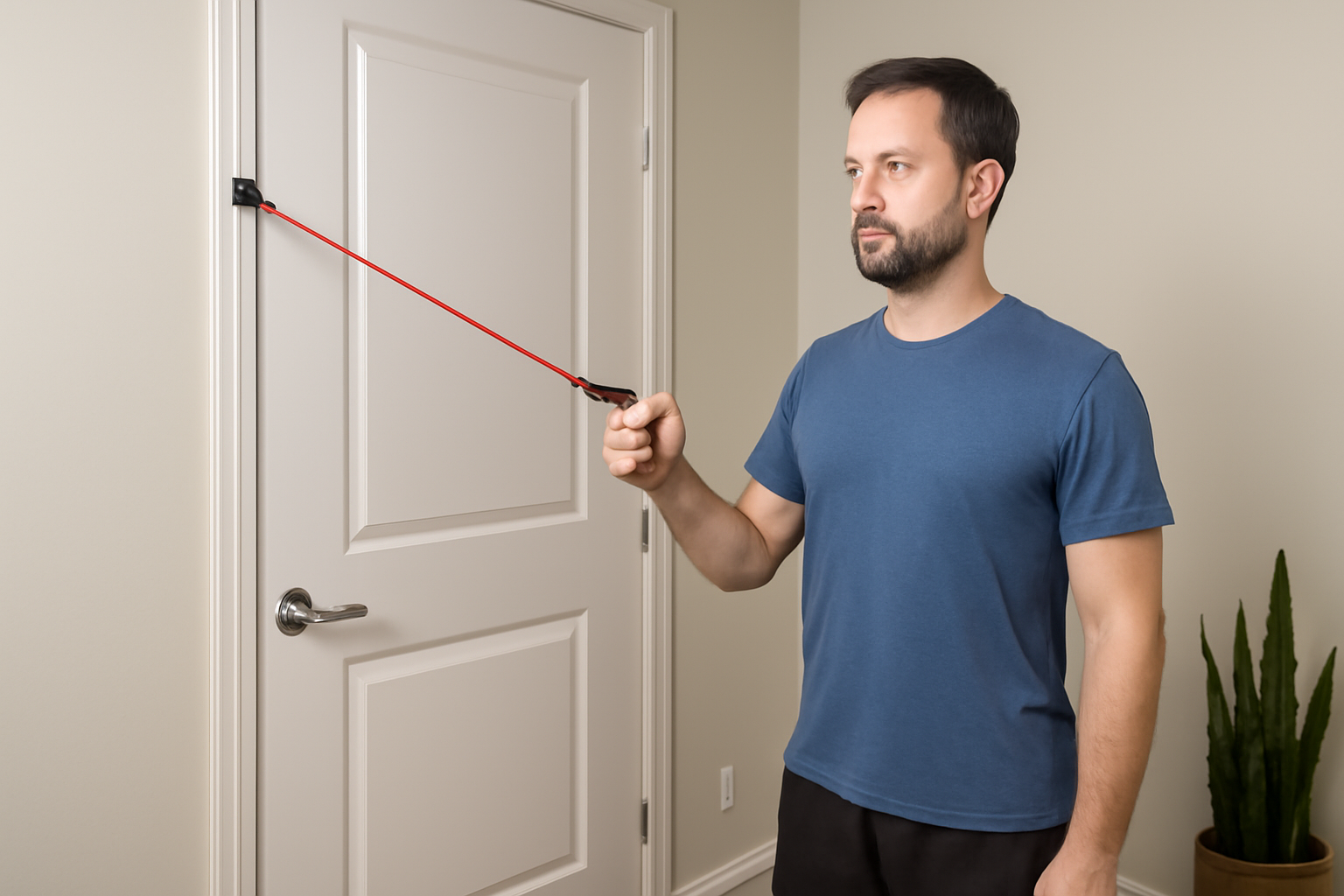
- Doorframe-anchored forward flexion
I tracked pain levels on a simple 1–10 scale before and after each session. I also noted sleep quality each morning, since shoulder pain had been disrupting my sleep badly. Week one averaged a 6/10 pain level during exercise. By the end of week two, I was consistently finishing sessions at 4/10.
Weeks 3–5: Progressive Loading
Around week three, I introduced the green band for some exercises while keeping the yellow for others. This is where the five-level set really proved its value. I could load different movement patterns differently based on current pain and strength levels.
New exercises added during this phase included:
- Side-lying external rotation (using yellow band looped around a door anchor)
- Diagonal D2 flexion and extension patterns
- Prone Y and T variations with the lightest band for added feedback
- Standing rows with the green band
Sessions extended to 30–35 minutes. I was exercising five days per week, with rest on weekends. Pain during activity dropped to a consistent 3/10 by the end of week five. More meaningfully, I started sleeping through the night again around week four. That felt like a genuine milestone.
Weeks 6–8: Strength and Overhead Reintroduction
The final phase introduced overhead work carefully. I was using the red band for most exercises by this point. Overhead reaching had been my biggest limitation, so reintroducing it felt significant.
Exercises included resisted overhead press simulations at partial range, lateral raises with the green band, and full diagonal patterns. I measured overhead reach height against a wall weekly. By week eight, I had recovered roughly 85% of my pre-injury range of motion, according to that rough measurement method.
What Actually Changed After Eight Weeks
In my experience, the results were meaningful and genuinely better than I expected going in. Here is an honest breakdown of what changed and when.
Sleep quality improved first. By week four, I was sleeping on my right side again without waking in pain. That alone improved my overall wellbeing significantly. Pain during daily activities — reaching into cabinets, lifting bags, dressing — dropped noticeably by week five.
Strength felt measurably better. I began week one barely able to complete 15 reps of external rotation with the yellow band without fatigue. By week eight, I was completing the same exercise with the red band comfortably. Research published in the American Journal of Sports Medicine has noted that consistent elastic band training over six to eight weeks can produce significant improvements in rotator cuff strength. That matched my personal experience closely.
The Lianjindun 5 Pcs Professional Resistance Bands held up perfectly across all eight weeks. No fraying, no snapping, no loss of elasticity that I could detect. That durability mattered because I used them almost daily.
The Moment I Almost Gave Up
I want to be honest here. Around week three, I had a setback. I pushed too hard on diagonal patterns and woke the next morning with a sharp 7/10 pain flare. I genuinely wondered if the protocol was making things worse. I almost quit.
My therapist reassured me that minor flares during rehab are common. She adjusted my load back to yellow-band-only for three days. However, the experience reminded me that equipment quality was not the whole story. Having professional guidance alongside any home rehab tool is genuinely important. The bands were fine — my execution had been the issue.
The Downsides You Should Know
No product is perfect. Here is what I found genuinely limiting about the Lianjindun 5 Pcs Professional Resistance Bands during my testing period.
The resistance gaps between levels feel uneven. The jump from green to red felt larger than the jump from yellow to green. For someone rehabbing a sensitive joint, that gap required more careful management than I expected.
No door anchor is included. Several shoulder exercises I needed required anchoring the band at door height. I had to buy a separate anchor strap for a few dollars. Not a dealbreaker — but worth knowing upfront.
The bands are not ideal for large-muscle exercises. If you want to use these for heavy leg work or full-body resistance training, the highest resistance level will likely feel insufficient. These bands are genuinely optimized for rehabilitation and mobility work, not max-effort strength training.
Who this will not work for: Anyone needing very heavy resistance for advanced athletic training. Also, anyone who wants a fully guided program should look elsewhere — these are just bands. The protocol has to come from a professional or a trusted external source.
Final Verdict: Who Should Buy These
After eight weeks of consistent use, my honest rating for this product is 4.4 out of 5 stars. The Lianjindun 5 Pcs Professional Resistance Bands delivered exactly what I needed for a structured resistance bands shoulder rehab protocol. They are durable, latex-free, smooth to handle, and provide enough resistance variety to support a genuine multi-week progression.
Buy these if: You are doing physical therapy or home rehab for shoulder, rotator cuff, elbow, or similar joint issues. They are also excellent for yoga, Pilates, and general mobility work. If latex sensitivity is a concern, this is a strong option.
Skip these if: You need heavy resistance for strength training or want a complete guided program in the box. On the other hand, for anyone in a similar situation to mine — shoulder impingement, PT-prescribed exercises, needing reliable home equipment — I would recommend these without hesitation.
👉 Check current pricing for the Lianjindun 5 Pcs Professional Resistance Bands on Amazon
A Quick Note on the Runner-Up Option
During my research phase, I seriously considered the Resistance Bands for Physical Therapy, Working Out Bands, Latex Free Elastic and Exercise Bands Set as an alternative. It is also latex-free and similarly color-coded across five resistance levels. Several reviewers noted good durability and smooth texture comparable to what I experienced with the Lianjindun set.
Ultimately, I went with the Lianjindun bands based on slightly stronger reviewer feedback for shoulder-specific rehab use. That said, if the Lianjindun set is out of stock or you want to compare options directly, this alternative is a genuinely solid second choice worth looking at.