
Health Disclaimer: I am not a medical professional. The information in this post reflects my personal experience and independent research only. Always consult a qualified healthcare provider before beginning any cervical disc herniation treatment program or making changes to an existing one.
Six months ago, I was sitting in my spine specialist’s office staring at an MRI printout showing a herniated disc at C5-C6. The radiologist’s report used words like “moderate foraminal narrowing” and “mild cord contact,” and my doctor said surgery was one option — but not necessarily the first one. That moment sent me down a deep research rabbit hole into every available cervical disc herniation treatment that didn’t involve going under a knife. What I found changed how I sleep, how I sit, and honestly, how I think about my neck entirely. If you’re in a similar position, this post is for you.

What Is Cervical Disc Herniation and Why Does C5-C6 Matter So Much?
Your cervical spine has seven vertebrae — C1 through C7 — and between each pair sits a disc that acts as a shock absorber. That disc has a tough outer layer called the annulus fibrosus and a gel-like center called the nucleus pulposus. When the outer layer weakens or tears, the inner material can push outward, pressing against nearby nerves or even the spinal cord itself. That’s a herniation.
The C5-C6 level is one of the most commonly affected segments in the cervical spine, largely because it bears significant mechanical stress during everyday movement. A herniation here can compress the C6 nerve root, causing symptoms that radiate down the arm, through the thumb and index finger, and into the forearm. For me, it presented as a constant dull ache in my left shoulder, occasional tingling in my thumb, and a stiffness in my neck that no amount of stretching seemed to touch.
Research published in the Journal of the American Academy of Orthopaedic Surgeons notes that the majority of cervical disc herniations — somewhere between 75 and 90 percent — improve significantly with conservative (non-surgical) management over a period of six to twelve weeks. That statistic became my north star.
Common Symptoms to Watch For
- Neck pain that worsens with certain movements or prolonged sitting
- Radiating pain, tingling, or numbness down one arm
- Weakness in the hand, wrist, or specific finger groups
- Headaches originating at the base of the skull
- Loss of fine motor coordination in severe cases
Conservative Cervical Disc Herniation Treatment: What the Research Actually Says
Conservative treatment is not a single thing — it’s a layered approach. My spine specialist recommended combining physical therapy, activity modification, sleep ergonomics, and targeted pain management. Over six months, I added and adjusted components based on what my body responded to. Here’s what the evidence supports and what worked for me.
Physical Therapy and Targeted Exercise
This was the single most impactful intervention for me. A skilled physical therapist focused on cervical traction, deep neck flexor strengthening, and scapular stabilization. Studies in the Spine Journal have consistently shown that supervised exercise therapy reduces radicular pain and improves functional outcomes in cervical disc herniation patients. Within eight weeks, my shoulder ache had dropped from about a 6 out of 10 to a 2 on most days.
Sleep Position and Cervical Pillow Support
Here’s the one that surprised me most. My PT told me that how I slept could either help or undo everything we worked on during the day. Sleeping on a pillow that doesn’t support the natural cervical curve forces the spine into hours of sustained abnormal loading. I started testing ergonomic cervical pillows immediately.
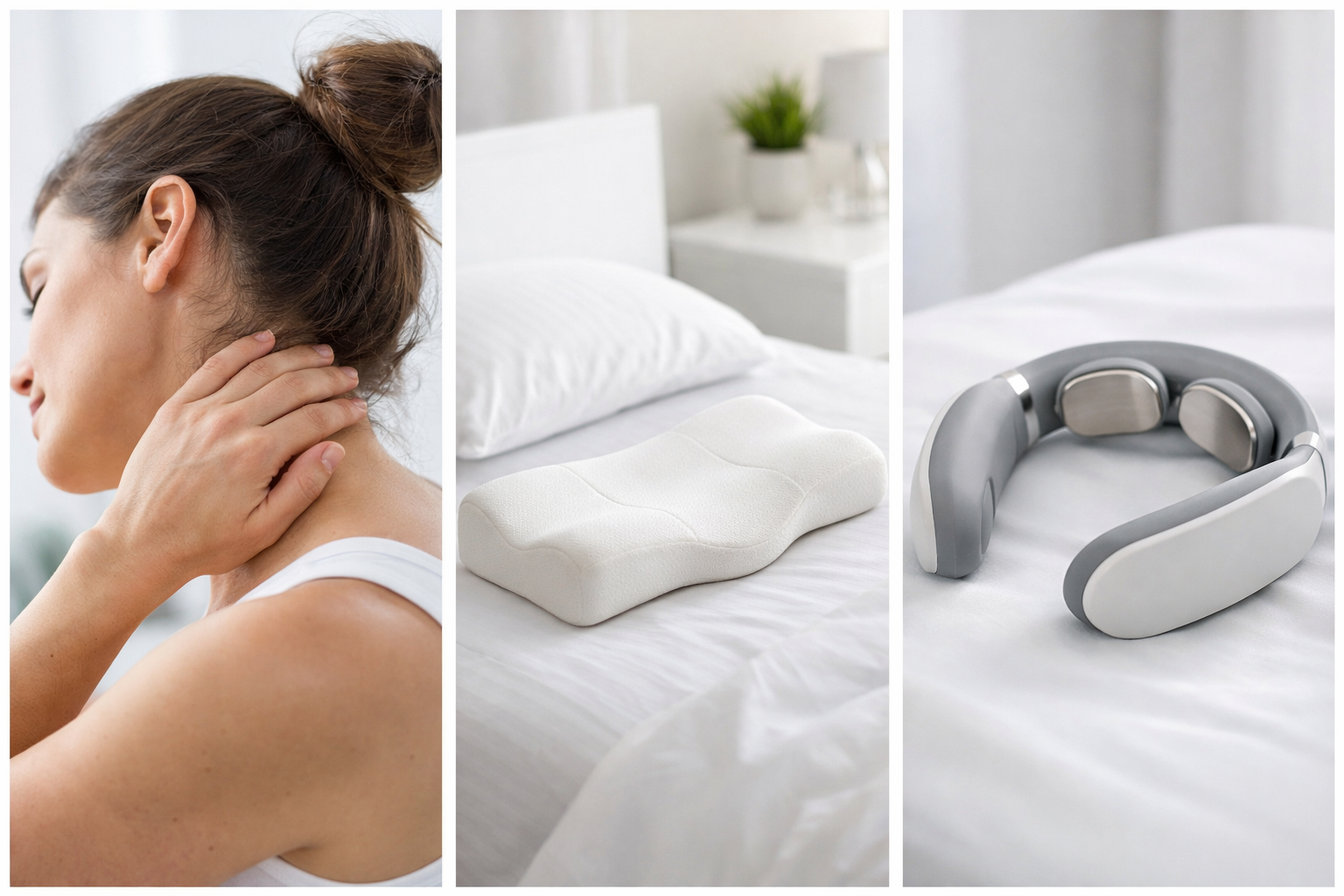
The Osteo Cervical Pillow for Neck Pain Relief with its hollow design and adjustable memory foam became my primary sleep pillow. The hollow center reduces pressure at the base of the skull while the contoured edges support the neck whether you’re on your back or side. The cooling case was a bonus I didn’t know I needed. For those who sleep in multiple positions, the Pain Relief Cervical Pillow with Adjustable Ergonomic Design is worth a look — it accommodates side, back, and stomach sleepers and uses an odorless orthopedic memory foam that holds its shape well throughout the night.
If you’re primarily a side sleeper dealing with neck and shoulder pain, the Cervical Neck Pillow for Pain Relief with Ergonomic Side Sleeper Design offers a contoured profile that keeps the ear, shoulder, and hip in better alignment — something a standard pillow simply cannot do.
Heat, Massage, and Myofascial Release
Muscle guarding is a constant companion with cervical disc herniation. When a nerve is irritated, the surrounding musculature tightens protectively — and that tightness creates its own secondary pain cycle. Targeted heat and massage help interrupt that cycle.
I’ve rotated between three massagers depending on the situation. The COMFIER Shiatsu Neck and Back Massager with Heat is my travel and office pick because it’s cordless and portable — I use it at my desk between work sessions. For deeper sessions at home, the UFFAE Shiatsu Neck and Back Massager with Heat delivers serious deep tissue kneading with consistent heat penetration. And the Snailax Shiatsu Neck and Shoulder Massager with Heat is the one I keep on the couch — versatile enough for the neck, upper back, and even feet after a long day on my feet.
A 2019 review in Evidence-Based Complementary and Alternative Medicine found that thermotherapy combined with massage significantly reduced neck pain intensity and improved range of motion compared to rest alone. That tracks exactly with what I experienced.

Posture Correction: The Overlooked Pillar of Recovery
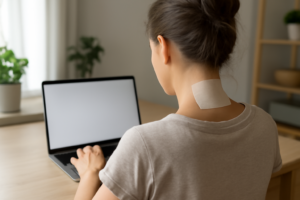
No cervical disc herniation recovery plan is complete without addressing posture — especially if you work at a desk. Forward head posture, which is endemic in our screen-driven lives, adds significant compressive load to the cervical discs. Research from Surgical Technology International famously calculated that a head tilted just 15 degrees forward adds roughly 27 pounds of effective force on the cervical spine. At 60 degrees — the angle many of us use looking at phones — that figure jumps to 60 pounds.
A posture corrector doesn’t fix herniation, but it trains proprioceptive awareness — meaning it reminds your body where “straight” is. The ComfyBrace Posture Corrector for Men and Women is fully adjustable and breathable enough to wear for a few hours of focused posture retraining each day without feeling restrictive. For those who need more comprehensive spinal support — particularly with upper and lower back involvement — the Fit Geno Back Brace Posture Corrector offers full back coverage with adjustable shoulder and spine correction. My PT recommended starting with just 30 to 60 minutes daily and building up gradually to avoid becoming dependent on external support.
Daily Habits That Compounded Over Six Months
- Monitor raised to eye level — eliminated the most significant daily flexion load on my neck
- Phone held up rather than looked down at — harder habit to build than I expected
- Walking breaks every 45 minutes during desk work — simple but highly effective
- Sleeping exclusively on my back or side — stomach sleeping had to go entirely
- Daily chin tuck exercises — the single most consistently recommended cervical exercise across all the research I found
What to Absolutely Avoid With a Cervical Disc Herniation
This section matters just as much as the treatment side. Several well-meaning approaches can genuinely worsen a cervical herniation, and I learned some of these the hard way.
- Aggressive cervical manipulation from an unqualified practitioner — high-velocity neck adjustments carry real risk when a disc is already herniated
- Inversion tables at steep angles — these can increase intradiscal pressure in ways that are contraindicated for herniations with cord involvement
- Ignoring progressive neurological symptoms — worsening weakness, loss of bladder or bowel control, or rapidly spreading numbness are red flags requiring immediate medical evaluation
- Extended bed rest — evidence clearly shows that prolonged immobilization slows recovery and weakens the supporting musculature
- Self-diagnosing based on symptoms alone — radiating arm pain has multiple causes, and treating the wrong one wastes precious recovery time
- Sleeping flat on your stomach — this extends and rotates the cervical spine for hours, directly compressing the posterior disc structures

The Cervical Pillow That Actually Supports Without Overcorrecting
With a herniated disc, your neck needs support that maintains neutral alignment without forcing excessive extension or flexion — the wrong pillow can aggravate symptoms within days. A properly contoured cervical pillow reduces strain on the affected disc and surrounding nerve roots, especially during the 6-8 hours you spend sleeping.
What works
- Memory foam cervical pillows maintain consistent neck support throughout the night without flattening, which matters because sagging pillows force your cervical spine into positions that compress herniated discs.
- The ergonomic contour reduces pressure on the C5-C6 area specifically by keeping your cervical spine aligned with your thoracic spine—most users report noticeably fewer morning symptoms after 2-3 weeks of consistent use.
- Adjustable height design matters: herniated disc sufferers often need a slightly firmer, higher support than average sleepers, and this pillow lets you customize rather than forcing you into a one-size-fits-all curve.
What doesn’t
- A cervical pillow is a support tool, not a fix—if your herniation is causing significant nerve compression or radiating pain down your arm, you need imaging and possibly physical therapy alongside the pillow, not instead of it.
- The adjustment period is real: your neck may feel awkward or slightly tender for the first 5-7 nights as muscles adapt to proper alignment, and some people never adjust to a contoured pillow no matter how good the design.
A better pillow won’t heal a herniation, but it removes one major source of repetitive strain while you’re doing the actual work—physical therapy, posture correction, and time. Check out the Osteo Cervical Pillow for Neck Pain Relief if you’re ready to stop waking up with your symptoms worse than you went to bed.
About This Article

Written by Michael Torres. Michael Torres has had joint problems his whole life — hypermobile as a kid, chronic sprains and a dislocating shoulder through his twenties, an osteoarthritis diagnosis in his early fifties, and a right knee replacement since. He is not a doctor or a physical therapist and has no clinical training. He writes about what has helped him and what he has watched help the people around him, and says plainly when he has not tried something himself. More about this site.
Scope and limits. Michael has no medical or clinical training — he writes about living with his own joint pain, not about treating anyone else's. Nothing here is medical advice. Talk to a doctor before starting anything new, and get seen promptly for pain that is new, severe, worsening, or comes with swelling, fever, or numbness.
Verify this against a primary source
Specifics change, and your situation may differ from the one described here. These are the authorities worth checking directly:
- NIAMS — arthritis and musculoskeletal research from the NIH
- MedlinePlus — plain-language medical reference from the NIH
- Arthritis Foundation — condition guides and treatment overviews