
You know that moment — you’ve been sitting at your desk for a couple of hours, you stand up to grab a cup of coffee, and suddenly your lower back lets out a sharp protest. Or maybe you’ve noticed your hips feel stiff every morning before you’ve even had a chance to get moving. If either of those sounds familiar, you’re in very good company. Hip and back joint health is something millions of people quietly struggle with every single day, often without realizing that small, consistent habits — not dramatic interventions — are what make the biggest long-term difference.
Why Your Daily Routine Has More Power Over Hip and Back Joint Health Than You Think
Here’s something I want you to sit with for a moment: the choices you make between Monday and Sunday — how long you sit, how you sleep, whether you stretch, what you eat — quietly shape the condition of your hips and back over months and years. Research suggests that prolonged sitting, poor posture, weak core muscles, and chronic low-grade inflammation are among the most significant contributors to hip and lower back pain. The encouraging news? Every single one of those factors is something you can influence starting today.
Think of your spine and hip joints like a suspension bridge. The structure itself is strong, but it depends on the cables — your muscles, tendons, and ligaments — staying properly tensioned and maintained. When we neglect movement, those cables weaken and shift, putting uneven stress on the joints themselves. Over time, that’s where pain, stiffness, and injury creep in.
Daily Habits That Genuinely Make a Difference
1. Break Up Your Sitting — Every Single Hour
If there’s one habit I’d ask every desk worker to adopt immediately, it’s this one. Sitting for extended periods compresses the lumbar discs, tightens the hip flexors, and reduces circulation to the joints. Many people find that simply standing up and walking for two to three minutes every hour brings noticeable relief over time. Set a phone alarm if you have to. It feels small, but compounded over weeks, it’s genuinely protective.
2. Strengthen Your Core and Glutes — Not Just Your Back
A lot of people focus exclusively on “back exercises” when they’re dealing with pain, but the hips and core are just as important. Weak glutes force your lower back to compensate, and weak core muscles leave your spine without the internal support it needs. Exercises like bridges, bird-dogs, and clamshells are low-impact options that many people find helpful for building that foundational strength. You don’t need a gym — a few minutes on a mat each morning may be enough to start shifting things in the right direction.
3. Stretch Your Hip Flexors Daily
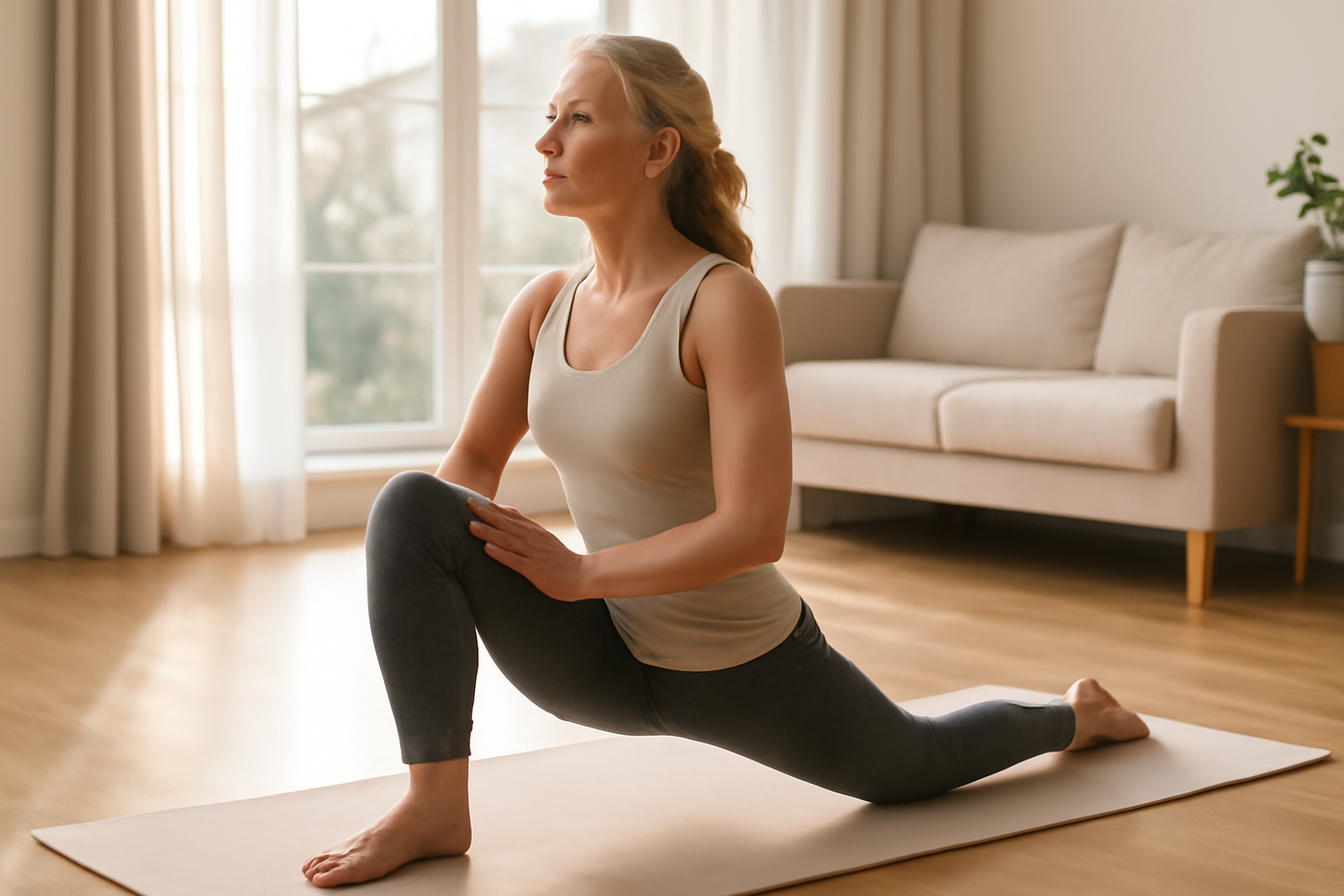
Most of us walk around with chronically tight hip flexors because we spend so many hours seated. When those muscles shorten and tighten, they pull on the lumbar spine and contribute to that nagging low back ache so many people experience. A simple kneeling hip flexor stretch held for 30 seconds on each side each morning may help counteract the damage done by long days at a desk. Consistency here is far more valuable than intensity.
4. Be Intentional About Sleep Position
How you sleep absolutely matters for hip and back health. Sleeping on your stomach puts significant strain on the lumbar spine. If you sleep on your side, placing a pillow between your knees helps keep the hips aligned and reduces rotational stress on the lower back. Back sleepers may benefit from a pillow under the knees to maintain the natural curve of the spine. These are small adjustments that many people report make a noticeable difference in how they feel in the morning.
5. Mind Your Sitting Surface
Not all sitting is created equal. A hard, unsupportive chair surface can increase pressure on the tailbone and sacral area, which radiates strain upward into the lumbar spine. A quality seat cushion may help redistribute your weight more evenly and reduce that pressure significantly — especially during long work hours.
Products Worth Trying for Hip and Back Support
I want to be honest here — no product is a cure, and none of these replaces the habits described above. But the right supportive tools can make those habits easier to maintain and may help reduce discomfort while your body builds strength. Here are a few options I think are genuinely worth considering.
The Back Support That Actually Stays Put During Your Workday
If you’re spending hours at a desk or dealing with that lower-back protest every time you stand up, a quality back brace can provide real spinal support and remind your body to maintain better posture — not as a permanent fix, but as a legitimate tool while you’re rebuilding strength and movement patterns.
What works
- Provides measurable compression and support during prolonged sitting or standing, reducing the load on your lower spine and helping you feel more stable when transitioning between positions.
- Unlike cheap neoprene braces that slip or lose tension by mid-afternoon, this one uses adjustable straps that hold firm without cutting off circulation — most users report it stays in place through a full 8-hour workday.
- The design is discreet enough to wear under clothes, so you’re not that person at the office in a massive medical corset; it’s an actual tool you’ll actually use consistently.
What doesn’t
- A back brace is stabilization, not treatment — if you’re wearing it 12 hours a day and never addressing core weakness or movement patterns, your pain returns the moment you take it off.
- It takes a few wears to find the right tightness and positioning; too loose and it doesn’t help, too tight and you’ll want to rip it off by 2 p.m.
This works best as part of a bigger picture — paired with movement, stretching, and gradually rebuilding stability — not as a substitute for addressing why your back protests in the first place. FEATOL Back Brace Support Belt
About This Article

Written by Michael Torres. Michael Torres has had joint problems his whole life — hypermobile as a kid, chronic sprains and a dislocating shoulder through his twenties, an osteoarthritis diagnosis in his early fifties, and a right knee replacement since. He is not a doctor or a physical therapist and has no clinical training. He writes about what has helped him and what he has watched help the people around him, and says plainly when he has not tried something himself. More about this site.
Scope and limits. Michael has no medical or clinical training — he writes about living with his own joint pain, not about treating anyone else's. Nothing here is medical advice. Talk to a doctor before starting anything new, and get seen promptly for pain that is new, severe, worsening, or comes with swelling, fever, or numbness.
Verify this against a primary source
Specifics change, and your situation may differ from the one described here. These are the authorities worth checking directly:
- NIAMS — arthritis and musculoskeletal research from the NIH
- MedlinePlus — plain-language medical reference from the NIH
- Arthritis Foundation — condition guides and treatment overviews