

Knowing that swimming, cycling, and walking are joint-friendly is one thing. Actually deciding what to buy for a home setup — and not wasting money on equipment that ends up as garage storage — is a different question entirely. If you’ve decided low-impact exercise is the right approach for your joints and you’re trying to figure out what’s actually worth the investment for home use, here’s an honest, equipment-focused breakdown.
What Actually Determines Whether Home Equipment Gets Used
The biggest predictor of whether a piece of exercise equipment helps your joints isn’t how good it is on paper — it’s whether you’ll actually use it consistently. Removing friction (no commute, no weather, no gym self-consciousness) tends to matter more than any feature list. That’s the lens worth applying to every purchase below: not “is this the best machine,” but “will this specific piece of equipment realistically fit into my space, budget, and daily routine.”
Home Equipment Worth Considering, by Category
Cardio: Recumbent Bikes
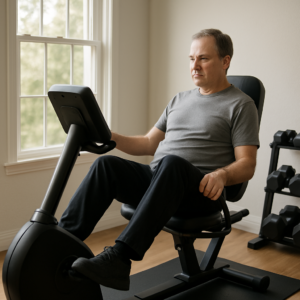
For knee, hip, or lower back discomfort, a recumbent bike is usually the safest cardio equipment to start with. The seated, reclined position takes pressure off the lower back that upright bikes and treadmills don’t, while still delivering real cardiovascular benefit. It’s a larger investment and takes up real floor space, so it’s best suited to people who know they’ll use cardio equipment several times a week rather than occasionally.
Strength: Resistance Bands Over Free Weights
For joint-safe strength work at home, resistance bands are almost always the better starting purchase over dumbbells. They provide graduated, controllable resistance with no sudden jarring load, take up virtually no storage space, and a full multi-level set typically costs a fraction of a comparable set of free weights.
Recovery: Foam Rollers and Massage Tools
A foam roller or massage ball is the lowest-cost, highest-use-frequency item on this list. Unlike cardio equipment, recovery tools don’t require a dedicated block of time — they get used in five-minute increments before or after other activity, which is part of why they tend to have the best cost-to-actual-use ratio of anything in a home setup.
What to Skip (Or at Least Deprioritize)
Elliptical machines and treadmills are often marketed as low-impact, but they take up significantly more space and cost more than a recumbent bike while offering a similar joint-friendly benefit for most people with mild to moderate joint pain. Unless you specifically enjoy that style of cardio, a recumbent bike or resistance bands usually deliver more consistent use per dollar spent.
Budgeting the Setup
You don’t need to buy everything at once. A reasonable order of priority, if budget is a constraint: resistance bands first (cheapest, most versatile), a foam roller or massage ball second, and a recumbent bike last, once you’ve confirmed that low-impact movement is a habit that’s actually sticking for you.
Building Consistency With Low-Impact Cardio: Why a Recumbent Bike Changes the Game
Of everything on this list, the recumbent bike is the biggest single purchase — so it’s worth the closest look. The biggest barrier to low-impact exercise isn’t knowing what to do, it’s actually doing it consistently. A recumbent bike removes the friction: no impact, no balance concerns, and you can use it at home without the mental load of getting to a gym.
What works
- Zero impact on knees, hips, and ankles, while still building cardiovascular endurance and leg strength.
- Back support matters more than you’d think; the recumbent position takes pressure off your lower back and makes it easier to sustain longer sessions than upright bikes.
- Home use means you’re far more likely to actually use it — the single biggest factor in whether this purchase pays off.
What doesn’t
- It’s the most expensive item on this list by a wide margin — if you’re not sure low-impact exercise will stick, start with resistance bands instead and upgrade later.
- Takes up real floor space; measure your intended spot before buying, since returns on large equipment are often a hassle.
If you’ve already confirmed low-impact movement works for you and you’re ready for the bigger investment, the Recumbent Exercise Bike for Home Use is worth checking against your space and budget.
About This Article

Written by Michael Torres. Michael Torres has had joint problems his whole life — hypermobile as a kid, chronic sprains and a dislocating shoulder through his twenties, an osteoarthritis diagnosis in his early fifties, and a right knee replacement since. He is not a doctor or a physical therapist and has no clinical training. He writes about what has helped him and what he has watched help the people around him, and says plainly when he has not tried something himself. More about this site.
Scope and limits. Michael has no medical or clinical training — he writes about living with his own joint pain, not about treating anyone else's. Nothing here is medical advice. Talk to a doctor before starting anything new, and get seen promptly for pain that is new, severe, worsening, or comes with swelling, fever, or numbness.
Verify this against a primary source
Specifics change, and your situation may differ from the one described here. These are the authorities worth checking directly:
- NIAMS — arthritis and musculoskeletal research from the NIH
- MedlinePlus — plain-language medical reference from the NIH
- Arthritis Foundation — condition guides and treatment overviews