
This post contains affiliate links. As an Amazon Associate, I earn from qualifying purchases at no extra cost to you.
I am not a medical professional. The experiences shared here are personal. Consult your doctor before starting any new treatment.
Every morning for the past eighteen months, my right shoulder has been the first thing to remind me it exists. Not in a good way. I’d roll over in bed and feel that familiar deep, grinding ache radiating from the top of my shoulder down toward my mid-back — the kind of discomfort that doesn’t scream at you but just sits there, dull and relentless, coloring everything you try to do before 9 a.m. I’d been dealing with what my doctor described as rotator cuff irritation and mild bursitis, likely from years of bad posture at a desk job and one too many ambitious weekend workouts. I’d tried heating pads, ice packs, foam rolling, and even a few sessions of physical therapy. Some of those things helped. None of them were convenient enough to use during a regular workday. When I started researching the Salonpas lidocaine patch shoulder option I kept seeing recommended in joint health forums, I was honestly skeptical but desperate enough to give it a real shot.
What followed was two full weeks of consistent, methodical use — and the results were genuinely surprising in some ways, slightly disappointing in others, and ultimately informative enough that I felt I had to write this down. If you’re dealing with shoulder pain and wondering whether a topical lidocaine patch is worth your time and money, I hope this saves you some guesswork.
Why I Chose the Salonpas Lidocaine 4% Patch Over Other Options
There’s no shortage of topical pain relief products on the market, and I’ve personally cycled through a lot of them — menthol-based roll-ons, capsaicin creams, diclofenac gels, and the standard NSAID patches you find at any drugstore. Each has its place, but I kept running into the same issues: either the smell was overpowering in a work environment, the cream rubbed off on my clothes, or the relief was so short-lived it barely made a dent in my afternoon slump.
What drew me specifically to the Salonpas Lidocaine 4% Pain Relieving Gel-Patch, 6 Count, for Back, Neck, Shoulder, Knee & Elbow Pain was the active ingredient. Lidocaine is a well-established local anesthetic that works by temporarily blocking sodium channels in nerve fibers, which interrupts the transmission of pain signals. A 2017 review published in the Journal of Pain Research found that topical lidocaine formulations were effective for localized pain management with a favorable safety profile compared to systemic analgesics. That gave me some confidence this wasn’t just a feel-good marketing claim — there’s actual pharmacology behind it.
I also appreciated that Salonpas is an FDA-approved brand with decades of market history. The 4% lidocaine concentration is the maximum allowed for over-the-counter topical anesthetics, which suggested I was getting a meaningful dose rather than a homeopathic gesture. At around $10–$14 for six patches on Amazon, the price point felt accessible enough to justify a genuine two-week trial.
First Impressions: Unboxing and Initial Feel
The box is compact and no-frills — six individually sealed patches, each roughly 2.6 by 3.5 inches. That’s a meaningful size, large enough to cover the area from my shoulder cap down toward the upper trapezius, but not so large that it would be awkward to apply alone. The packaging includes a clear usage guide, which I actually read in full before starting.
Peeling back the foil on the first patch, I noticed the gel side immediately. Unlike traditional dry adhesive patches, this one has a soft, slightly moist gel surface — almost like a thin, flexible hydrogel pad. It felt cooling against my fingertip before I even applied it. The scent was minimal, which mattered to me a lot. I work in an open office two days a week and the last thing I wanted was to announce my pain relief routine to everyone within six feet.
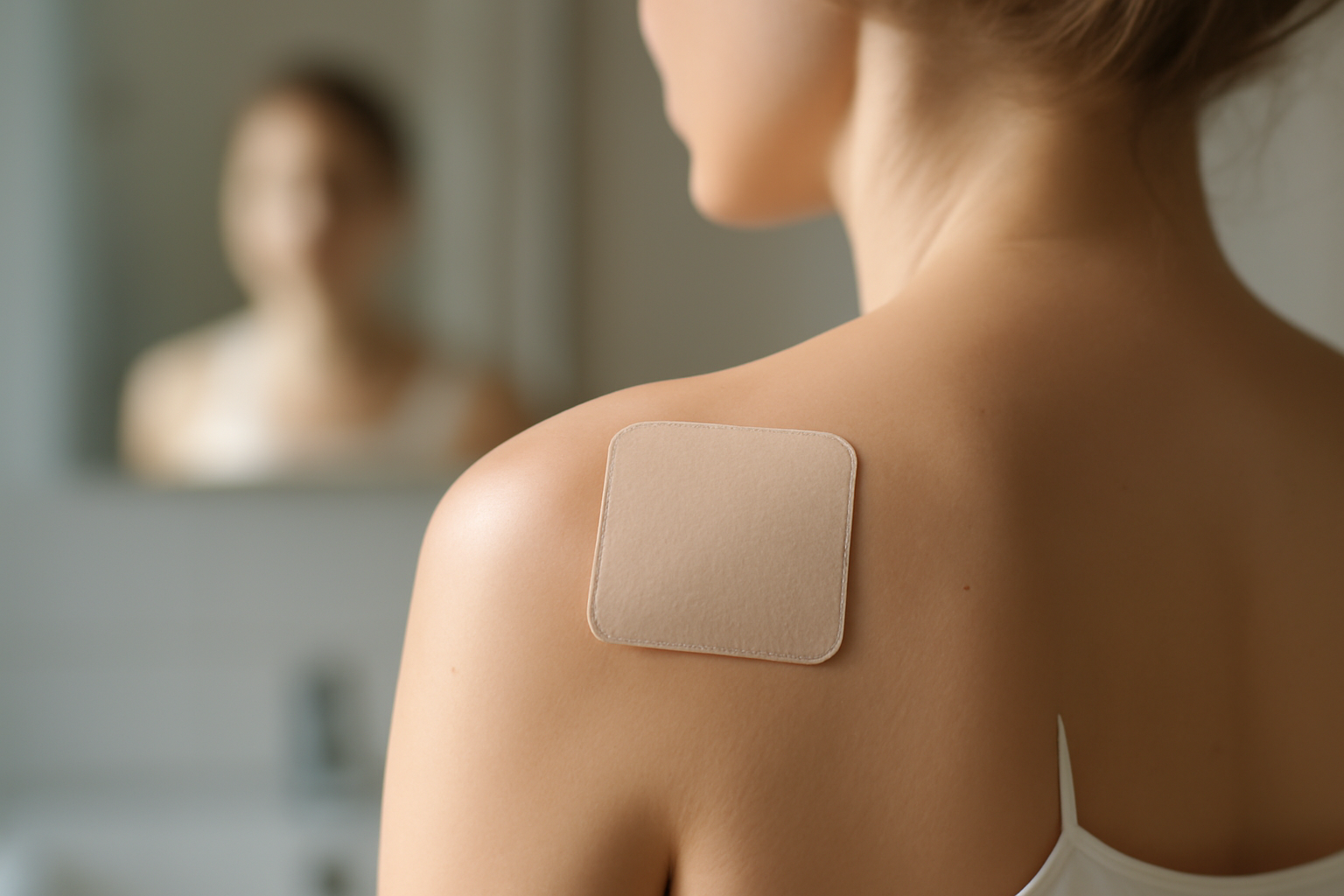
Application on the shoulder was straightforward. I peeled the liner, pressed the gel side directly onto the meatiest part of my shoulder near the supraspinatus region, and smoothed it down. It adhered well initially — better than I expected — and the cooling sensation started almost immediately. Within about five to ten minutes, I noticed a mild numbing effect in the superficial tissue. It wasn’t dramatic, but it was real and distinctly different from a menthol patch’s “feeling cold” sensation. This was actual reduced sensitivity in the area.
My Two-Week Testing Protocol
I wanted to give this a fair, structured trial rather than slapping one patch on and writing it off after a day. Here’s exactly what I did:
- Duration: 14 consecutive days, one patch per day in the morning
- Application site: Right shoulder, specifically targeting the posterior and superior aspect near where my bursitis typically flares
- Wear time: 8–12 hours per session, removed before bed
- What I tracked: Morning pain on a 1–10 scale before application, pain level at midday (4–5 hours post-application), and pain level the following morning before the next patch
- What I didn’t change: My sleep position, desk setup, and exercise routine — I kept everything else consistent so any changes could be reasonably attributed to the patches
- No other topical treatments during the trial period
I also kept informal notes on sleep quality, specifically whether shoulder pain was waking me at night or making it hard to find a comfortable position. That had been one of my more frustrating symptoms — being unable to lie on my right side without discomfort.
What Actually Changed: Honest Results Week by Week
Week One
The first three days were genuinely impressive for daytime relief. My morning pain was typically a 6–7 out of 10 before the patch. By midday on days one through three, I was consistently sitting at a 3–4. That’s a meaningful reduction — enough to get through focused work, attend a video call without shifting uncomfortably every ten minutes, and reach overhead without wincing quite as dramatically.
However — and here’s my first note of honesty — the relief wasn’t lasting as long as I’d hoped by day four and five. I noticed the effective window felt closer to six hours rather than eight. By the time early evening rolled around, the ache was creeping back to a 5 or 6. I’d expected full eight-hour coverage based on the packaging, so this was a mild disappointment. I started applying the patch a bit earlier in the morning to try to capture more of my active hours.
Sleep quality in week one showed early improvement. By days five through seven, I was waking up less frequently from shoulder pain. I can’t be certain this was the patches directly, since I wasn’t wearing them at night, but the cumulative daytime relief may have reduced overall inflammation enough to make nights slightly more comfortable.
Week Two
Week two continued the trend with a few nuances. My morning baseline pain felt like it had dropped slightly — I was starting most days at a 5 rather than a 7. Whether this was the patches, general rest, or placebo, I honestly can’t say with certainty. What I can say is that in my experience, consistent daily use seemed to keep my shoulder in a more manageable state than it had been in months.
By day twelve, I had a notably good day — my midday pain reading was a 2, which hasn’t happened since before my shoulder issues started. I don’t want to overstate this. One data point isn’t a pattern. But it was encouraging enough to make me want to continue using these beyond the trial.
The Downsides You Should Know About the Salonpas Lidocaine Patch Shoulder Experience
I want to be genuinely useful here, which means being upfront about the real limitations I encountered.
- Adhesion degrades with movement: On days when I was more active — doing light stretching or any kind of reaching — the edges of the patch would start to peel by hour four or five. The shoulder is a high-mobility joint, and this patch wasn’t always able to keep up. I found that applying it to the more posterior, stationary part of my shoulder (rather than the deltoid area) improved adhesion significantly.
- No deep tissue penetration: Lidocaine works on surface and near-surface nerves. If your shoulder pain is driven by deep structural issues — a significant labral tear, for example, or deep tendon pathology — a topical patch is not going to reach those tissues. In my experience, it managed the referred muscular aching and surface-level pain better than the deep grinding sensation.
- Six patches go fast: If you’re using one daily, a six-count box lasts less than a week. Stocking up is worth doing if you find this works for you. The per-patch cost is reasonable, but it’s worth factoring in if you’re budget-conscious.
- Skin sensitivity: By day ten, I noticed slight redness at the application site after removing the patch. It faded within an hour, but it was consistent enough that I started rotating the exact placement by about half an inch each day to reduce repeated irritation to the same skin area.
- Not a fix — a manager: This is the most important honest note. The Salonpas Lidocaine 4% Pain Relieving Gel-Patch, 6 Count, for Back, Neck, Shoulder, Knee & Elbow Pain helped me function better on painful days. It did not resolve the underlying issue. My shoulder still bothered me in the mornings. I still need physical therapy and ergonomic adjustments. Anyone expecting a cure will be disappointed.
Final Verdict: Is the Salonpas Lidocaine Patch Shoulder Option Worth It?
After two weeks of consistent, tracked use, I’d give the Salonpas Lidocaine 4% Pain Relieving Gel-Patch, 6 Count, for Back, Neck, Shoulder, Knee & Elbow Pain a solid 4 out of 5 for what it’s actually designed to do.
Buy this if: You have localized shoulder, neck, or upper back pain that flares during your workday and you need a discreet, low-scent, non-oral way to take the edge off. If you’re dealing with the kind of muscular aching and surface-level nerve irritation that comes with bursitis, minor rotator cuff inflammation, or postural strain, this is a genuinely useful tool. The Salonpas lidocaine patch shoulder combination is one of the more practical OTC options I’ve tried for getting through a workday without reaching for ibuprofen every six hours.
Skip this if: Your pain is deep, structural, or severe. If you’re post-surgical, dealing with a significant tear, or your pain regularly hits an 8 or above, this product will likely feel like putting a bandage on something that needs stitches. It’s also not ideal for anyone with sensitive skin or adhesive allergies.
The Runner-Up: Salonpas Large Pain Relieving Patch
If you want more coverage area or prefer a patch that relies on methyl salicylate and menthol rather than lidocaine — essentially a different pharmacological approach targeting inflammation through a counterirritant mechanism — the Salonpas Pain Relieving Patch, Large, 6 Count, for Back, Neck, Shoulder, Knee Pain and Muscle Soreness, 8 Hour Pain Relief is worth considering. The larger format covers a broader surface area, which can be useful if your pain spreads across the shoulder blade and mid-back rather than sitting in one concentrated spot. The trade-off is the stronger menthol scent, which I personally found limiting in professional settings. For home use or weekend recovery days, it’s a solid alternative. I’d call the lidocaine version my everyday option and the large salicylate patch my “heavier day” backup.
Ultimately, managing shoulder pain is rarely about finding one magic solution