This post contains affiliate links. As an Amazon Associate, I earn from qualifying purchases at no extra cost to you.
I am not a medical professional. The experiences shared here are personal. Consult your doctor before starting any new treatment.
Every night for the better part of eighteen months, I’d climb into bed with that familiar dull throb sitting deep in my lower back — the kind that doesn’t scream at you, it just hums. Constantly. I’d been dealing with lumbar stiffness and what my doctor called “early degenerative joint changes” since my late thirties, and by the time I actually did something serious about my nighttime routine, I’d already burned through two cheap drugstore heating pads that either scorched one spot or quit working after six weeks. I’d been reading up on thermotherapy for joint pain, and I kept landing on the same product in forum after forum: a Sunbeam heating pad for lower back use, specifically their XL model. I finally ordered it, used it every single night for six weeks straight, and I’m ready to tell you exactly what happened.
Before I get into the details, I want to be clear: I’m not a doctor, I’m a 41-year-old who coaches youth soccer on weekends, sits at a desk for eight hours a day, and has been fighting low-grade lumbar pain for longer than I’d like to admit. What I can offer is six weeks of consistent, documented personal experience with one product — and an honest take on whether it’s worth your money.
Why I Chose the Sunbeam XL Heating Pad for My Lower Back
I didn’t just impulse-buy this. I spent about two weeks researching before I clicked “add to cart.” My starting point was a 2021 review published in The Clinical Journal of Pain that suggested superficial heat therapy can meaningfully reduce perceived pain intensity and muscle stiffness in people with non-specific low back pain — especially when applied consistently over multiple sessions rather than sporadically. That lit a fire under me (no pun intended) to find something I could realistically use every night without it feeling like a chore.
My requirements were specific. I needed something large enough to cover my entire lumbar region — not just a narrow strip — because my discomfort spreads from roughly L3 down through my sacrum and sometimes catches the right hip. I also needed adjustable heat settings because I’d burned myself on a cheap pad that only had one temperature: “too hot.” And I wanted auto shut-off because, honestly, I fall asleep during use more often than not.
The Sunbeam XL Heating Pad for Back Neck and Shoulder Pain Relief Auto Shut Off 6 Heat Settings Extra Large 12 x 24 Green Ideal for Muscle Aches and Arthritis Pain checked every box. Six heat settings, a 12 x 24 inch surface, auto shut-off at two hours, and thousands of reviews from people specifically mentioning lower back use. The green color is a small thing, but it also looked less clinical than the gray and beige pads I’d seen. I paid around $30 at the time, which felt like a reasonable experiment.
First Impressions: Unboxing, Build Quality, and Initial Feel
The pad arrived in standard Amazon packaging. Inside was the heating pad itself, a controller cord with a simple dial, and a basic instruction sheet. No fancy box, no extras — which is fine at this price point. My first impression of the pad itself was that it felt more substantial than I expected. The fabric cover has a soft, almost micro-fleece texture that sits comfortably against skin even through a thin shirt. It’s not the kind of stiff, crinkly pad that sounds like a potato chip bag every time you shift position.
The 12 x 24 inch size was immediately impressive when I laid it flat. It covered from the top of my waistband up to about mid-back — exactly the coverage I needed. The controller is a simple cord with a numbered dial (1 through 6) and a power button. Nothing complicated. I did notice the cord is about six feet long, which was just barely long enough when my outlet is on the far side of the nightstand. That’s a minor annoyance worth flagging.
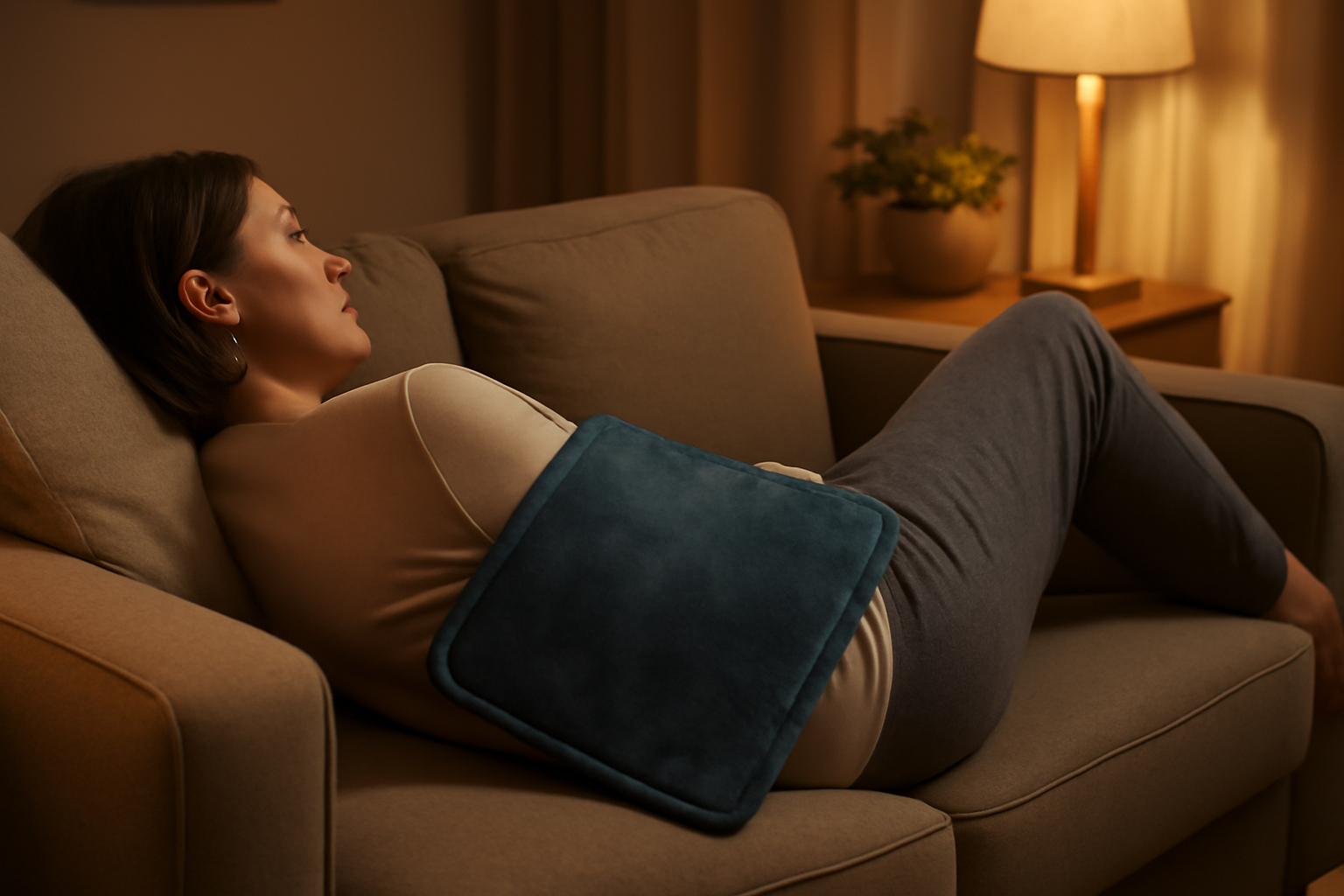
My first session was at setting 3, lying on my back with the pad tucked between me and the mattress. Within about four minutes, I felt consistent, even warmth spreading across my lumbar region. No hot spots, no cold patches at the edges. That was a genuine first for me — every cheaper pad I’d used before had uneven heat distribution that felt more like a lottery than therapy.
My Six-Week Testing Protocol
I kept this structured on purpose. I wanted to actually know whether what I was experiencing was real or just placebo, so I tracked a few simple things in the notes app on my phone each morning:
- My subjective pain level at bedtime and when I woke up (1–10 scale)
- How quickly I fell asleep (rough estimate)
- Morning stiffness duration — how long before I felt “normal” after getting up
- Which heat setting I used and for how long before the auto shut-off kicked in
My routine was consistent: I’d get into bed around 10 PM, place the pad against my lower back, start at setting 3 or 4, and read or watch something low-stimulation for 30–45 minutes before sleep. On particularly rough days after coaching or long drives, I bumped it to setting 5. I never used setting 6 — it felt uncomfortably hot in my brief test of it and I didn’t see the need. I also used the pad twice after particularly bad sessions sitting through a long work conference, doing a midday 20-minute session on setting 4 while seated at my desk.
I did not change my diet, exercise routine, or medications during this period, which I think is important for anyone reading this as a reference point. The only variable I added was this pad.
What Actually Changed After Six Weeks
Weeks One and Two: Cautious Optimism
The first two weeks, my bedtime pain scores dropped from an average of about 5.5 down to roughly 4. That’s not dramatic, but I noticed I was falling asleep faster — typically within 20 minutes instead of my usual 35–45 minutes of lying there, shifting, trying to get comfortable. Research published in Sleep Medicine Reviews has suggested that mild passive body heating before sleep can accelerate sleep onset by influencing the body’s thermoregulatory system, and in my experience, that tracked. Whether it was purely the warmth or the relaxation response, I can’t say for certain — but something was working.
Weeks Three and Four: The Real Progress
By week three, the change that mattered most to me started showing up in the mornings. My stiffness window — that groggy, locked-up feeling right after getting out of bed — went from lasting about 25–30 minutes down to roughly 10–15 minutes. I’m not claiming the pad fixed anything structurally; it clearly didn’t. But the muscles around my lumbar spine felt less braced and reactive when I woke up. I started looking forward to using it at night, which says something about how meaningfully it was affecting my comfort.
Weeks Five and Six: Establishing a Baseline
My average bedtime pain score by week six was sitting around 3 to 3.5. Morning stiffness was consistently in the 10–15 minute range. Sleep quality felt noticeably better — I was waking up less in the middle of the night, which had been a consistent problem tied to repositioning because of discomfort. I also used it twice after soccer coaching, and in my experience, that post-activity recovery window felt shorter and less uncomfortable than usual.
The Downsides You Should Know Before You Buy
I want to be straight with you here, because a review that’s all praise isn’t useful to anyone.
The cord length bothered me more as time went on. Six feet sounds like plenty until your outlet is behind a nightstand and you need some slack to position the pad comfortably. I ended up using a short extension cord, which isn’t ideal.
The auto shut-off is both a feature and a frustration. Two hours is the cutoff, and it’s not adjustable. A couple of times I woke up at 2 AM and genuinely wanted more heat, but the pad had already clicked off. For safety reasons I understand it completely, but it’s worth knowing.
The fabric cover is not removable for washing on this particular model. You can spot-clean it, but if you’re a sweaty sleeper or use it directly on skin regularly, that’s something to think about. I always used it over a thin shirt, which helped.
I had a genuine moment of doubt around day ten. I’d had a rough day — long drive, lots of sitting — and used the pad at setting 5 expecting relief. The heat felt good in the moment, but I woke up the next morning with my stiffness feeling about the same as before I started the experiment. I almost wrote the whole thing off. Looking back, that was just a bad pain day, not a failure of the product. But if you’re expecting this to be a cure-all on your worst days, you’ll be disappointed.
This pad is not suitable for people with circulation disorders, diabetes-related neuropathy, or anyone who can’t reliably feel heat on their skin. Those are real safety concerns with any heating pad, and I’d encourage you to talk to your doctor before using one if any of those apply to you.
Final Verdict: Is the Sunbeam Heating Pad for Lower Back Pain Worth It?
After six weeks of nightly use, my answer is a clear yes — with realistic expectations attached. The Sunbeam XL Heating Pad for Back Neck and Shoulder Pain Relief Auto Shut Off 6 Heat Settings Extra Large 12 x 24 Green Ideal for Muscle Aches and Arthritis Pain is not going to undo structural joint changes or replace physical therapy. What it did, consistently, was reduce my nightly discomfort, shorten my morning stiffness window, and help me fall asleep faster. For around $30, that’s an exceptional return.
I’d rate this 4.4 out of 5. The cord length and non-removable cover keep it from being perfect, but the core experience — consistent, even heat across a genuinely large surface — is hard to argue with.
Buy This If:
- You have lumbar stiffness, muscle tension, or arthritis-related discomfort in the lower back
- You want a large-coverage pad that doesn’t require repositioning constantly
- You fall asleep during use and need auto shut-off for peace of mind
- You want a low-cost, low-effort addition to a broader pain management routine
Skip This If:
- You need moist heat therapy specifically — this model is dry heat only
- You want a washable cover
- You have a condition that makes heat sensitivity or skin sensation an issue
- You’re looking for a targeted neck or small-area pad — this is built for broad coverage
A Quick Note on the Alternative: Sunbeam XL with Moist Heat Option
If moist heat is important to you — and for some types of joint stiffness and muscle tension, research does suggest moist heat penetrates tissue more effectively than dry — the Sunbeam XL Heating Pad for Back Neck and Shoulder Pain Relief with Sponge for Moist Heating Option Extra Large 12 x 24″ Blue is the model I’d point you toward. It’s the same core size and design but includes a sponge insert that, when dampened, delivers moist thermotherapy. It runs slightly higher in price and requires a bit more setup, but if your doctor or physical therapist has specifically recommended moist heat for your condition, it’s the smarter pick. For my needs — primarily dry heat for nightly muscle relaxation — the green model I tested was the right call