
You know that feeling — you finally get into bed after a long day, your body is exhausted, and just as you’re drifting off, your knee starts aching. Maybe it’s a dull throb, maybe it’s a sharper pain that makes you shift positions every twenty minutes. If you’ve been lying awake searching for knee pain at night relief support, you’re not imagining things, and you’re definitely not alone. Nighttime knee pain is one of the most common complaints I hear, and the frustrating part is that rest is supposed to be healing time. When pain interrupts that, everything suffers — your mood, your energy, your ability to move well the next day. In this post, I want to walk you through why this happens and, more importantly, what you can actually do about it tonight.
Why Does Knee Pain Get Worse at Night?
This is one of the first questions people ask me, and it’s a great one. During the day, movement actually keeps your joints lubricated and your mind distracted from discomfort. When you lie still, a few things happen that can amplify knee pain significantly.
First, there’s the stillness factor. When you stop moving, circulation slows, and your joints may stiffen up. Fluid that helps cushion the knee can pool or shift, leading to that achy, heavy feeling. Second, nighttime is when your cortisol levels — the body’s natural anti-inflammatory hormone — are at their lowest. Research suggests this dip in cortisol may contribute to increased joint inflammation and sensitivity during sleeping hours. Third, your sleeping position matters enormously. If your knees are unsupported, slightly bent, or pressing against each other, the joint is under subtle but constant strain all night long.
Common conditions that tend to flare at night include osteoarthritis, bursitis, runner’s knee, patellar tendinitis, and general ligament or cartilage wear. Cold temperatures can also tighten the tissues around the knee and make everything feel worse. The good news? Understanding the “why” points directly to the “what helps.”
Sleep Position and Alignment: The Foundation of Nighttime Knee Pain Relief Support
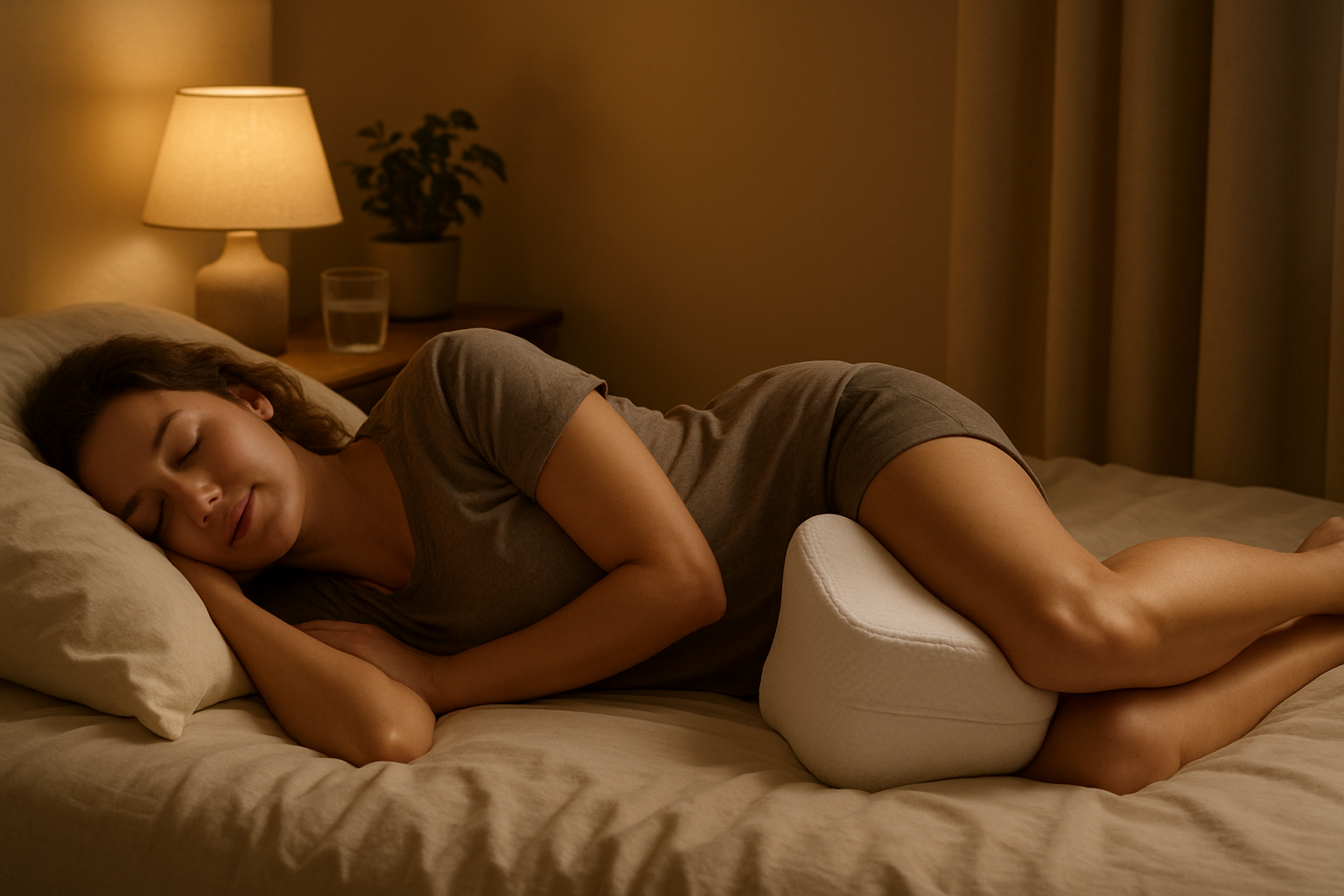
Before we even get to products, let’s talk about the single most impactful change many people overlook: how you’re positioned while you sleep. If you’re a side sleeper — which most people are — your top knee is likely dropping forward and creating a torque on your hip, lower back, and knee joint simultaneously. Your knees may also be pressing directly against each other, which adds pressure on the inner knee and can aggravate pain significantly over the course of a night.
The fix is proper alignment support between and beneath your knees. When your hips, knees, and ankles are stacked and supported, the stress on the knee joint is dramatically reduced. Many people find that within just a few nights of using a supportive leg or knee pillow, they’re waking up with noticeably less stiffness and pain. It sounds simple, but alignment really is that powerful.
For back sleepers, placing a pillow or bolster under the knees to keep them in a slightly bent, supported position can also make a meaningful difference. Fully extended knees on a flat surface may seem neutral, but for many people with knee issues, that stretch is actually uncomfortable over several hours.
Positioning Your Knee for Sleep: Why a Proper Support Pillow Actually Matters
Night knee pain often gets worse the longer you stay in one position — your body weight compresses the joint, inflammation settles in, and muscles tighten around it. A knee pillow designed for side or back sleeping takes pressure off the joint by keeping your legs in a neutral alignment, which is one of the simplest mechanical fixes that actually shows up in how people sleep.
What works
- The contoured foam keeps your top knee from rolling inward (which torques the joint) and prevents direct pressure on the bone itself — most people notice they’re shifting positions less within the first few nights.
- Unlike a flat pillow you try to improvise, a proper knee pillow maintains its shape throughout the night and supports the full thigh, not just the knee, which distributes weight more evenly across the joint.
- The research on joint positioning during sleep is straightforward: neutral alignment reduces overnight stiffness and inflammation accumulation, which is why physical therapists recommend this even before suggesting supplements.
What doesn’t
- A pillow won’t fix underlying damage or severe osteoarthritis — if your knee pain comes from structural degeneration, this helps manage the symptom but doesn’t address the cause.
- Back sleepers need to place this between the knees (not under one knee), and stomach sleepers don’t benefit much from this approach — it only works if your sleeping position actually suits it.
This is a support tool, not a cure, and the relief depends on consistent use — a few nights won’t tell you much, but two to three weeks of nightly use usually makes clear whether positioning is your limiting factor. Contour Legacy Leg & Knee Foam Support Pillow
About This Article

Written by Michael Torres. Michael Torres has had joint problems his whole life — hypermobile as a kid, chronic sprains and a dislocating shoulder through his twenties, an osteoarthritis diagnosis in his early fifties, and a right knee replacement since. He is not a doctor or a physical therapist and has no clinical training. He writes about what has helped him and what he has watched help the people around him, and says plainly when he has not tried something himself. More about this site.
Scope and limits. Michael has no medical or clinical training — he writes about living with his own joint pain, not about treating anyone else's. Nothing here is medical advice. Talk to a doctor before starting anything new, and get seen promptly for pain that is new, severe, worsening, or comes with swelling, fever, or numbness.
Verify this against a primary source
Specifics change, and your situation may differ from the one described here. These are the authorities worth checking directly:
- NIAMS — arthritis and musculoskeletal research from the NIH
- MedlinePlus — plain-language medical reference from the NIH
- Arthritis Foundation — condition guides and treatment overviews