
You’ve just come home from surgery, your leg is propped up on a pillow, and you’re staring at a stack of discharge paperwork wondering what comes next. If that sounds familiar, you’re not alone — and if you’re deep in researching knee brace post surgery recovery options right now, I want you to know you’ve landed in the right place. I’ve spent years working alongside people navigating exactly this kind of recovery, and I know firsthand how overwhelming those early days can feel. The good news? The right support products can make a meaningful difference in how comfortable, confident, and consistent your rehab journey actually is.
Why the Right Knee Brace Post Surgery Recovery Matters More Than You Think
Here’s something I tell everyone coming out of knee surgery: a brace isn’t just a piece of hardware strapped to your leg. When it fits correctly and is appropriate for your procedure, it becomes a communication tool between your healing tissue and your brain. It tells your nervous system, “You’re protected — it’s okay to move.” That reassurance alone can help reduce the fear-avoidance patterns that slow so many recoveries down.
After procedures like ACL reconstruction, PCL repair, MCL surgery, or even a meniscectomy, your knee’s natural proprioception — its sense of where it is in space — is temporarily disrupted. Research suggests that structured bracing during the early and mid-stages of recovery may help reinforce safe movement patterns and reduce the risk of accidental re-injury while your ligaments and muscles rebuild their strength and coordination. That said, no brace replaces proper rehabilitation, and your care team’s protocol always comes first.
What to Look for in a Post-Op Knee Brace
Not all knee braces are created equal, and the differences really do matter after surgery. Here’s what I always encourage people to pay attention to when evaluating their options:
- ROM (Range of Motion) Control: Many post-op braces allow you to set specific flexion and extension limits. This is essential in the early weeks when your surgeon may want to restrict how far your knee bends or straightens to protect fresh repairs.
- Side Stabilizers and Hinges: Bilateral hinges keep the joint tracking properly and prevent unwanted lateral movement — a major concern after ligament surgery.
- Adjustability: Swelling fluctuates dramatically in the first few weeks post-op. A brace with multiple adjustment points means you can adapt the fit as your leg changes, rather than fighting a brace that no longer fits right.
- Comfort and Breathability: You may be wearing this brace for hours each day. Padding, ventilation, and skin-friendly materials aren’t luxuries — they’re what keep you compliant with wearing it consistently.
- Left/Right Compatibility: Some braces are universal, while others are leg-specific. Make sure what you order actually fits your surgical side.
The Post-Op Knee Brace That Actually Keeps Your Range of Motion From Stalling
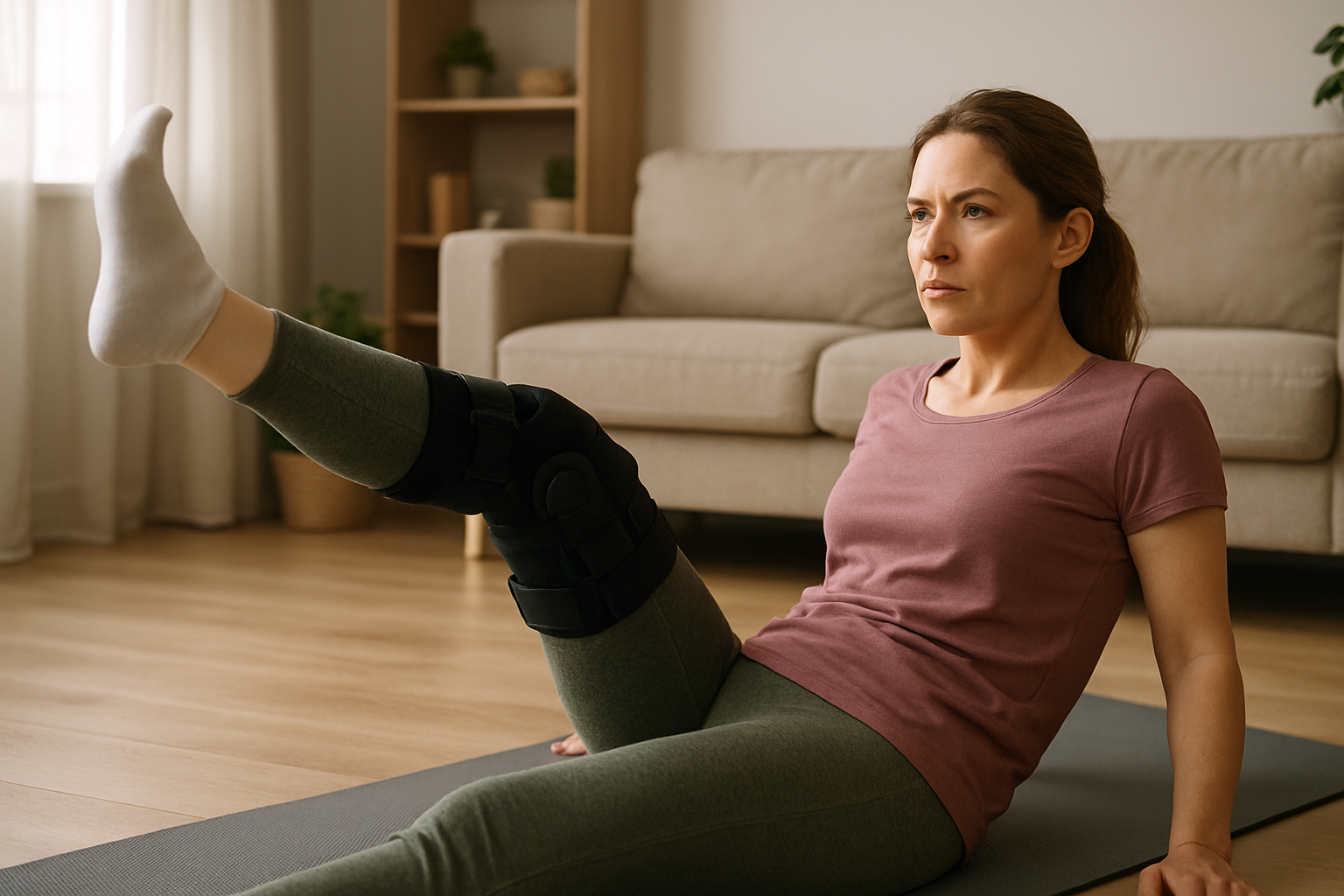
In the first 4-6 weeks after surgery, your biggest enemy isn’t pain — it’s stiffness. A quality hinged ROM (range of motion) brace lets you move safely without the constant micro-instability that makes you guard your knee and avoid the mobility work your surgeon wants you doing. This is where a post-op brace earns its place, not as a crutch forever, but as the training wheels that let you actually *do* your PT.
What works
- The hinged design provides medial and lateral support without restricting flexion, so you can actually bend your knee during those early PT sessions without feeling like the joint is going to give way.
- Research on post-op bracing supports early mobilization in a controlled way — users who wear a proper hinged brace during recovery typically report faster confidence with weight-bearing and less guarding (the protective tension that slows down your rehab timeline).
- The neoprene sleeve provides consistent compression that helps manage the swelling that loves to come back around day 5-7 when you start moving more — without the neoprene, you’re fighting inflammation while trying to rebuild strength.
What doesn’t
- This isn’t a magic “return to normal faster” device — you still need to do your physical therapy, and honestly, a brace won’t compensate for skipping those exercises or moving too aggressively too soon.
- If your surgeon didn’t recommend bracing for your specific surgery type, or if you have significant swelling that doesn’t respond to elevation and ice first, you might need a custom brace or medical evaluation before trying an off-the-shelf option.
A brace works best when it’s paired with a real rehab plan — it’s not the solution on its own, it’s the tool that makes the solution possible. If you’re cleared by your surgeon to start gentle range-of-motion work, Brace Direct Breg T Scope Premier Post Op Knee Brace gives you that structural confidence without overdoing the restriction.
About This Article

Written by Michael Torres. Michael Torres has had joint problems his whole life — hypermobile as a kid, chronic sprains and a dislocating shoulder through his twenties, an osteoarthritis diagnosis in his early fifties, and a right knee replacement since. He is not a doctor or a physical therapist and has no clinical training. He writes about what has helped him and what he has watched help the people around him, and says plainly when he has not tried something himself. More about this site.
Scope and limits. Michael has no medical or clinical training — he writes about living with his own joint pain, not about treating anyone else's. Nothing here is medical advice. Talk to a doctor before starting anything new, and get seen promptly for pain that is new, severe, worsening, or comes with swelling, fever, or numbness.
Verify this against a primary source
Specifics change, and your situation may differ from the one described here. These are the authorities worth checking directly:
- NIAMS — arthritis and musculoskeletal research from the NIH
- MedlinePlus — plain-language medical reference from the NIH
- Arthritis Foundation — condition guides and treatment overviews