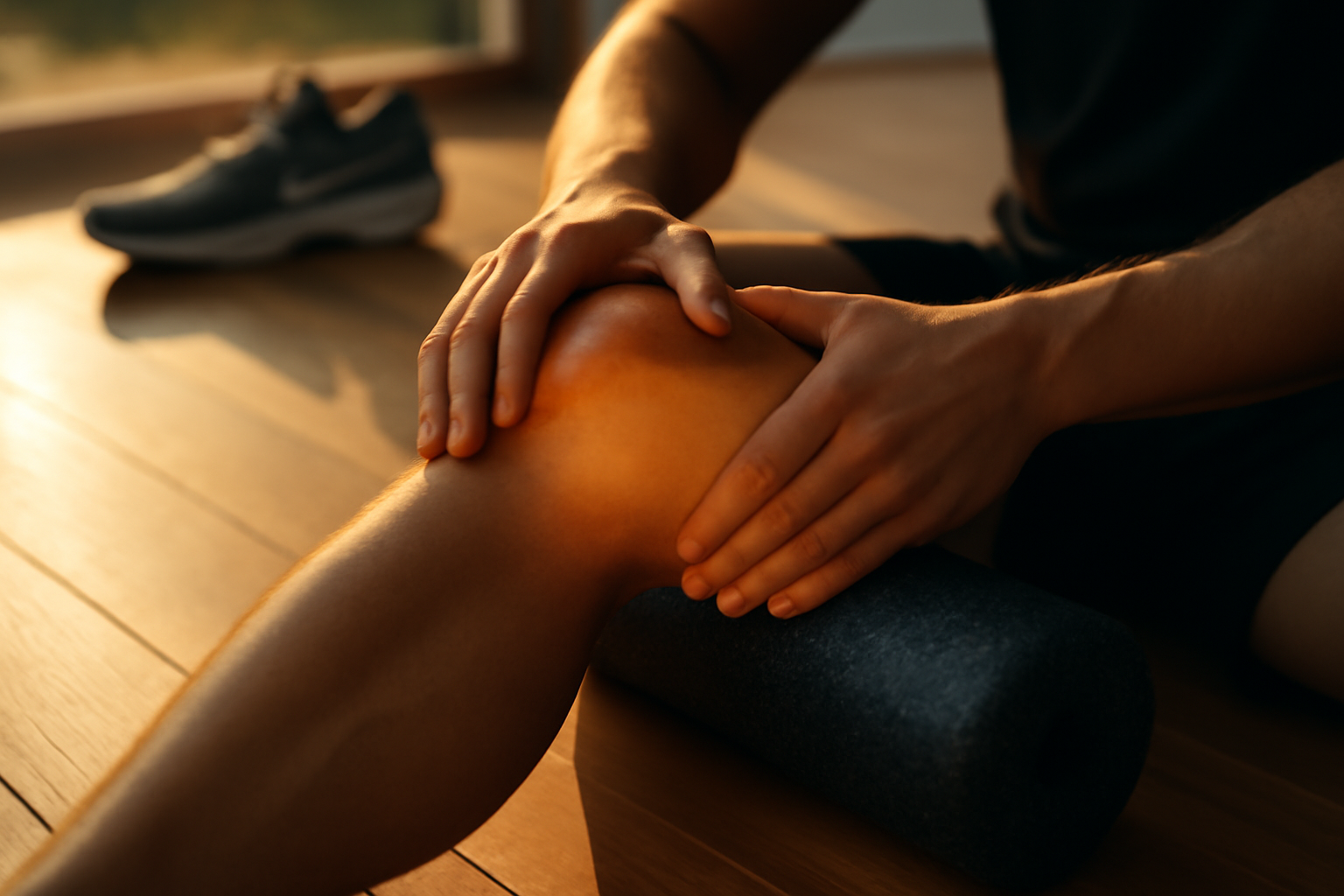

Quick Summary: Running Joint Massage Recovery
- Running generates repetitive ground reaction forces that accumulate in the knees, hips, ankles, and IT band, leading to soft tissue stiffness and reduced joint mobility over time.
- Research published in the Journal of Athletic Training supports soft tissue massage as a strategy for reducing delayed onset muscle soreness and improving range of motion in active individuals.
- Physical therapists recommend timing massage interventions carefully: light mobilization before a run, deeper soft tissue work afterward for optimal recovery benefit.
- Foam rollers, percussive massage guns, massage balls, and roller sticks each address different anatomical regions and recovery goals for runners.
- Consistent soft tissue maintenance — not just post-injury treatment — is associated with longer injury-free training periods among recreational and competitive runners.
Why Do Runners’ Joints Take So Much Punishment?
Running is a high-impact, repetitive activity in which each foot strike transmits a ground reaction force estimated at two to three times body weight up through the kinetic chain — feet, ankles, knees, hips, and lumbar spine. According to the American Academy of Orthopaedic Surgeons (AAOS), cumulative mechanical loading on these joints, particularly the tibiofemoral (knee) and hip joints, is a primary contributor to overuse injury in distance runners. When mileage increases too quickly, when athletes train on hard surfaces, or when recovery is deprioritized, the soft tissues surrounding these joints — fascia, tendons, and synovial capsule — develop adhesions, reduce their viscoelastic compliance, and restrict functional range of motion.
The joints most frequently affected in runners are the patellofemoral joint, the iliotibial band insertion at the lateral knee, the hip flexor complex, and the subtalar joint of the ankle. These structures accumulate mechanical tension rapidly and release it slowly without intentional intervention. Runners who incorporate regular soft tissue work around these joints often report fewer flare-ups and more consistent training performance than those who rely on rest alone.
What Does Research Say About Massage for Running Recovery?
Research published in the Journal of Athletic Training suggests that massage therapy applied within two hours post-exercise may significantly reduce delayed onset muscle soreness (DOMS) and support faster restoration of perceived muscle function. The American Physical Therapy Association (APTA) recognizes soft tissue mobilization as a clinically supported modality for improving local circulation, reducing myofascial tension, and facilitating neuromuscular relaxation. For runners, these mechanisms translate directly into reduced joint stiffness, improved stride mechanics, and a lower risk of compensatory injury patterns developing over a training cycle.
Physical therapists in clinical practice frequently observe that athletes who perform consistent soft tissue work around the knee and hip report noticeably improved joint mobility within three to four weeks of establishing a daily routine — even when the total time invested is as little as ten minutes per session.
Which Types of Massage Are Most Effective for Runner Joint Recovery?
Foam Rolling
Foam rolling is a form of self-myofascial release that applies sustained compressive force to large muscle groups surrounding key running joints — the quadriceps, hamstrings, gastrocnemius, and iliotibial band. Physical therapists commonly recommend spending 30 to 60 seconds per region, moving slowly and pausing on areas of focal tenderness to allow the viscoelastic tissue to respond. Fast, repetitive rolling reduces therapeutic effectiveness. Foam rolling is generally best positioned as a post-run cooldown tool rather than a primary warm-up strategy, as prolonged pressure can temporarily reduce force production in the muscle if applied immediately before high-intensity effort.
Percussive Massage Devices
Percussive massage guns deliver rapid, oscillating pulses at programmable depths and frequencies, targeting deep muscle belly tissue with mechanical stimulation that promotes blood flow and reduces neuromuscular hypertonicity. Clinical evidence supports percussive therapy for improving short-term range of motion without impairing muscle strength, making it suitable for both pre- and post-run use. Orthopedic specialists note that percussive devices should never be applied directly over bony joint structures such as the patella or medial malleolus — the therapeutic target is the surrounding musculature, not the joint capsule itself.
Manual Massage Tools
Massage balls and handheld roller sticks offer targeted pressure to anatomical areas that foam rollers cannot effectively reach — the gluteus medius, the plantar fascia, the piriformis, and the tibialis anterior. These tools give athletes precise control over depth and angle, and licensed occupational therapists frequently recommend them for daily maintenance work between formal physical therapy sessions. Their compact size also makes them practical for athletes who travel frequently for races or training camps.
When Should Runners Use Massage Tools: Before or After a Run?
Timing is a clinically meaningful variable in massage application. Before a run, light percussive work on a low-frequency setting or gentle foam rolling for two to three minutes per area may enhance local circulation and proprioceptive readiness without producing the muscle inhibition associated with prolonged static stretching. The focus should remain on the hip flexors, quadriceps, and calves. Post-run is the appropriate window for deeper, more sustained soft tissue work. After a cooldown walk, athletes should spend 10 to 15 minutes systematically addressing the calves, IT band, quadriceps, and glutes. This post-run window is generally considered the highest-value opportunity for massage-based recovery in a runner’s routine.
The Massage Gun That Actually Reaches Runner’s Knee and Calf Tension
After a hard run, your quads, calves, and the soft tissue around your knees are tight and inflamed — and a handheld massage gun lets you target those exact spots without waiting for an appointment or dropping money on weekly sessions. The TOLOCO with 10 interchangeable heads gives you options for different muscle groups and recovery phases, which matters because what works for a tight calf doesn’t work the same way on your knee joint itself.
What works
- The multiple head attachments mean you can switch between broad coverage (for the quad and hamstring) and precision work (for the IT band and surrounding tendons), which research supports as more effective than a one-size-fits-all approach for runners.
- Most runners report noticeable tension relief within 2–3 minutes of use post-run, and consistent use (3–4 times per week) seems to reduce next-day soreness and help you tolerate higher mileage without joint flare-ups.
- The percussion frequency (around 3,200 pulses per minute on this model) is in the sweet spot: strong enough to break up muscle tightness that restricts joint mobility, but not so aggressive that it aggravates inflamed joint capsules if you avoid direct contact with bony landmarks.
What doesn’t
- A massage gun doesn’t fix faulty running mechanics, strength imbalances, or overtraining — if your knee pain is structural or you’re adding 20% mileage per week, this is a band-aid, not a solution.
- Some runners with joint inflammation or swelling report increased pain if they use the gun too aggressively or too soon after injury; you need to use it thoughtfully on the muscle tissue around the joint, not on the joint capsule itself.
A massage gun speeds up recovery and feels great, but it works best as part of a bigger strategy that includes adequate rest, strength work, and smart mileage progression. TOLOCO Massage Gun
About This Article

Written by Michael Torres. Michael Torres has had joint problems his whole life — hypermobile as a kid, chronic sprains and a dislocating shoulder through his twenties, an osteoarthritis diagnosis in his early fifties, and a right knee replacement since. He is not a doctor or a physical therapist and has no clinical training. He writes about what has helped him and what he has watched help the people around him, and says plainly when he has not tried something himself. More about this site.
Scope and limits. Michael has no medical or clinical training — he writes about living with his own joint pain, not about treating anyone else's. Nothing here is medical advice. Talk to a doctor before starting anything new, and get seen promptly for pain that is new, severe, worsening, or comes with swelling, fever, or numbness.
Verify this against a primary source
Specifics change, and your situation may differ from the one described here. These are the authorities worth checking directly:
- NIAMS — arthritis and musculoskeletal research from the NIH
- MedlinePlus — plain-language medical reference from the NIH
- Arthritis Foundation — condition guides and treatment overviews