

This content is for informational purposes only and does not substitute for professional medical advice. Always consult a board-certified orthopedic surgeon or licensed physical therapist before making decisions about surgical intervention or rehabilitation.
Wrist Tendonitis Surgery Recovery: What Patients and Clinicians Say to Really Expect
For patients who have exhausted conservative treatment — bracing, corticosteroid injections, anti-inflammatory medication, and structured physical therapy — wrist tendonitis surgery may become the next clinical step. This evidence-informed guide compiles what surgical recovery genuinely involves, from timeline to rehabilitation to supportive products.
Quick Summary
- Most wrist tendonitis cases resolve with conservative care; surgery is typically considered only after six or more months of persistent symptoms despite appropriate treatment.
- The three primary surgical approaches — debridement, tendon sheath release, and tendon repair — carry meaningfully different recovery timelines.
- Full biological tendon healing can take 6–12 months; the American Academy of Orthopaedic Surgeons notes that tendons heal more slowly than most other soft tissues due to limited vascular supply.
- Physical therapy following surgery is clinically essential, not optional — orthopedic specialists consistently identify rehabilitation adherence as the primary predictor of surgical outcomes.
- Supportive wrist bracing during the mid-to-late recovery phase can protect the healing tendon during daily activity and reduce overnight inflammation.
When Does Wrist Tendonitis Actually Require Surgery?
In most cases, wrist tendonitis never requires surgical intervention. Conservative care — including structured rest, thermoplastic bracing, corticosteroid injections, and targeted physical therapy aligned with American Physical Therapy Association (APTA) guidelines — resolves symptoms in most patients. However, a clinically significant subset of individuals does not respond adequately to these measures.
Surgical evaluation is typically indicated when a patient has experienced persistent pain for six months or more despite compliant conservative management, and when diagnostic imaging — most commonly MRI or high-resolution musculoskeletal ultrasound — reveals structural pathology. This includes partial tendon tears, tendinosis (chronic degenerative breakdown of tendon collagen), or constriction of the tendon sheath that limits normal gliding mechanics. The American Academy of Orthopaedic Surgeons (AAOS) identifies structural imaging findings as a key criterion for surgical candidacy in chronic wrist tendon conditions.
What Are the Main Types of Wrist Tendonitis Surgery?
The specific procedure recommended will depend on the anatomical location of the pathology, the degree of structural damage, and the patient’s functional goals. The three most common surgical approaches are outlined below.
Tendon Debridement
Debridement is the most frequently performed surgical procedure for chronic wrist tendonitis. The surgeon excises degenerated tendon tissue and inflamed synovial sheath material, removing the pathological burden that prevents normal healing. When performed arthroscopically — using small portals and a camera rather than a large open incision — recovery time is generally shorter and post-operative pain is reduced compared to open debridement techniques.
Tendon Sheath Release
De Quervain’s tenosynovitis, a condition affecting the abductor pollicis longus and extensor pollicis brevis tendons on the radial (thumb) side of the wrist, is among the most common diagnoses treated with sheath release surgery. The procedure involves incising the first dorsal compartment to decompress the constricted tendon tunnel, eliminating the mechanical friction responsible for pain. Research published in the Journal of Hand Surgery supports first dorsal compartment release as a highly effective intervention for De Quervain’s that has not responded to conservative care, with strong patient-reported outcome scores at 12-month follow-up.
Tendon Repair
When imaging identifies a partial or complete tendon tear, a formal repair procedure may be required. This is a more technically involved surgery with a longer, more structured recovery protocol — typically including an extended immobilization phase followed by a carefully staged rehabilitation progression. In general, patients undergoing tendon repair should expect the longest recovery windows and the most demanding rehabilitation programs of the three procedure types.
What Does Wrist Tendonitis Surgery Recovery Look Like Week by Week?
Physical therapists in practice consistently observe that patients underperform their recovery potential when they lack a realistic framework for what each phase involves. The following timeline reflects typical post-surgical progression — individual variation is substantial based on procedure type, patient age, comorbidities, and rehabilitation adherence.
- Weeks 1–2: The wrist is immobilized in a surgical splint or cast. Post-operative swelling, bruising, and aching are expected and represent normal inflammatory healing. Elevation above heart level and gentle distal finger movement — if cleared by the operating surgeon — are the primary patient responsibilities during this phase.
- Weeks 3–6: Many patients transition to a removable orthosis and begin supervised range-of-motion exercises with a physical therapist. Stiffness and perceived weakness during this phase are clinically normal and should not be interpreted as surgical failure.
- Months 2–3: Progressive resistance and tendon-loading exercises typically begin under physical therapy supervision. Patients frequently notice measurable functional improvement, though the wrist may still fatigue rapidly with sustained use.
- Months 4–6: Return to light daily activities and sedentary occupational tasks is common within this window for debridement and release procedures. Repetitive manual labor, weightlifting, and sport-specific activities generally require longer timelines.
- 6–12 months: Full biological and functional recovery from wrist tendon surgery can require up to one year. The AAOS notes that tendon tissue heals more slowly than muscle or ligament due to its comparatively poor blood supply — a physiological reality that patients benefit from understanding early in recovery.
What Do Patient Testimonies Reveal About Wrist Tendonitis Surgery Recovery?
A consistent pattern emerges when orthopedic clinicians and physical therapists review wrist tendonitis surgery testimonies: patients who enter recovery with realistic expectations demonstrate measurably better rehabilitation adherence and report higher satisfaction with outcomes. Three themes recur with particular frequency.
First, many patients report underestimating the psychological burden of temporary hand dysfunction. The loss of even partial wrist function affects dressing, cooking, driving, and professional tasks simultaneously — clinicians recommend pre-surgical planning for this period, including identifying household support resources in advance.
Second, the early post-operative weeks frequently feel worse than the pre-surgical baseline, as acute surgical inflammation compounds existing tissue sensitivity. Physical therapists in practice emphasize that this is a normal and expected phase of healing, not evidence of a poor surgical result.
Third, and critically, surgery does not guarantee a return to full pre-injury function. Patients who treat post-operative rehabilitation with the same commitment as the surgical procedure itself tend to achieve the best documented outcomes. Physical therapy following wrist tendon surgery is not supplementary care — it is the second half of the clinical intervention.
The Wrist Brace That Actually Stays Put During Recovery
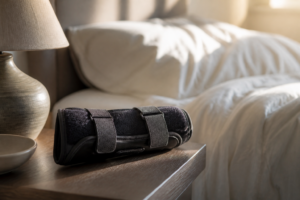
After wrist tendonitis surgery, you need immobilization that doesn’t slip, bunch up, or cut off circulation during those first critical weeks of healing. A properly fitted brace reduces compensatory strain on adjacent tendons and gives your surgical site the stable environment it needs to rebuild without constant micro-movements that aggravate inflammation.
What works
- Anatomical pre-formed design (rather than generic wraps) maintains consistent wrist position without daily re-adjustment, which matters when you’re healing and can’t tolerate repeated pressure changes.
- Breathable, moisture-wicking material prevents skin breakdown and swelling complications—common frustrations during weeks 2-6 post-op when inflammation peaks and tight compression feels intolerable.
- Fits under clothing and typing at a desk without bulk, so you can actually comply with wearing it consistently instead of abandoning it because it’s too awkward—real-world adherence matters more than perfect specs on paper.
What doesn’t
- This is not a replacement for structured physical therapy once your surgeon clears you for gentle range-of-motion work (usually 3-4 weeks post-op)—the brace stabilizes, but it doesn’t rebuild strength or restore movement patterns.
- If your wrist is significantly swollen or your surgeon prescribed a rigid post-surgical splint instead of a brace, this won’t be what you need in the immediate post-op phase; check with your surgical team before substituting anything they’ve ordered.
Expect to wear this consistently for at least 4-6 weeks—healing doesn’t happen faster if you take it off when it feels annoying, and that early impatience is exactly when re-injury risk is highest. FEATOL Wrist Brace
About This Article

Written by Michael Torres. Michael Torres has had joint problems his whole life — hypermobile as a kid, chronic sprains and a dislocating shoulder through his twenties, an osteoarthritis diagnosis in his early fifties, and a right knee replacement since. He is not a doctor or a physical therapist and has no clinical training. He writes about what has helped him and what he has watched help the people around him, and says plainly when he has not tried something himself. More about this site.
Scope and limits. Michael has no medical or clinical training — he writes about living with his own joint pain, not about treating anyone else's. Nothing here is medical advice. Talk to a doctor before starting anything new, and get seen promptly for pain that is new, severe, worsening, or comes with swelling, fever, or numbness.
Verify this against a primary source
Specifics change, and your situation may differ from the one described here. These are the authorities worth checking directly:
- NIAMS — arthritis and musculoskeletal research from the NIH
- MedlinePlus — plain-language medical reference from the NIH
- Arthritis Foundation — condition guides and treatment overviews