

You finally committed to staying consistent with your exercise routine this winter — and then a cold comes along and knocks you flat for a week. Sound familiar? If you’ve ever tried to navigate winter joint health exercise while also fighting off seasonal bugs, stiff muscles, and the general misery of cold weather, you already know how quickly good intentions can unravel. I’ve talked with enough people to know that this time of year is genuinely hard on the body — not just because of the cold itself, but because of everything that comes with it: less movement, less sunlight, more inflammation, and a weakened immune system that can leave your joints aching even more than usual.
Why Winter Is Especially Tough on Your Joints
Here’s something that often surprises people: cold weather doesn’t just make you feel achy — it can actually contribute to increased joint stiffness and discomfort through a few real physiological mechanisms. Research suggests that drops in barometric pressure (common in winter weather systems) may cause tissues around joints to expand slightly, which can increase sensitivity and pain perception. Add to that the fact that most of us move less when it’s cold outside, and you’ve got a recipe for stiff, unhappy joints.
Then there’s the immune connection. Respiratory infections spike in winter — partly because we spend more time indoors in close contact with others, and partly because cold, dry air can impair the mucous membranes that normally act as a first line of defense. When your immune system is fighting off a respiratory bug, inflammatory markers in the body often rise. For people with arthritis or chronic joint issues, that systemic inflammation can show up as a noticeable flare in joint pain. It’s not in your head — your body really is working against you a little more this time of year.
Winter Joint Health Exercise: How to Keep Moving Without Making Things Worse
The good news is that movement is still one of the best things you can do for your joints — even in winter. The key is being smarter about how you do it. Here’s what I tell people when they’re trying to stay active during cold-weather months:
Warm Up Longer Than You Think You Need To
In warmer months, a five-minute warm-up might be plenty. In winter, your muscles and connective tissues are starting from a colder baseline, which means they need more time to become pliable and ready for movement. Give yourself at least ten to fifteen minutes of gentle, dynamic movement before any real exercise. Think leg swings, arm circles, slow bodyweight squats, and gentle torso rotations — nothing aggressive, just coaxing the body awake.
Choose Indoor Low-Impact Options
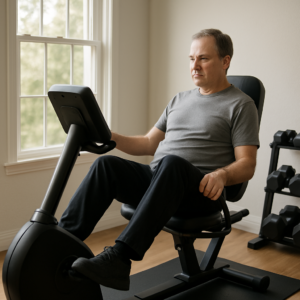
Winter is a great time to lean into low-impact indoor exercise. Swimming in a heated pool, walking on a treadmill, cycling on a stationary bike, yoga, Pilates, and resistance band training are all excellent choices for keeping joints mobile without the pounding of high-impact activity. Many people find that water-based exercise in particular provides significant relief during flare-prone months because the buoyancy reduces load on weight-bearing joints while still allowing a full range of motion.
Don’t Skip Movement on “Bad” Days
This one is counterintuitive, but important: on days when your joints feel stiff or achy, complete rest often makes things worse, not better. Gentle movement — even just a slow ten-minute walk or some light stretching — helps circulate synovial fluid through the joints, which acts like natural lubrication. The goal isn’t to push through pain; it’s to avoid the stiffness that comes from prolonged inactivity.
Rebuilding Lung Capacity When You’re Sidelined by Illness
When you’re recovering from a cold or flu, your respiratory capacity tanks — and that makes getting back to safe exercise feel impossible. A volumetric breathing trainer won’t prevent colds, but it addresses the real barrier most people face: the shortness of breath and shallow recovery that keeps you stuck on the couch for weeks after the virus clears.
What works
- Measurable improvement in breathing capacity within 2–3 weeks of consistent use (the 5000ml volume gives you real room to progress, which matters if you’re not starting from zero).
- Makes the transition back to joint-friendly cardio feel less terrifying — you rebuild confidence in your body’s ability to handle movement before you’re asking your joints to do the work.
- Unlike generic breathing exercises, the visual feedback of the balls rising and falling gives you something concrete to track, which actually makes people stick with it during recovery.
What doesn’t
- This is a recovery tool, not a shortcut — you won’t feel dramatically better after one session, and if you’re still actively sick with a respiratory infection, you should wait until the acute phase is over.
- If your breathing issues persist beyond 3–4 weeks post-illness, that’s a sign to check in with your doctor; a breathing device won’t fix underlying inflammation or complications.
Think of this as scaffolding for your recovery, not a replacement for patience — your lungs need time to clear, and this just helps you use that time productively. Breathing Exercise Device for Lungs – 5000ml Volumetric Deep Breathing Trainer
About This Article

Written by Michael Torres. Michael Torres has had joint problems his whole life — hypermobile as a kid, chronic sprains and a dislocating shoulder through his twenties, an osteoarthritis diagnosis in his early fifties, and a right knee replacement since. He is not a doctor or a physical therapist and has no clinical training. He writes about what has helped him and what he has watched help the people around him, and says plainly when he has not tried something himself. More about this site.
Scope and limits. Michael has no medical or clinical training — he writes about living with his own joint pain, not about treating anyone else's. Nothing here is medical advice. Talk to a doctor before starting anything new, and get seen promptly for pain that is new, severe, worsening, or comes with swelling, fever, or numbness.
Verify this against a primary source
Specifics change, and your situation may differ from the one described here. These are the authorities worth checking directly:
- NIAMS — arthritis and musculoskeletal research from the NIH
- MedlinePlus — plain-language medical reference from the NIH
- Arthritis Foundation — condition guides and treatment overviews