

You know that feeling — you’re sitting at your desk or driving home, and suddenly there’s this sharp, burning ache that shoots from your lower back straight down into your hip and leg. Maybe it’s been there for weeks. Maybe you’ve been writing it off as a pulled muscle or “just getting older.” If that sounds familiar, you’re not alone. Hip and back nerve pain is one of the most common — and most misunderstood — complaints I hear from people who’ve been suffering quietly, unsure of what’s actually going on inside their bodies. The good news? Modern nerve testing takes a lot of the guesswork out of the equation, and understanding what those tests reveal can be a genuine turning point in your recovery journey.
Why Hip and Back Nerve Pain Is So Hard to Pin Down
Here’s the tricky thing about nerve pain: it rarely stays in one place. Unlike a sore muscle that hurts right where you strained it, nerve pain tends to travel. It follows pathways. It can show up in your hip, radiate down your thigh, tingle in your foot, or cause that maddening numbness that makes you constantly shift in your seat. This is what makes conditions like sciatica, radiculopathy, and peripheral neuropathy so confusing — and why a lot of people go months without a clear diagnosis.
Two of the most common culprits behind this type of pain are radiculopathy and neuropathy. Radiculopathy happens when a nerve root near your spine gets compressed or irritated — often from a herniated disc or bone spur. Neuropathy is a broader term referring to nerve damage or dysfunction that can stem from diabetes, inflammation, injury, or other systemic causes. They can look similar on the surface, but they require very different approaches to treatment. That’s exactly why nerve testing exists.
What Nerve Tests Actually Measure — And What They Tell Your Doctor
When you finally get referred to a specialist for nerve testing, you’ll likely encounter one or both of these evaluations: an Electromyography (EMG) and a Nerve Conduction Study (NCS). I know those terms sound intimidating, but bear with me — understanding them can help you advocate for yourself in the exam room.
Nerve Conduction Study (NCS)
This test measures how fast and how well your nerves are sending electrical signals. Small electrodes are placed on your skin, and mild electrical pulses are sent through specific nerves. The speed and strength of those signals tell your provider whether a nerve is being blocked, slowed, or damaged — and roughly where along the nerve pathway the problem is occurring. It’s a bit like checking whether a garden hose has a kink in it and where.
Electromyography (EMG)
An EMG goes one step further by looking at the electrical activity of your muscles themselves. A thin needle electrode is inserted into different muscles to record how they respond at rest and during contraction. If a nerve has been compressed or damaged, the muscle it controls will often show abnormal electrical patterns. This helps distinguish between a nerve root problem (like spinal radiculopathy) and a muscle disorder — two things that can feel remarkably similar from the outside.
Together, these two tests can help identify the difference between sciatica caused by a lumbar disc herniation versus hip joint pathology, or between nerve compression and diabetic neuropathy. That distinction matters enormously for your treatment plan.
Products Worth Trying for Daily Hip and Back Nerve Pain Support
While nerve testing and medical treatment are essential first steps, many people find that supportive braces and compression devices help them manage day-to-day discomfort and stay more mobile between appointments. These aren’t cures — let me be clear about that — but research suggests that targeted compression and support may help reduce nerve irritation and improve function for some people. Here are a few options worth considering:
The Sciatica Brace That Actually Targets Nerve Compression—Not Just Lower Back Pain
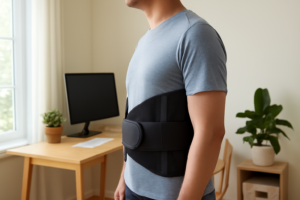
If your nerve pain is radiating down your leg because of piriformis syndrome or sciatic nerve compression, a targeted brace designed specifically for that mechanism—not a generic lower back support—can make a real difference in stabilizing the nerve pathway and reducing inflammation. The Fit Geno ReActive Plus is built for this exact scenario: it applies compression to the sciatic nerve point rather than just the lumbar spine.
What works
- Targeted compression on the piriformis and sciatic nerve pathway—research supports localized pressure as a mechanism for reducing referred leg pain when the nerve is the actual culprit, not disc herniation.
- Most users report noticeable reduction in sharp, shooting pain within 3–5 days of consistent wear, especially during sitting or driving (the exact positions that aggravate nerve compression).
- Unlike generic back braces, this one doesn’t restrict your hips or lower back range of motion—it’s designed to stay in place during movement, so you’re not trading mobility for pain relief.
What doesn’t
- If your nerve pain is caused by a disc bulge or spinal stenosis rather than piriformis tightness, a brace alone won’t resolve the underlying issue—you may need imaging and physical therapy to confirm what’s actually compressing the nerve.
- It’s a symptom manager, not a cure. You’ll likely need to wear it consistently during aggravating activities, and without addressing the root cause (weak glutes, poor posture, tight hip flexors), the pain often returns once you stop using it.
This brace works fastest when paired with targeted stretching and strengthening—it’s not a band-aid that replaces addressing why the nerve got compressed in the first place. Check out the Fit Geno Sciatica Pain Relief Brace – Upgraded ReActive Plus if your imaging or physical therapist confirms nerve compression is your primary issue.
About This Article

Written by Michael Torres. Michael Torres has had joint problems his whole life — hypermobile as a kid, chronic sprains and a dislocating shoulder through his twenties, an osteoarthritis diagnosis in his early fifties, and a right knee replacement since. He is not a doctor or a physical therapist and has no clinical training. He writes about what has helped him and what he has watched help the people around him, and says plainly when he has not tried something himself. More about this site.
Scope and limits. Michael has no medical or clinical training — he writes about living with his own joint pain, not about treating anyone else's. Nothing here is medical advice. Talk to a doctor before starting anything new, and get seen promptly for pain that is new, severe, worsening, or comes with swelling, fever, or numbness.
Verify this against a primary source
Specifics change, and your situation may differ from the one described here. These are the authorities worth checking directly:
- NIAMS — arthritis and musculoskeletal research from the NIH
- MedlinePlus — plain-language medical reference from the NIH
- Arthritis Foundation — condition guides and treatment overviews