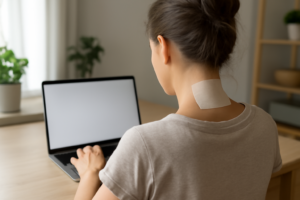

You know that feeling — it’s 3 PM, you’ve been hunched over your laptop since morning, and your neck starts sending out distress signals you can no longer ignore. A dull ache at the base of your skull, stiffness when you try to turn your head, maybe even a tension headache creeping in from behind your eyes. If that sounds familiar, you’re dealing with what millions of people now experience every single day: tech neck cervical joint pain. And honestly? It makes complete sense given how we live now. The average adult spends 10+ hours a day looking at screens, and our cervical spine — those delicate seven vertebrae stacking up from the base of your skull — was simply not designed for that kind of sustained forward load.
What Tech Neck Actually Does to Your Cervical Joints
Let me paint a picture that might make you sit up a little straighter right now. In a neutral, upright position, your head weighs roughly 10 to 12 pounds — about the weight of a bowling ball. The moment you tilt your head forward just 15 degrees to glance at your phone, the effective load on your cervical spine increases to around 27 pounds. At 30 degrees of forward tilt, that number jumps to approximately 40 pounds. At 60 degrees — which is a very common phone-scrolling angle — research suggests your cervical joints may be absorbing up to 60 pounds of compressive force.
That sustained, unnatural loading affects more than just your muscles. Over time, it can compress the intervertebral discs between your cervical vertebrae, place stress on your facet joints, and contribute to forward head posture — a structural shift that becomes harder to reverse the longer it goes unaddressed. Many people find that what starts as muscle soreness gradually evolves into joint stiffness, reduced range of motion, and in some cases, nerve-related symptoms like tingling in the arms or hands. I’m not trying to alarm you — I’m trying to get your attention, because the earlier you take this seriously, the better.
Daily Habits That May Help Protect Your Cervical Spine
Before we talk about tools and products, I want to be clear: the most powerful thing you can do for your cervical joints is change how you move throughout the day. No device replaces consistent, mindful habits. Here are the strategies I’d share with anyone who comes to me with neck pain rooted in screen use:
Raise Your Screen to Eye Level
This one change alone can dramatically reduce the forward flexion load on your cervical spine. Whether it’s stacking books under your laptop, investing in a monitor arm, or holding your phone up rather than dropping your chin down — anything that brings your screen to eye level matters. Your cervical joints will thank you almost immediately.
Practice the 20-20-20 Rule — With a Twist
Most people have heard the 20-20-20 rule for eye strain: every 20 minutes, look 20 feet away for 20 seconds. I’d add a cervical component to it. Every 20 to 30 minutes, stand up, gently retract your chin (think: make a subtle double chin), and do 5 slow neck rolls or chin tucks. These micro-movements help restore circulation to the joint tissues and counteract the sustained flexion position your cervical spine has been holding.
Strengthen the Deep Neck Flexors
The muscles most responsible for holding your head in proper alignment — the deep cervical flexors — tend to become weak and underactive in people with forward head posture. Simple exercises like chin tucks performed lying down, wall angels, and scapular retractions can help rebuild the support system your cervical joints rely on. Research suggests that consistent deep neck flexor training may reduce neck pain and improve postural alignment over time.
Products Worth Trying for Tech Neck Cervical Joint Pain Relief
Sometimes you need more than exercises — especially when inflammation and joint compression have already set in. These tools are ones many people find genuinely useful as part of a broader self-care routine. None of them are substitutes for professional evaluation if your symptoms are severe, but as daily support tools, they may help take the edge off and create better conditions for your cervical joints to recover.
Cervical Traction for Decompressing Pinched Joints: When Posture Fixes Aren’t Enough
If you’ve been doing neck stretches and adjusting your desk setup but still feel that grinding sensation or radiating pain down your shoulders, your cervical discs might actually need physical decompression — not just postural adjustment. A proper neck traction device gently separates your vertebrae, reducing pressure on nerves and inflamed joints that desk work has compressed over months or years.
What works
- Research on cervical traction shows real pain reduction when the force is gentle and sustained (typically 7–12 lbs) — not the aggressive pulling that makes things worse. This device gives you that controlled, gradual decompression without guesswork.
- Most people report noticeable relief within 1–2 weeks of consistent daily use (10–15 minutes), especially when nerve irritation is the root cause rather than pure muscle tension.
- Unlike passive neck collars that lock you in place, traction actually creates space in your joint — which means inflammation can begin to settle and your discs get a real chance to heal, not just get supported.
What doesn’t
- If your pain is purely muscular (tight upper traps, tension knots), traction won’t address the root cause — you’ll need stretching and trigger point work instead. Not everything that feels like “neck pain” is a joint decompression problem.
- Results require actual consistency — a few random uses won’t cut it. You need 5–7 days a week for at least 2–3 weeks before you’ll know if your specific situation responds to it.
Traction is a tool, not a cure — it only works if you also address what got you here in the first place (your desk posture, screen height, break frequency). Try the S Cervical Neck Traction Device if you’ve narrowed down your pain to disc compression or nerve irritation rather than pure muscle tension.
About This Article

Written by Michael Torres. Michael Torres has had joint problems his whole life — hypermobile as a kid, chronic sprains and a dislocating shoulder through his twenties, an osteoarthritis diagnosis in his early fifties, and a right knee replacement since. He is not a doctor or a physical therapist and has no clinical training. He writes about what has helped him and what he has watched help the people around him, and says plainly when he has not tried something himself. More about this site.
Scope and limits. Michael has no medical or clinical training — he writes about living with his own joint pain, not about treating anyone else's. Nothing here is medical advice. Talk to a doctor before starting anything new, and get seen promptly for pain that is new, severe, worsening, or comes with swelling, fever, or numbness.
Verify this against a primary source
Specifics change, and your situation may differ from the one described here. These are the authorities worth checking directly:
- NIAMS — arthritis and musculoskeletal research from the NIH
- MedlinePlus — plain-language medical reference from the NIH
- Arthritis Foundation — condition guides and treatment overviews