
You know that feeling — you wake up, swing your legs over the side of the bed, and take those first few stiff, creaky steps toward the bathroom. Maybe your knees ache, your hips feel tight, or your ankles protest the morning like they’re filing a formal complaint. If that sounds familiar, I want you to know you’re not alone, and I also want to tell you something that might surprise you: one of the best things you can do about it is also the simplest. The walking for joint health benefits conversation is one I have almost every week with people who are shocked to learn that a daily walk — done right — may do more for their joints than almost anything else they’re trying.
Why Walking for Joint Health Benefits Is More Powerful Than People Think
Here’s what I hear all the time: “I have bad knees, so I don’t walk much anymore.” I completely understand the instinct. When movement hurts, rest feels like the logical answer. But here’s the thing — for most people dealing with joint discomfort, prolonged rest can actually make things worse over time.
Your joints don’t have a direct blood supply the way your muscles do. Instead, they rely on movement to circulate synovial fluid — essentially the joint’s built-in lubrication system. When you walk, that gentle, rhythmic compression and release acts like a pump, delivering nutrients to cartilage and helping flush out inflammatory byproducts. Research suggests that regular low-impact walking may help reduce joint stiffness, support cartilage health, and even ease symptoms associated with osteoarthritis over time.
Walking also strengthens the muscles surrounding your joints — particularly the quadriceps, glutes, and hip stabilizers — which act as natural shock absorbers. The stronger those muscles are, the less raw impact your joint surfaces have to handle with every step. It’s a beautiful, self-reinforcing cycle when you approach it correctly.
Common Mistakes That Turn a Good Walk Into a Bad One
Not all walking is created equal, and if you’ve tried walking for exercise and ended up feeling worse, there’s a good chance one of these factors was at play.
Doing Too Much Too Soon
This is the number one mistake I see. Someone decides to get serious about walking, goes out for a 45-minute power walk on day one, and ends up with aching knees for three days. Start shorter than you think you need to. Even 10 to 15 minutes of comfortable walking is a legitimate, valuable starting point. Build gradually — adding five minutes every week or two — and pay attention to how your joints feel the morning after, not just during the walk.
Walking in the Wrong Footwear
Your shoes are the foundation of every step you take. Old, worn-out sneakers or flat unsupportive shoes can transfer shock directly up through your ankles, knees, and hips in ways that accumulate with every mile. Look for footwear with genuine cushioning and arch support — especially if you overpronate or have flat feet, which can throw off your entire kinetic chain and place uneven stress on your joints.
Skipping Warm-Up and Cool-Down
Starting a brisk walk cold — especially first thing in the morning — can aggravate stiff joints. Try a few minutes of slow, gentle walking first, then pick up your pace. At the end of your walk, slow down again and spend a few minutes doing light stretches for your calves, hip flexors, and quads. Many people find that this simple routine makes a noticeable difference in how they feel afterward.
Trekking Poles: The Joint Offloader Most People Overlook on Daily Walks
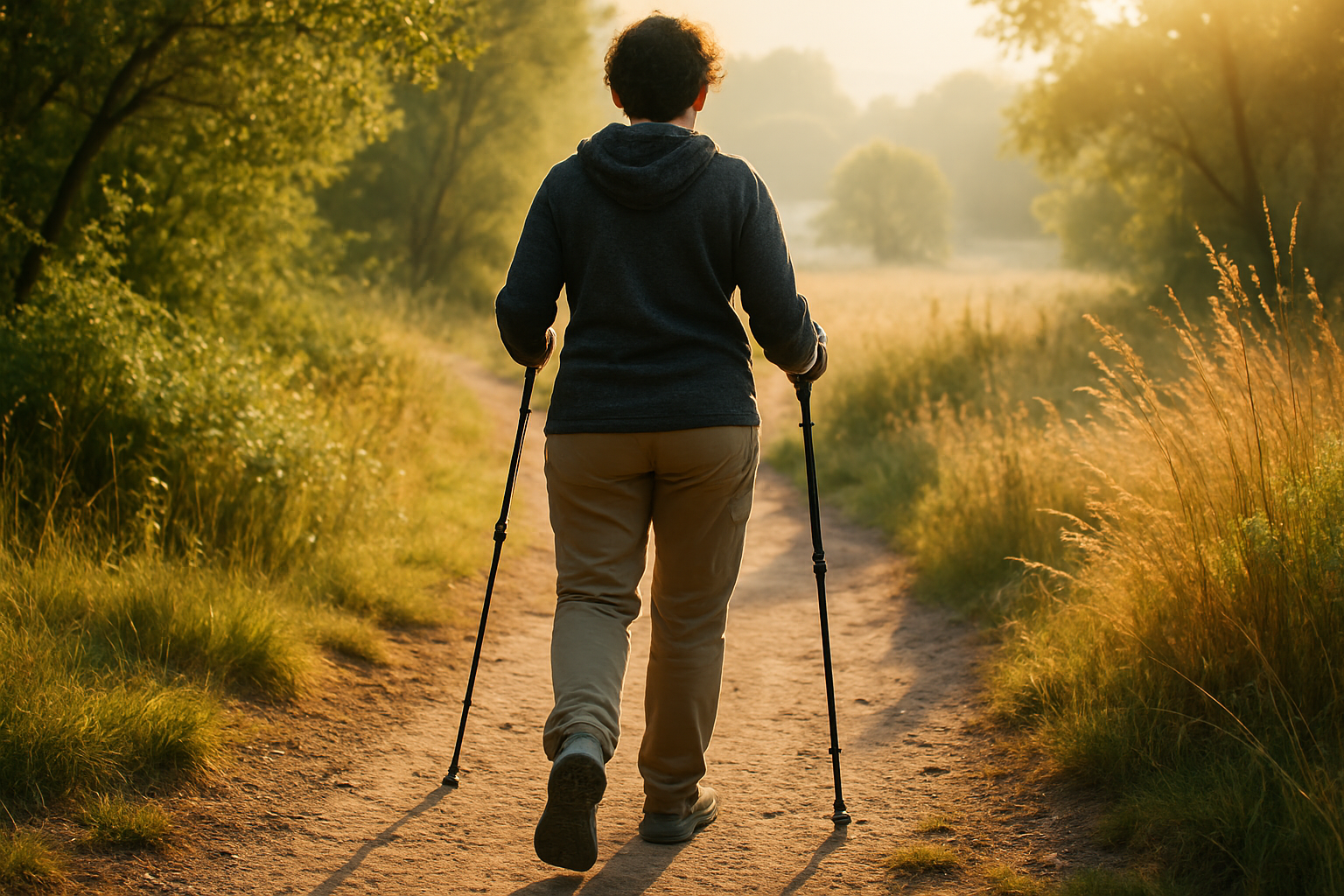
If you’re dealing with knee, hip, or ankle pain during walks, trekking poles aren’t just for mountain hiking—they’re a practical way to reduce load on your lower joints by distributing weight through your upper body and arms. For people whose mornings start with stiffness but who know movement helps, poles can be the difference between a 10-minute shuffle and a genuine 30-minute walk without pain escalation.
What works
- Research supports that trekking poles reduce impact load on knees and hips by 10–20%, which translates to noticeably less joint stress without sacrificing distance or pace.
- Most users report being able to walk longer or on hillier terrain without that familiar joint flare-up, often within the first few outings once the rhythm clicks.
- Folding models pack flat, so they’re not a commitment—you can test them on a few walks before deciding they’re worth keeping in your routine.
What doesn’t
- The learning curve is real—using poles awkwardly for the first week can feel clunky and may even create shoulder or wrist tension if your form isn’t right, so expect a brief adjustment period.
- Poles are a load-management tool, not a fix; if your joint pain is driven by weakness, poor alignment, or tissue damage, poles let you walk more comfortably but won’t address the root cause.
Give yourself at least 3–4 walks to find your rhythm before deciding if poles are your thing—the first outing always feels weird. If you’re serious about walking as your movement anchor, Folding Trekking Poles are worth a low-risk experiment.
About This Article

Written by Michael Torres. Michael Torres has had joint problems his whole life — hypermobile as a kid, chronic sprains and a dislocating shoulder through his twenties, an osteoarthritis diagnosis in his early fifties, and a right knee replacement since. He is not a doctor or a physical therapist and has no clinical training. He writes about what has helped him and what he has watched help the people around him, and says plainly when he has not tried something himself. More about this site.
Scope and limits. Michael has no medical or clinical training — he writes about living with his own joint pain, not about treating anyone else's. Nothing here is medical advice. Talk to a doctor before starting anything new, and get seen promptly for pain that is new, severe, worsening, or comes with swelling, fever, or numbness.
Verify this against a primary source
Specifics change, and your situation may differ from the one described here. These are the authorities worth checking directly:
- NIAMS — arthritis and musculoskeletal research from the NIH
- MedlinePlus — plain-language medical reference from the NIH
- Arthritis Foundation — condition guides and treatment overviews