I am not a medical professional. The experiences shared here are personal. Consult your doctor before starting any new treatment.
If you’ve ever searched for a Purple seat cushion hip pain review, you probably already know what it feels like to dread sitting down. Last year, I hit a point where two hours at my desk felt like punishment. My left hip would ache, tighten, and then radiate discomfort down my outer thigh. Getting up felt like peeling myself off a torture device. I’d tried folded blankets, a rolled towel, and even a memory foam donut cushion — none of it worked for more than twenty minutes.
My physical therapist kept reminding me that pressure distribution matters as much as support. She wasn’t recommending any specific product, but her explanation of how uneven pressure concentrates stress on the hip joint finally made me pay attention to what I was sitting on. That conversation sent me down a rabbit hole of cushion research I never expected to care about.
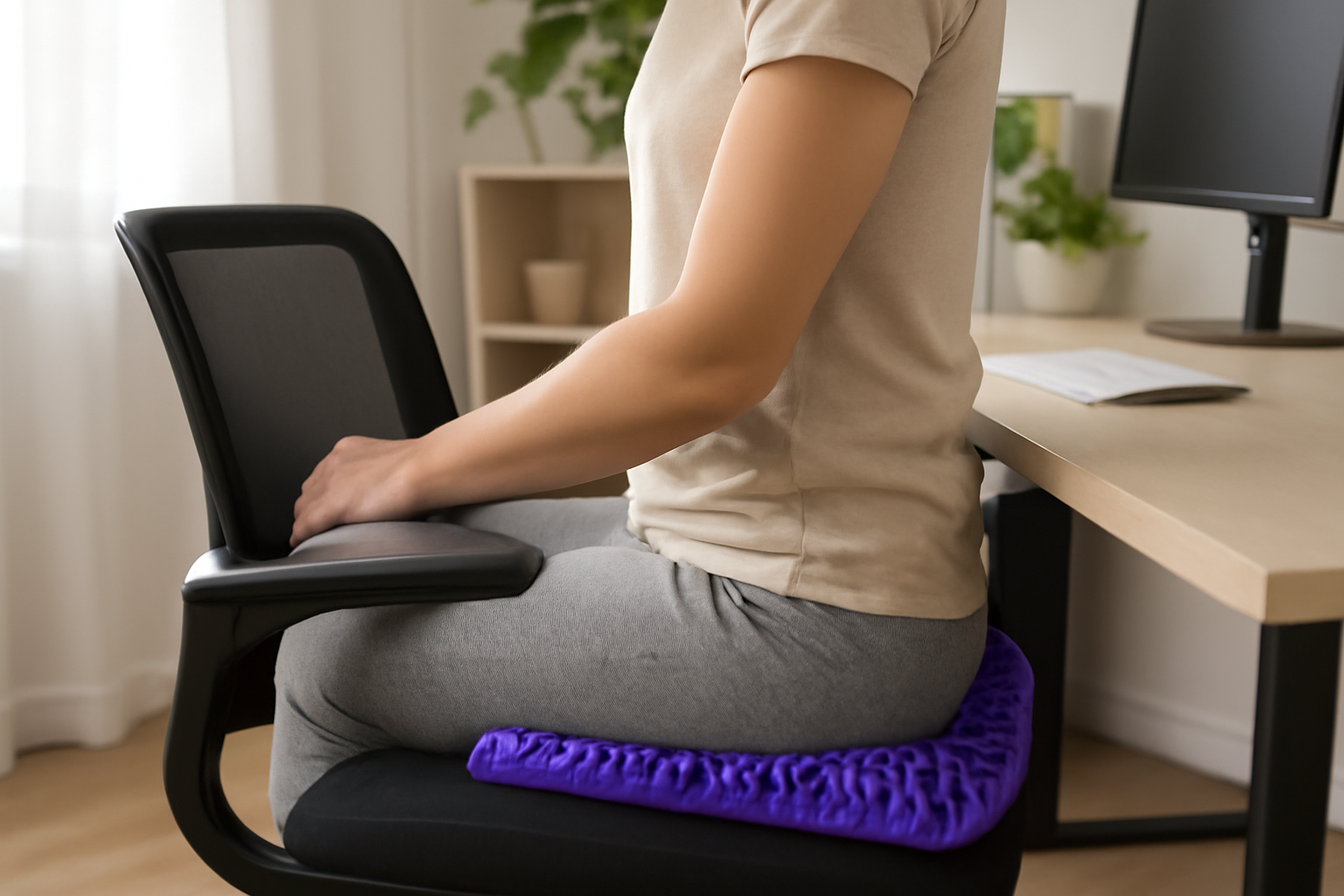
After weeks of reading reviews and comparing options, I landed on the Purple Royal Seat Cushion. This review covers everything — my experience, the timeline, the honest downsides, and whether I’d recommend it to someone in a similar situation.
Why I Chose the Purple Royal Seat Cushion
Most gel cushions I looked at relied on a solid layer of material that compresses under weight. That sounded fine in theory. In practice, compressed gel still creates pressure points — it just feels slightly softer while doing so. What caught my attention about Purple was the grid design. Rather than a flat surface, the elastomer grid is engineered to buckle under high-pressure spots and stay open under low-pressure ones.
Honestly, I was skeptical at first. It sounded like clever marketing language. Then I watched a few slow-motion videos showing the grid in action under weight, and something clicked. The science seemed genuinely different from what I’d tried before. Research into pressure ulcer prevention — a very different use case — consistently points to grid-style or alternating-pressure surfaces as more effective than flat foam. That’s not a medical claim. It’s just context that made me curious enough to try it.
I also noticed the Purple Royal Seat Cushion is described as temperature neutral. Previous gel cushions I’d used either trapped heat or felt uncomfortably cold in winter. The open-grid structure allows airflow, which addressed another complaint I had with my old memory foam cushion. Between the pressure-distribution design and the breathability, it checked more boxes than anything else I’d found at a comparable price point.
First Impressions Out of the Box
The cushion arrives in a compact box. It’s vacuum-sealed inside, so it takes a few minutes to fully expand once opened. My first thought was: this is surprisingly thin. Coming from a thick memory foam cushion, I expected something more substantial. The grid itself is about an inch deep, which felt underwhelming to look at.
Touching it for the first time is genuinely strange. It’s firm but flexible. Pressing into individual grid squares with a finger, you can feel how they give way and then spring back. The outer cover is soft, fits snugly, and has a non-slip bottom. Build quality felt solid — nothing cheap or flimsy about the construction. The whole thing has a slight weight to it that suggests durability rather than cutting corners on materials.
Setting it on my office chair, I noticed it sits relatively flat without any awkward tilting. That matters because an uneven cushion can shift your pelvis in ways that actually increase hip discomfort. My first sit was brief — maybe five minutes — and the sensation was unlike anything I’d tried. It felt simultaneously supportive and absent. Hard to explain until you try it yourself.
My Testing Protocol
I committed to a structured four-week test. During week one, I used the cushion exclusively at my desk — roughly six to seven hours per day across my workday. I made no other changes to my routine: same chair height, same monitor setup, same everything. I wanted to isolate the variable as cleanly as possible.
Starting in week two, I also moved the cushion to my car for my thirty-minute commute each way. Hip discomfort during driving had become its own separate problem, especially on longer trips. Adding the car test felt like a natural extension that would give me more data points across different sitting positions.
Throughout the test, I tracked three things each day: when I first noticed hip discomfort, how severe it felt on a simple one-to-ten scale, and how long I could sit before needing to stand and stretch. I kept notes in a basic spreadsheet. Nothing scientific — just consistent enough to notice real patterns rather than relying on vague impressions after the fact.
My Baseline Before the Cushion
Before using the Purple Royal Seat Cushion, my average discomfort onset was around the ninety-minute mark. Severity hovered between a five and a seven by mid-afternoon. Maximum comfortable sitting time without a break was rarely more than two hours, and even that left me feeling stiff for the first few minutes after standing.
What Actually Changed — Honest Results With a Timeline
Week one was mixed, and I almost gave up. The cushion felt different from what my body expected, and the adjustment period was real. By day three, I noticed some mild lower back tension I hadn’t experienced before. I later realized I was unconsciously holding my posture differently. Once I relaxed and let the cushion do its job, that resolved on its own.
By the end of week one, discomfort onset had shifted from around ninety minutes to approximately two hours and fifteen minutes. That felt meaningful. Not dramatic, but consistent across multiple days. Severity ratings in the afternoon dropped from an average of six down to around four.
Week two brought a more noticeable improvement. The car commute, which usually left my hip tight by the time I arrived at work, felt significantly better. I stopped doing my usual stretch routine at the car door before walking in — not because I was being lazy, but because the tightness I was stretching out simply wasn’t there at the same intensity.
Weeks three and four continued the positive trend. My maximum comfortable sitting time extended to nearly three hours on several occasions. Afternoon severity ratings settled consistently around three. I still needed to move regularly — and probably always will — but the window of comfortable sitting nearly doubled compared to my baseline. In my experience, that’s a significant quality-of-life change for a $50-60 product.
The Moment I Almost Returned It
Day four of week one, I genuinely considered returning the cushion. The adjustment discomfort felt like a step backward. I even drafted the return request before deciding to give it a full two weeks. Sticking with that decision was the right call, but I want to be transparent: the first week is not comfortable for everyone. Your body needs time to adapt to a new pressure pattern.
The Downsides — What the Marketing Doesn’t Tell You
No product is perfect, and this one has real limitations worth knowing before you buy.
- The adjustment period is real. Plan for at least a week of “different” before you feel better. This isn’t unusual for ergonomic products, but it’s worth setting expectations.
- It looks thinner than it performs. The visual appearance underwhelmed me initially. If you’re expecting a plush, cushion-like experience, this feels more technical than cozy.
- Seat height changes slightly. Adding any cushion raises your seated position. If your desk or steering wheel setup is already dialed in, you may need minor adjustments.
- The cover can shift on very smooth chair surfaces. The non-slip bottom works well on fabric chairs. On leather or vinyl, occasional repositioning is needed.
- It won’t fix structural issues. In my experience, this cushion reduced discomfort — it didn’t eliminate it. Anyone expecting a cure rather than relief will likely be disappointed.
Additionally, the cushion is not cheap for what it appears to be. Some people will look at it and feel the price doesn’t match the simplicity of the design. I understand that reaction. Ultimately, you’re paying for the material engineering, not the visual impression — but that’s a personal value judgment only you can make.
This post contains affiliate links. As an Amazon Associate, I earn from qualifying purchases at no extra cost to you.
Purple Royal Seat Cushion Hip Pain Review — Final Verdict
After four weeks of consistent, tracked use, my conclusion is straightforward: the Purple Royal Seat Cushion genuinely changed my daily experience with hip discomfort while sitting. It didn’t eliminate the problem — and I wouldn’t expect any cushion to do that. What it did was meaningfully extend my comfortable sitting window, reduce afternoon discomfort intensity, and make car commuting noticeably less aggravating.
This Purple seat cushion hip pain review leads me to recommend it with one important caveat: commit to at least two full weeks before judging it. The adjustment period is real, and bailing out early means missing the actual benefits.
Who Should Buy This
- People who sit for extended periods and experience hip or tailbone discomfort
- Anyone who has tried traditional foam or gel cushions without lasting relief
- Remote workers, drivers, or anyone tied to a seat for large portions of the day
- People who run warm and hate how most cushions trap heat
Who Should Skip This
- Anyone looking for a plush, soft, cushioned feel — this is firmness-focused by design
- People who need immediate, day-one relief without an adjustment period
- Anyone expecting a medical solution — this is a comfort product, not a treatment
- Budget shoppers — there are cheaper cushions, though in my experience none performed comparably
Consider This Alternative: Purple Ultimate Seat Cushion
If you’re a gamer or want a cushion specifically optimized for longer stationary sessions, consider the Purple Ultimate Seat Cushion. It uses the same pressure-reducing grid technology but is designed with gaming and extended seated performance in mind. The core material experience is similar, though the design specifics differ slightly. For pure desk or car use, the Royal model was my preference. However, if your primary concern is marathon gaming sessions, the Ultimate version may be worth a closer look.
Either way, the underlying Purple grid technology is what makes both products worth considering over conventional foam alternatives.