I Tested the TheraBand FlexBar for Tennis Elbow Rehab

8 min read

This post contains affiliate links. As an Amazon Associate, I earn from qualifying purchases at no extra cost to you.

I am not a medical professional. The experiences shared here are personal. Consult your doctor before starting any new treatment.

For about eight months, my right elbow was a constant, nagging problem. Every time I reached for a coffee mug, typed a long email, or swung a racket, a sharp ache would radiate from the outer part of my elbow straight down into my forearm. My physical therapist confirmed what I had started to suspect: lateral epicondylitis, better known as tennis elbow. After trying rest, ice packs, and a compression strap with limited success, she mentioned the TheraBand FlexBar tennis elbow rehabilitation tool. I was skeptical but desperate enough to try anything.

The pain had started to affect my sleep. Rolling onto my right side sent a dull throb through my arm that woke me up two or three times a night. Grip strength in my right hand had noticeably weakened. Simple tasks — opening a jar, carrying groceries — had become genuinely uncomfortable. I needed a solution that I could use consistently at home, between PT appointments.

That is when I started researching in earnest. What I found surprised me. This simple rubber bar had actual clinical evidence behind it. I decided to document my experience carefully so other people dealing with the same frustrating condition could make an informed decision.

Why I Chose the TheraBand FlexBar for Tennis Elbow

My physical therapist was the first to bring it up. She mentioned a specific exercise protocol called the “Tyler Twist,” developed by researcher Tim Tyler. A 2010 study published in the Journal of Orthopaedic & Sports Physical Therapy found that patients using the FlexBar alongside standard physical therapy reported significantly greater pain reduction and strength gains compared to those doing standard therapy alone. That caught my attention immediately.

Beyond the research, practical factors mattered too. The THERABAND FlexBar Resistance Bar, Light, Red Flex Therapy Bar for Physical Therapy, Wrist & Forearm Exercise Equipment, Non Slip Grip, Compact Design was affordable. It required no gym membership, no complicated setup, and no appointment. I could use it while watching television or during a work break.

I specifically chose the red (light resistance) version on my therapist’s recommendation. She explained that starting too heavy too soon is a common mistake. For lateral epicondylitis, starting with manageable resistance protects the already-irritated tendon insertion point. That guidance turned out to be important advice.

First Impressions: Unboxing and Build Quality

The package arrived in two days. Honestly, my first reaction was mild doubt. The bar looks almost comically simple — a ridged rubber cylinder about twelve inches long. There is no instruction manual included in the box, which caught me off guard. That was mildly frustrating, especially for a rehab tool.

However, my concern faded quickly once I held it. The rubber has a firm, dense feel without being rigid. The ridged surface provides genuine grip — my hand did not slip during twisting motions, even after the bar warmed up from use. The compact design means it fits easily in a desk drawer or gym bag.

Build quality feels solid and durable. There are no seams that look like they will split, and the material has a slight give without feeling flimsy. For the price point, the construction impressed me. That said, I did need to watch YouTube tutorials to learn the Tyler Twist technique correctly. TheraBand really should include a printed instruction card.

Key Physical Features

  • Dense, high-quality rubber construction
  • Ridged surface for non-slip grip during twisting exercises
  • Approximately 12 inches long — compact and portable
  • Red color indicates light resistance level
  • No assembly required — ready to use immediately

My 8-Week Testing Protocol

I committed to a structured eight-week testing period. My physical therapist outlined a starting routine, and I tracked my progress using a simple pain journal. Every evening, I rated my elbow pain on a scale from one to ten and noted any changes in grip strength or daily function.

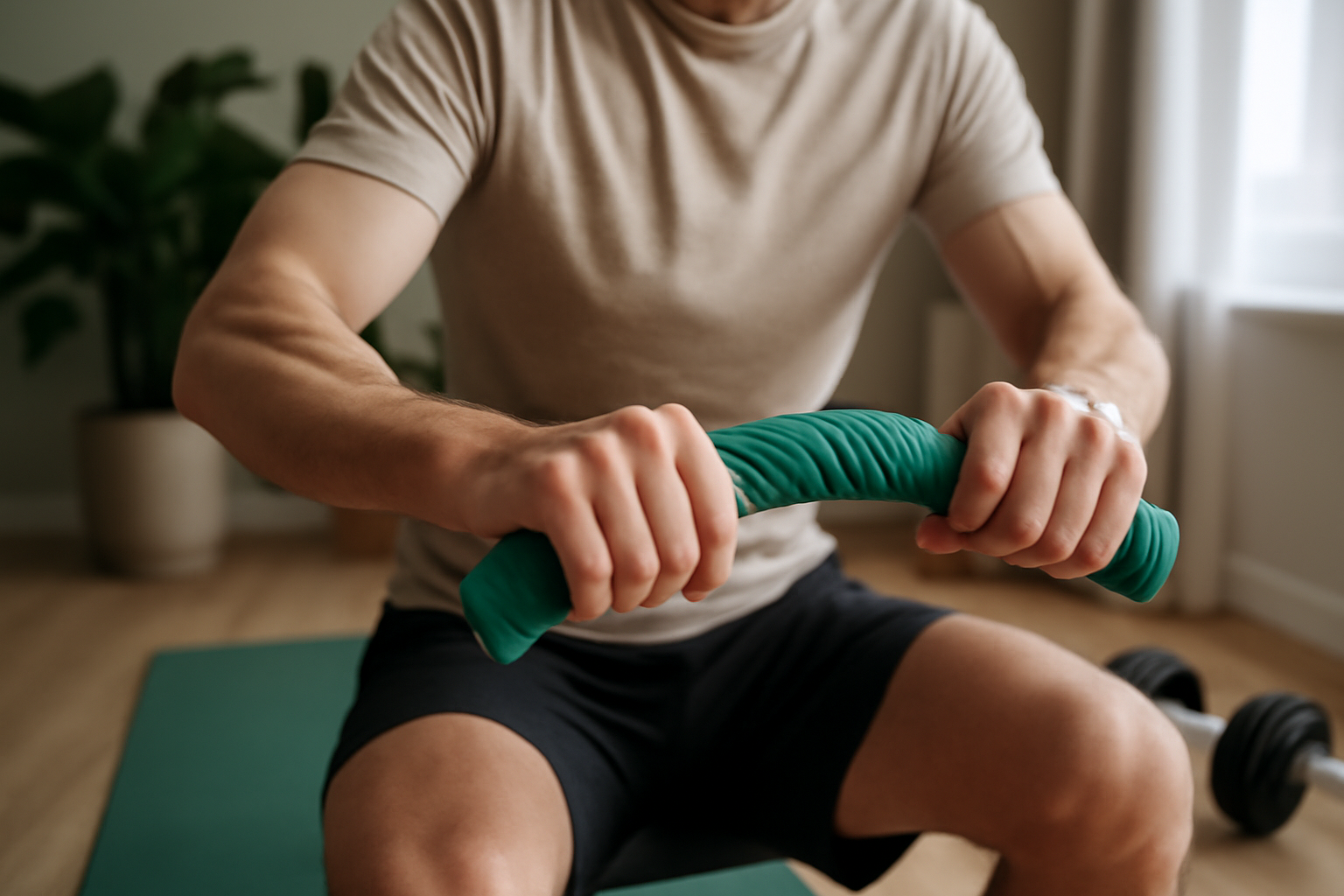
For the first two weeks, I performed three sets of fifteen Tyler Twist repetitions once daily. The Tyler Twist involves twisting the bar with both hands simultaneously — one hand pronating while the other supinates — which places an eccentric load on the wrist extensors. Eccentric loading, research suggests, is particularly effective for tendon rehabilitation.

Weeks three through six, I increased to twice daily sessions. Morning sessions happened before work, and evening sessions happened after dinner. Each session took about ten minutes total, including warm-up movements. In weeks seven and eight, I added wrist flexion and extension exercises using the bar’s flex resistance.

What I Tracked Each Week

  • Daily pain rating (1–10 scale, morning and evening)
  • Grip strength (measured informally by squeezing a stress ball)
  • Sleep quality — specifically how often elbow pain woke me up
  • Functional tasks: typing comfort, carrying bags, opening jars
  • Any soreness or increased pain after sessions

I continued seeing my physical therapist every two weeks throughout this period. She monitored my technique and adjusted the program as needed. Using the bar as a standalone treatment without any professional guidance is not something I would personally recommend.

What Actually Changed Over 8 Weeks

Week one produced no dramatic results. My elbow actually felt slightly more sore after the first few sessions. My therapist had warned me this might happen — a mild increase in discomfort during early eccentric loading is apparently normal. Still, it tested my patience.

By week three, something shifted. My morning pain rating dropped from a consistent seven to around a five. More importantly, I stopped waking up in the night from elbow pain. That sleep improvement alone felt significant after months of disrupted rest.

Week five brought the most noticeable progress. Typing for long stretches became far less uncomfortable. I noticed I was instinctively reaching for things without bracing for pain first. That behavioral change — not guarding the joint constantly — felt like a real turning point.

Results by Week 8

By the end of eight weeks, my daily pain rating had dropped from an average of seven down to about two. Grip strength felt noticeably restored in my right hand. Specifically, carrying grocery bags and opening jar lids no longer caused discomfort. My sleep had been uninterrupted for the final three weeks of testing.

In my experience, the THERABAND FlexBar Resistance Bar, Light, Red Flex Therapy Bar for Physical Therapy, Wrist & Forearm Exercise Equipment, Non Slip Grip, Compact Design delivered meaningful improvement. However, I want to be honest: results were gradual, not dramatic. Anyone expecting quick relief will likely be frustrated in the early weeks.

The research I referenced earlier aligns with my experience. That Journal of Orthopaedic & Sports Physical Therapy study reported that FlexBar users experienced roughly 81% reduction in pain at six-week follow-up — considerably better than the control group. My results were meaningful, though perhaps not quite that dramatic.

The Downsides You Should Know About

No product is perfect, and this one has genuine limitations worth discussing honestly.

First, the lack of included instructions is a real problem. Performing the Tyler Twist incorrectly can potentially worsen symptoms. Without guidance, most users will default to watching online videos — which works, but should not be necessary for a rehabilitation product.

Second, the early weeks of use genuinely felt discouraging. My pain slightly increased before it improved. Someone without professional guidance or prior knowledge of eccentric loading protocols might quit too early. That is a legitimate risk.

Third, this tool will not work in isolation for everyone. My improvement happened alongside continued physical therapy. On the other hand, I recognize not everyone has access to a PT. For people using this entirely alone, progress may be slower or less predictable.

Who This Product Won’t Work For

  • People expecting fast pain relief — this is a slow, gradual process
  • Those with severe or acute tendon tears (consult a doctor first)
  • Anyone unwilling to learn proper technique and commit to daily use
  • People who need heavier resistance from day one (red may feel too easy for some)
  • Those managing golfer’s elbow (medial epicondylitis) — a different exercise protocol applies

One more honest note: the bar gets slightly tacky in warm conditions. During summer sessions, I occasionally needed to wipe it down mid-exercise. It is a minor annoyance, not a dealbreaker, but worth mentioning.

Final Verdict: Is the TheraBand FlexBar Tennis Elbow Tool Worth It?

After eight weeks of consistent, structured use, my honest rating is 4.3 out of 5 stars. The TheraBand FlexBar tennis elbow rehabilitation bar genuinely delivered results I had not achieved through rest and compression alone. The clinical backing, the build quality, and the price point all make it an easy recommendation — with one important condition.

You must be willing to commit to daily use for at least six to eight weeks. Early results are modest. Patience and consistency are non-negotiable with this product.

Buy it if: you have confirmed lateral epicondylitis, you can access some professional guidance on technique, and you are prepared for a gradual recovery process. The THERABAND FlexBar Resistance Bar, Light, Red Flex Therapy Bar for Physical Therapy, Wrist & Forearm Exercise Equipment, Non Slip Grip, Compact Design is genuinely one of the more evidence-supported home rehab tools I have encountered at this price.

Skip it if: you want immediate relief, you have an acute injury that has not been properly diagnosed, or you are unwilling to invest time in learning correct technique.

Consider This Alternative: The TheraBand FlexBar 3-Pack

If you already know that resistance progression will be part of your recovery plan, consider the THERABAND FlexBar 3-Pack, Resistance Bars for Tennis Elbow & Grip Strength, Color-Coded Therapy Bars for Tendonitis & Golfer’s Elbow, Red, Green, Blue Exerciser. It includes red (light), green (medium), and blue (heavy) bars in a single purchase.

For someone further along in their recovery — or managing multiple conditions like golfer’s elbow alongside tennis elbow — the 3-pack offers long-term value. However, for most people starting out, the single red bar is the smarter, lower-commitment entry point. Build the habit first, then progress from there.