This post contains affiliate links. As an Amazon Associate, I earn from qualifying purchases at no extra cost to you.
I am not a medical professional. The experiences shared here are personal. Consult your doctor before starting any new treatment.
Every evening around 7 p.m., my right shoulder would lock up like a rusted hinge. The stiffness started gradually, about eighteen months ago. At first, I blamed it on bad posture at my desk. Then I blamed my mattress. Eventually, I stopped blaming anything and just accepted the dull, grinding ache as part of my routine. Reaching across my body felt like pulling a seatbelt that had locked. Rolling my shoulder in circles helped slightly, but the relief never lasted more than a few minutes. That cycle of temporary relief and returning stiffness was exhausting. Finding a real solution for Theragun Mini shoulder joint stiffness eventually became my evening mission.
I tried heat packs. I tried a foam roller wedged awkwardly against the wall. A friend suggested stretching bands, which helped my range of motion but did nothing for the deep tissue tightness. My doctor confirmed there was no structural damage — just chronic muscle tension around the joint, likely from prolonged sitting and old scar tissue from a minor injury years ago. That diagnosis was reassuring, but it also left me without a clear treatment path. I needed something practical, portable, and consistent enough that I would actually use it every single day.
Why I Chose the TheraGun Mini (3rd Generation)
Percussion therapy kept coming up in my research. Specifically, I found a 2020 study published in the Journal of Clinical and Diagnostic Research suggesting that vibration therapy can reduce delayed onset muscle soreness and improve blood circulation in targeted tissue. That caught my attention. However, full-sized massage guns felt like overkill for my situation. Many of them are heavy, loud, and frankly intimidating for someone just trying to wind down before bed.
The TheraGun Mini (3rd Generation) by Therabody kept appearing at the top of recommendations for portability and ease of use. Its compact size was the first thing that appealed to me. So was the price point relative to larger Therabody models. Several physical therapists I follow online mentioned it specifically for people dealing with shoulder and neck tension rather than post-workout recovery. That audience felt much closer to my situation. I also appreciated that Therabody as a brand has clinical roots — they partner with sports medicine professionals and have published their own white papers on percussive therapy protocols.
On the other hand, I did consider the larger TheraGun Relief by Therabody briefly. That model is designed specifically for everyday pain relief and has an ergonomic handle. Ultimately, the Mini’s pocketable form factor won me over. I travel for work monthly, and dragging a full-sized device through airport security felt like a non-starter.
First Impressions: Unboxing and Build Quality
The box arrived in two days. Opening it felt satisfyingly premium — the device sits in a molded tray with a USB-C charging cable and one attachment head pre-installed. The build quality surprised me immediately. It feels solid and dense in the hand, not plasticky. The matte black finish is clean and understated. Nothing about it screams “medical device,” which I appreciated.
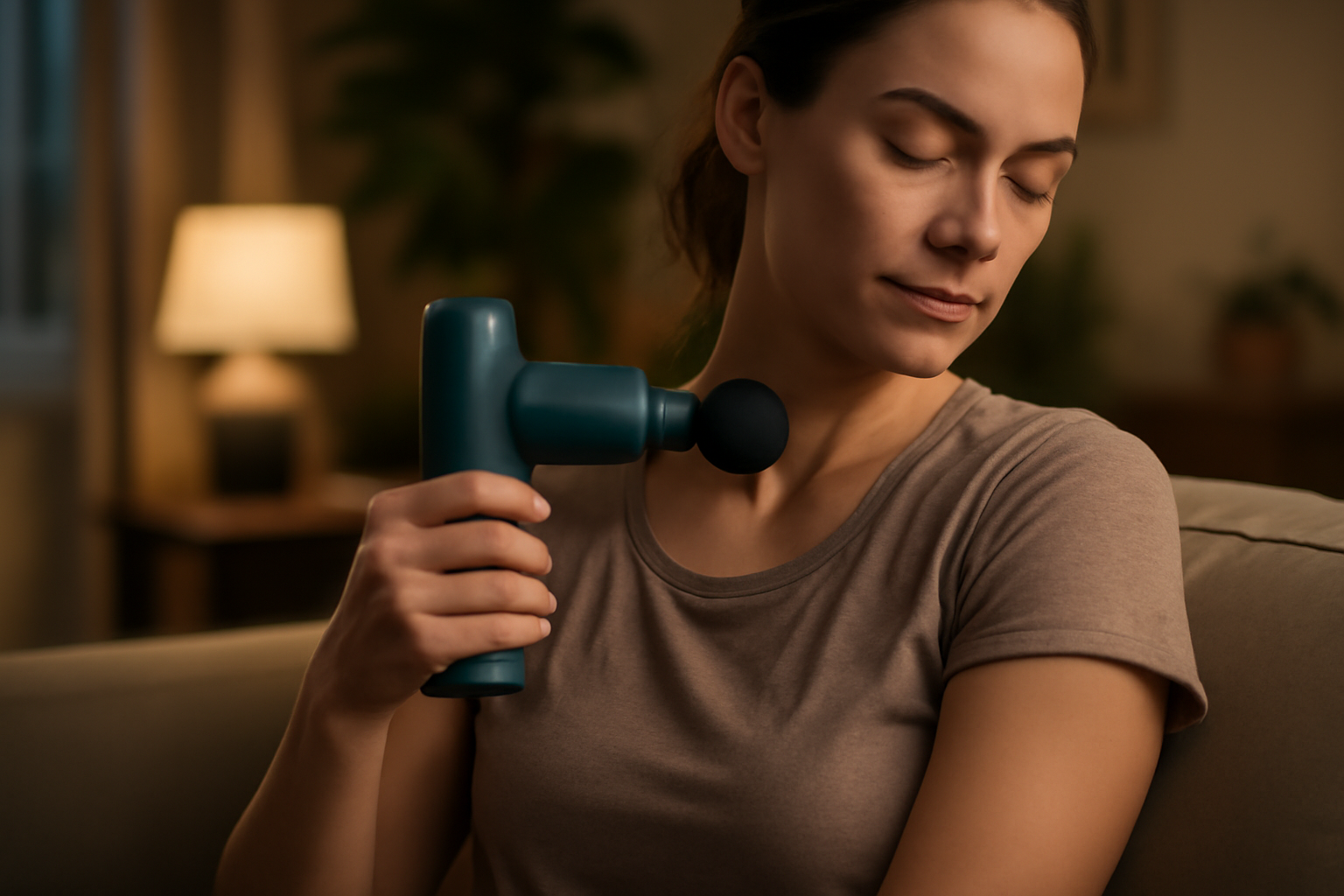
The device is genuinely small. It fits in my palm without any part hanging over the edge. Weighing around 1.43 pounds, it is light enough to hold at shoulder height without my arm fatiguing quickly. That detail matters more than you might think. If a device is too heavy, you rush the session just to put it down. With the Mini, I could hold it comfortably for a full two-minute shoulder session without strain.
Setup was effortless. Charge the device, press the single button to power on, press again to cycle through the three speed settings. That simplicity was a relief. No app required for basic use, no Bluetooth pairing necessary unless you want guided routines. For my purposes, I kept it straightforward.
Noise Level and Speed Settings
I tested it at 9 p.m. on the first night, with my partner already winding down nearby. The noise level on the lowest setting was genuinely quiet — closer to a soft hum than the jackhammer sound I associated with massage guns. The highest setting is louder but still manageable. In my experience, the middle speed became my default almost immediately. It delivered enough percussive depth to feel effective without feeling aggressive.
My 6-Week Testing Protocol for Theragun Mini Shoulder Joint Stiffness
I committed to a structured six-week trial. Consistency was the whole point. I used the device every evening, seven days a week, approximately 30 minutes before bed. Each session lasted between eight and twelve minutes total.
My routine looked like this:
- Two minutes on the trapezius muscle along the top of my shoulder
- Two minutes on the posterior deltoid and rear shoulder capsule
- Two minutes moving slowly along the side of my neck toward the shoulder blade
- One to two minutes on my upper arm near the shoulder insertion point
I avoided pressing directly on the joint itself and kept the device moving at all times, as recommended in Therabody’s usage guidelines. I tracked three things each day: my perceived stiffness on a scale of one to ten before and after each session, my sleep quality using my phone’s sleep tracker, and how far I could rotate my arm across my body without discomfort.
Adding the Therabody App (Weeks Three and Four)
Midway through the trial, I downloaded the Therabody app and synced it with the device via Bluetooth. The app offers guided routines for specific body areas. I found the shoulder and neck routine useful for correcting my technique. Specifically, I realized I had been spending too much time in one spot rather than gliding slowly. That small adjustment made a noticeable difference in how the sessions felt afterward.
What Actually Changed: My Honest Results
Week one was underwhelming, I will be honest. My stiffness scores before and after sessions barely moved. I went from a 7 to a 6 most nights. The shoulder felt slightly warmer and looser immediately after each session, but by morning the tightness had returned fully. I questioned whether I had made a smart purchase.
Week two brought the first real signal. My pre-session stiffness scores started dropping. Instead of beginning at a 7, I was starting at a 5 or 6. That suggested something cumulative was happening — not just temporary relief during the session itself. Research supports this idea. A study in the Journal of Sports Science and Medicine found that repeated percussive therapy sessions over multiple days showed greater range-of-motion improvements than single-session treatments.
By week four, I noticed something unexpected: my sleep was measurably better. My phone’s sleep tracker showed fewer nighttime movement events on days I used the device versus the occasional rest day. That surprised me. In my experience, the shoulder tension had been disrupting my sleep more than I realized. Releasing that tension before bed seemed to help my body settle faster.
At the six-week mark, my arm rotation across my body had improved noticeably. I could reach further without the sharp catch sensation that had become my baseline. My average pre-session stiffness score had dropped from 7 to around 3.5. That is a meaningful shift for something I use every evening at home without any professional intervention.
What Did Not Change
Complete elimination of stiffness did not happen. Morning tightness still exists, though it is milder than before. The device addresses tension in the surrounding muscles, not the joint itself. That distinction matters. If your stiffness stems from the joint structure rather than muscle tightness, your results may differ significantly from mine.
The Downsides You Should Know Before Buying
The TheraGun Mini (3rd Generation) by Therabody has real limitations worth discussing honestly.
First, it ships with only one attachment head. Larger Therabody models include multiple heads for different tissue types. The standard ball attachment works well for shoulders. However, if you also want to use it on bony areas or for pinpoint trigger point work, you will need to purchase additional attachments separately. That adds cost.
Second, the battery life is rated at approximately 150 minutes. For my nightly sessions, that translates to roughly two weeks per charge. That is perfectly adequate. Still, if you forget to charge it, you will notice — it gives no low-battery warning sound, just dies mid-session.
Third, reaching the back of your own shoulder is awkward. That is not a design flaw unique to this device — it is an anatomical reality. I solved it by pressing the device gently against a doorframe to angle it toward my rear deltoid. However, it is worth acknowledging that self-application on hard-to-reach spots requires some creativity.
Finally, this device will not suit everyone with joint stiffness. People with inflammatory arthritis, bursitis, or acute injuries should consult a physician before using percussion therapy near affected joints. The device itself includes this caution in the documentation, and it is worth taking seriously.
Final Verdict: Who Should Buy the Theragun Mini for Shoulder Joint Stiffness
After six weeks of consistent evening use, I believe the TheraGun Mini (3rd Generation) by Therabody is genuinely effective for muscle-related shoulder tension when used consistently over multiple weeks. It is not a one-session fix. Results build gradually and require patience during the first two weeks especially.
For Theragun Mini shoulder joint stiffness relief specifically, this device earns a strong recommendation with one important caveat: your stiffness needs to be muscle-tension-driven rather than structural. If your doctor has confirmed no acute damage and the issue is chronic tightness, this is one of the most practical and portable tools available at this price point.
Buy It If:
- You have chronic shoulder or neck muscle tension without acute injury
- You travel frequently and want a device that fits in a carry-on easily
- You prefer a simple, low-maintenance device with minimal setup
- You will commit to consistent daily use rather than occasional sessions
Skip It If:
- You need multiple attachment heads from the start
- You are dealing with an acute or inflammatory joint condition
- You want deep tissue work on large muscle groups like quads or hamstrings
- You prefer a full ergonomic handle for extended body-wide use
My overall rating: 4.3 out of 5. The Mini loses points only for the single included attachment and the lack of a low-battery alert. Everything else — size, noise level, build quality, and cumulative results — exceeded my expectations for a compact device.
The Runner-Up Alternative Worth Considering
If portability is less of a priority for you, consider the TheraGun Relief by Therabody. This navy-colored model is specifically designed for everyday pain relief rather than athletic recovery. Its ergonomic handle makes self-application easier on difficult-to-reach spots like the rear shoulder. It is slightly larger and heavier than the Mini, but that added size brings better leverage for solo use. For someone who primarily uses their device at home and wants maximum comfort during sessions, the Relief model is a strong alternative worth comparing.