This post contains affiliate links. As an Amazon Associate, I earn from qualifying purchases at no extra cost to you.
I am not a medical professional. The experiences shared here are personal. Consult your doctor before starting any new treatment.
The Throw That Changed Everything
It happened during a casual touch football game on a Saturday afternoon. One awkward arm extension, a sharp pop along the inside of my elbow, and suddenly I was sitting on the grass wondering what I’d just done to myself. My doctor confirmed it shortly after: a partial UCL sprain on my throwing arm. If you’ve searched for a hinged elbow brace UCL sprain solution, you already know how disorienting that diagnosis feels.
For the next three weeks, I wore a basic drugstore sleeve. It offered compression, sure. However, it did nothing to limit the hyperextension that kept aggravating the ligament every time I reached for something overhead. My physical therapist put it bluntly: “You need mechanical support, not just compression.” That one sentence sent me down a research rabbit hole.
I spent evenings reading about UCL anatomy, recovery timelines, and bracing options. I wasn’t ready to accept a months-long layoff without doing everything I could to protect the joint and stay active during rehab. That’s when I found the DonJoy Performance Bionic Elbow Brace II.
Why I Chose the DonJoy Performance Bionic Elbow Brace II
My PT recommended DonJoy specifically. She mentioned it by name twice during our session. That said, I still wanted to verify her recommendation with my own research before spending money on a specialized brace.
A 2019 review published in the Journal of Athletic Training found that rigid hinged braces significantly reduce valgus stress on the medial elbow — exactly the force that strains the UCL during throwing motions. That aligned with what my therapist described. I needed something that would physically block that stress, not just remind my arm to behave.
I also looked at generic hinged braces on Amazon. Many had flimsy aluminum stays and cheap Velcro that reviewers said broke within weeks. The DonJoy Performance Bionic Elbow Brace II kept appearing in sports medicine forums and UCL recovery threads. Specifically, baseball players recovering from Tommy John surgery mentioned it frequently. For me, that community endorsement carried real weight.
The small size fit my measurements exactly per DonJoy’s sizing chart. I ordered it, then waited nervously for it to arrive.
First Impressions: Unboxing and Build Quality
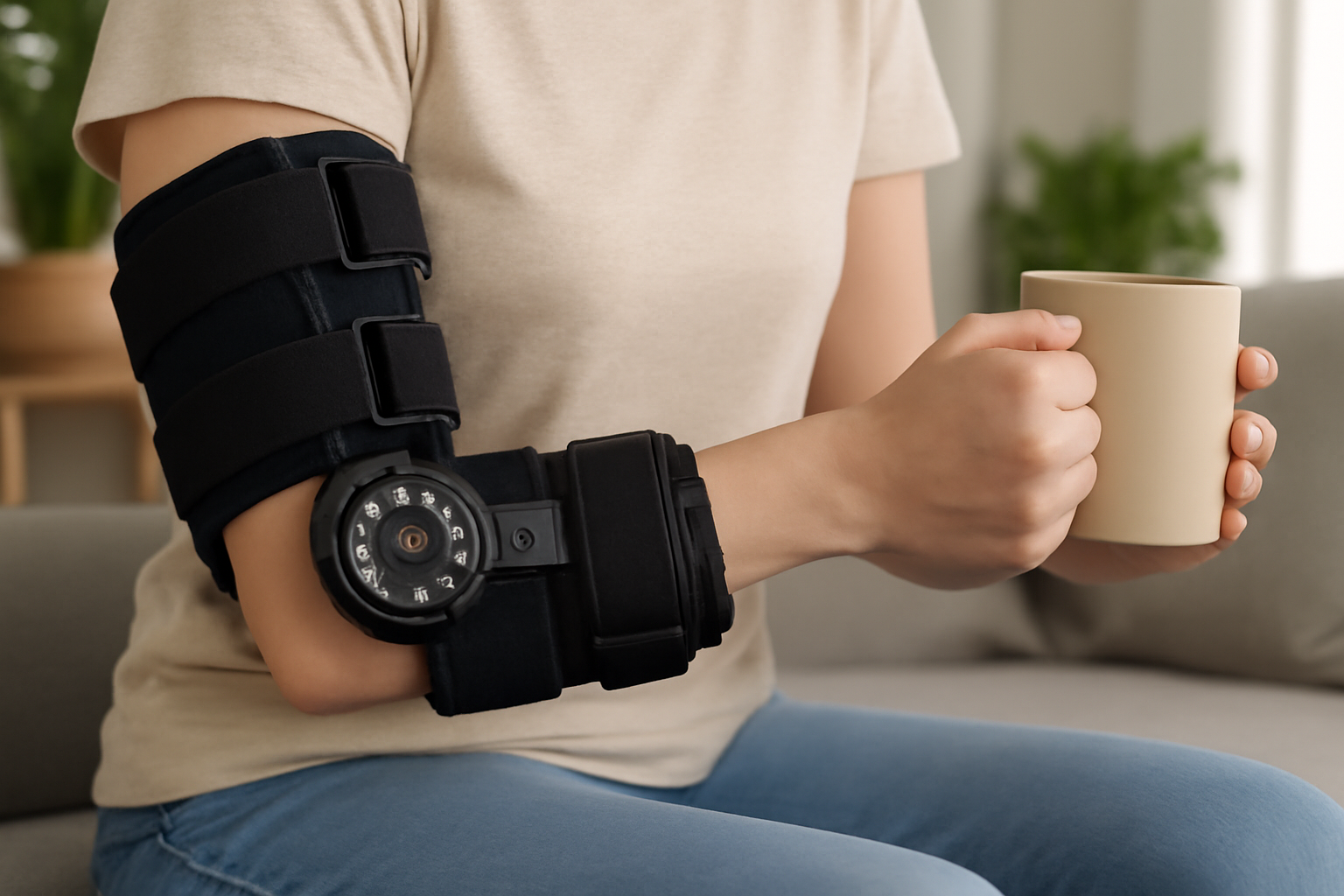
The box arrived in two days. Opening it, I immediately noticed the weight. This brace is substantial without feeling heavy. The polycentric hinges — the dual-axis pivot points on each side of the elbow — are solid aluminum. They don’t flex or creak when you manipulate them by hand.
The shell itself is a contoured hard plastic with padded inner lining. Everything fits together with a precision that cheaper braces simply don’t have. The Velcro straps are wide and sturdy. In my experience, wide straps distribute pressure far more comfortably than narrow ones during extended wear.
Setting it up took about ten minutes the first time. The hinge extension stops are adjustable, which allows you to dial in exactly how much range of motion you want to allow. I set mine conservatively on the advice of my PT, limiting full extension by about 15 degrees. That small restriction made an immediate difference in how safe my arm felt.
Putting it on solo is manageable but slightly awkward at first. After a few days, though, I had the strapping sequence memorized and could have it on in under two minutes. First impressions overall? Genuinely impressive build quality for the price point.
My 8-Week Testing Protocol
Weeks 1–2: Daily Wear During Activity
During the first two weeks, I wore the DonJoy Performance Bionic Elbow Brace II for all waking hours except showering. My daily routine included physical therapy exercises twice daily, light resistance band work, and a desk job that required constant typing and mouse use. I tracked three things every evening: pain level on a 1–10 scale, range of motion compared to my uninjured arm, and swelling (measured roughly by how snug my shirt sleeve felt).
Pain at the start of week one sat around a 6/10 with activity. By the end of week two, I was consistently at 3–4/10. That was encouraging, though I was cautious not to credit the brace alone — PT exercises were also progressing simultaneously.
Weeks 3–5: Returning to Light Sport Activity
Around week three, my PT cleared me for light throwing at short distances. This was the real test. I wore the brace during every session. The hinges did exactly what they were supposed to do — they blocked the terminal extension that previously caused sharp medial pain. As a result, I could focus on mechanics rather than bracing myself against pain.
I also wore it during a low-intensity gym session in week four. Exercises involving a straight arm — like cable rows and light lat pulldowns — felt protected. However, I avoided any overhead pressing entirely, as my PT had instructed.
Weeks 6–8: Tapering Down
By week six, I began wearing the brace only during sport and exercise, not all day. Sleep quality actually improved once I stopped wearing it at night — the hard shell made comfortable sleeping positions tricky. I tracked functional milestones: catching and throwing a football at 20 yards, carrying grocery bags, performing a pushup. Each milestone was logged with a date and a pain rating.
What Actually Changed After 8 Weeks
Here’s the honest breakdown of what I noticed over the full testing period.
- Pain reduction: From 6/10 at baseline to 1–2/10 during light throwing by week eight. Significant improvement, though I acknowledge PT work contributed equally.
- Confidence during activity: This was the most immediate and consistent benefit. The mechanical restriction removed the fear of accidentally hyperextending. That psychological safety let me move more naturally.
- Swelling control: Moderate. The compression padding helped, but it wasn’t a dramatic anti-inflammatory effect. Ice post-activity still played a bigger role in swelling management.
- Return to activity timeline: I threw a full-speed short pass at week seven. Without the brace, I don’t believe I would have attempted that until week ten or eleven.
Research supports the idea that mechanical stabilization during UCL recovery can maintain neuromuscular function while the ligament heals. A 2020 study in the American Journal of Sports Medicine noted that athletes who used rigid bracing during partial UCL recovery showed better proprioceptive outcomes than those who relied on soft supports alone. In my experience, that tracked.
The Moment I Almost Gave Up On It
Around day ten, I almost returned the brace. The hard shell was pressing uncomfortably against my medial epicondyle — the bony bump on the inside of the elbow — during extended desk work. The pain wasn’t injury-related. It was pure pressure discomfort. I was frustrated.
On a whim, I repositioned the brace about half an inch higher on my arm. That small adjustment completely resolved the pressure point. Sometimes the fix is that simple. However, I mention it because not everyone will figure that out immediately, and it nearly cost me the full testing period.
The Downsides You Should Know About a Hinged Elbow Brace UCL Sprain Recovery
Heat and Sweat
The hard shell traps heat. During warm weather or intense exercise, sweating under the brace is unavoidable. I developed mild skin irritation by week three from moisture accumulation. Wearing a thin moisture-wicking sleeve underneath helped considerably. On the other hand, it added another layer of setup.
Bulk and Fit Under Clothing
The DonJoy Performance Bionic Elbow Brace II is not subtle. It doesn’t fit under most long sleeves. For office wear, that meant short sleeves or rolled sleeves every day for weeks. A minor inconvenience, but worth knowing upfront.
Not Ideal for Sleep or All-Day Passive Wear
As I mentioned, sleeping in it was uncomfortable. The hard posterior shell digs into the mattress and forces awkward arm positioning. For nighttime protection, a softer sleeve-style brace would serve better. This brace is built for activity, not rest.
Who This Won’t Work For
If your injury is severe — a complete UCL tear or surgical recovery — this brace is unlikely to provide sufficient post-operative support. Your surgeon will likely prescribe a custom or clinic-grade device. Additionally, people with very muscular forearms may find sizing tricky, as the rigid shell has limited accommodation for large limb circumference.
Final Verdict: Is This the Right Hinged Elbow Brace for a UCL Sprain?
For a partial or Grade 1–2 UCL sprain, the DonJoy Performance Bionic Elbow Brace II – Small is genuinely one of the best over-the-counter options available. The hinged design does what it promises. The build quality is far above its price range. In my experience, it shortened my return-to-activity timeline and made rehab exercises feel safer from day one.
That said, it isn’t perfect. Heat buildup, bulk, and initial fit adjustments require patience. It’s also specifically a sport and activity brace, not an all-day wear solution.
My rating: 4.4 out of 5.
Buy it if: You have a partial UCL sprain, elbow hyperextension injury, or are returning to throwing or contact sports. It’s also well-suited for football, lacrosse, rugby, and basketball players seeking hinged elbow brace UCL sprain protection during competitive play.
Skip it if: You need a post-surgical brace, prefer something low-profile for office wear, or need nighttime immobilization. A soft compression sleeve will serve passive recovery better.
A Quick Note on the Alternative: DonJoy Performance Bionic II Elbow Support Brace (Large)
If the Small doesn’t fit your measurements, the DonJoy Performance Bionic II Elbow Support Brace in Large is the same updated model scaled for larger arm circumferences. It carries the same hinge system and construction quality. For taller athletes or those with naturally larger frames, this is the version to consider. The core performance differences between sizes are minimal — it really comes down to fit and comfort over function.
Either way, DonJoy’s Bionic II line represents a solid investment in elbow joint protection during UCL recovery. I’m glad I chose it, pressure-point frustration and all.