This post contains affiliate links. As an Amazon Associate, I earn from qualifying purchases at no extra cost to you.
I am not a medical professional. The experiences shared here are personal. Consult your doctor before starting any new treatment.
Every morning for nearly two years, I woke up with a deep, nagging ache in my left glute. It radiated down my hamstring and made sitting at my desk feel like a punishment. My physical therapist suspected piriformis tightness. She mentioned lacrosse ball piriformis release as something I could do at home between sessions. I nodded, went home, and promptly did nothing about it for three more months.
Eventually, the discomfort started affecting my sleep. Lying on my left side became impossible. That was my tipping point. I finally decided to take the self-myofascial release route seriously and ordered a set to try.
What followed was four weeks of consistent, sometimes uncomfortable, and ultimately eye-opening work. Here is exactly what happened.
Why I Chose the Massage Lacrosse Balls for Myofascial Release, Trigger Point Therapy, Muscle Knots, and Yoga Therapy
I did not pick the first lacrosse ball I found. In fact, I spent more time researching than I care to admit. My physical therapist recommended a firm ball over a softer foam roller for targeting the piriformis specifically. The piriformis sits deep beneath the gluteal muscles. Reaching it requires something small, dense, and unyielding.
Several forums pointed me toward the Massage Lacrosse Balls for Myofascial Release, Trigger Point Therapy, Muscle Knots, and Yoga Therapy. Set of 2 Firm Balls (Blue and Red). The two-ball set was a practical draw. Having two meant I could experiment with placement and firmness without buying separately.
Research also nudged me in this direction. A 2015 study published in the Journal of Athletic Training found that self-myofascial release with a lacrosse-style ball improved hip range of motion compared to no treatment. That was enough for me to commit.
First Impressions: Unboxing and Build Quality
The package arrived in two days. Inside were two solid rubber balls — one blue, one red. Both measure the standard lacrosse ball diameter of approximately 2.5 inches. They came in a simple mesh bag, which I still use to keep them together in my home office.
My first impression was density. These are not soft. Squeezing one reveals almost no give at all. That intimidated me slightly at first. However, I quickly understood why that firmness matters for deep-tissue work.
The surface texture is smooth but grippy. It does not slide across hardwood floors, which I appreciated immediately. The build quality feels solid and consistent between both balls. There are no seams, no rough patches, and no smell. Some rubber products arrive with a strong chemical odor. These did not.
One small observation: both balls feel identical in firmness. The color difference appears purely cosmetic. That said, having two is still useful. I often place one under each hip when I want symmetrical work.
My 4-Week Lacrosse Ball Piriformis Release Testing Protocol
I followed a consistent routine from day one. Structure matters when you are trying to track changes honestly. Here is what my protocol looked like:
- Frequency: Once daily, six days per week
- Duration per session: 8 to 10 minutes total
- Timing: Every morning before sitting down at my desk
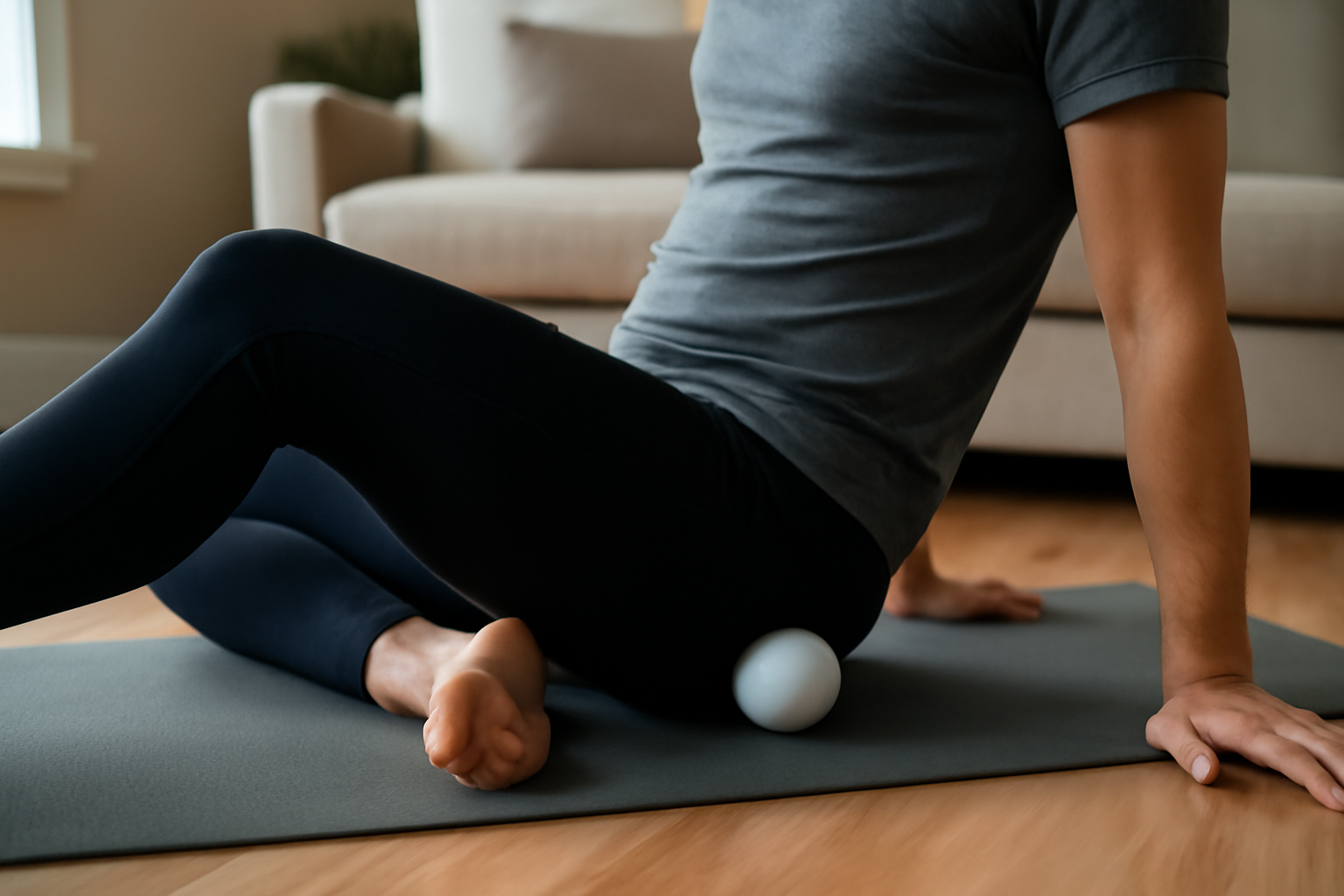
- Position: Seated on the floor, ball placed under left glute, foot crossed over opposite knee to externally rotate the hip
- Technique: Slow, deliberate pressure on tender spots for 30 to 60 seconds each
- Tracking: I rated my morning discomfort on a 1-to-10 scale before and after each session
I also tracked two secondary markers: how long I could sit comfortably before discomfort started, and whether I could sleep on my left side. Both had been problems before I started.
My baseline sitting tolerance was about 25 minutes before the ache intensified. Sleeping on my left side was almost completely off the table. Those were my benchmarks.
How I Actually Used the Ball Each Session
Each morning, I sat on a yoga mat with the ball positioned just to the inside of my left sit bone. Slightly crossing my left ankle over my right knee opened the hip and increased pressure on the piriformis area. I moved slowly, searching for tender spots.
When I found one, I held still and breathed. The discomfort was real — not sharp, but a deep, satisfying pressure that my PT had called “good pain.” I held each spot for 30 to 60 seconds. Then I moved on.
On some days I worked standing against a wall instead. Placing the ball between the wall and my glute gave me better control over how much weight I applied. That variation helped on mornings when the floor felt too intense.
What Actually Changed Over 4 Weeks
Week one was humbling. My baseline pain rating averaged a 6 out of 10 each morning. The ball sessions were uncomfortable, and I honestly questioned whether I was doing anything useful. Results felt nonexistent.
By the end of week two, something shifted. My morning pain score dropped consistently to around a 4. More noticeably, I could sit at my desk for nearly 40 minutes before discomfort returned. That was a 15-minute improvement. Small, but real.
Weeks Three and Four: Noticeable Progress
Week three brought the clearest change. On day 19, I woke up and realized I had slept on my left side without waking. That had not happened in months. My morning pain rating that day was a 3.
By week four, my average morning pain score had settled around 2.5. Sitting tolerance had climbed to roughly 55 minutes. The radiating sensation down my hamstring had become infrequent rather than constant. In my experience, consistent daily use made the biggest difference.
Research supports the idea that regular myofascial release can reduce perceived pain and improve tissue pliability. A review in the Journal of Bodywork and Movement Therapies noted that sustained pressure on myofascial trigger points reduces local muscle hypertonicity over time. That aligns closely with what I felt happening.
I also noticed improved hip mobility. Crossing my left leg while seated became easier. Getting up from low chairs stopped requiring the careful, braced movement I had grown used to.
The Downsides You Should Know Before Buying
Honesty matters here. This tool is not magical. There were real frustrations along the way.
First, the learning curve. Positioning for the piriformis is genuinely tricky. The muscle sits deep, and finding it with a ball takes practice. During week one, I was often unsure I was hitting the right spot at all. Without guidance from my PT, I might have given up.
Second, the firmness that makes this ball effective can feel punishing if your soft tissue is very sensitive. On flare-up days, even light pressure felt excessive. I had to modify by using less body weight or switching to the wall technique.
Who This Product May Not Suit
This ball set is not ideal for everyone. Specifically, consider skipping it if:
- You have been diagnosed with sciatica from a herniated disc — pressure in the wrong spot could aggravate symptoms
- You are dealing with bursitis in the hip area — firm pressure may worsen inflammation
- You prefer a guided, progressive approach — these balls require you to self-direct, which demands some body awareness
- You need something softer for general relaxation — these are genuinely firm
Also worth mentioning: these balls did not eliminate my discomfort entirely. By week four, I felt significantly better. However, some residual tightness remained. In my experience, this tool works best as part of a broader routine — stretching, movement, and ideally professional guidance alongside it.
Final Verdict: Is the Massage Lacrosse Balls Set Worth It?
After four weeks of consistent lacrosse ball piriformis release work, I can say with confidence that this product delivered real, measurable improvements for me. My morning pain dropped from a 6 to around a 2.5. Sitting tolerance more than doubled. Sleep quality improved meaningfully. Those are not trivial changes.
The Massage Lacrosse Balls for Myofascial Release, Trigger Point Therapy, Muscle Knots, and Yoga Therapy. Set of 2 Firm Balls (Blue and Red) earns a strong recommendation from me — with one important caveat. You need to be willing to learn proper technique and use it consistently. Results do not come from casual, infrequent use.
My Rating: 4.5 out of 5
Buy this if: You have piriformis tightness, hip stiffness, or glute-area tension. You are willing to use it daily and learn correct positioning. You want an affordable, durable home recovery tool that lasts.
Skip this if: You have an acute injury or active inflammation. You want something gentler. You prefer fully guided recovery tools with built-in feedback.
For the price of a single co-pay, this set has genuinely supported my joint health routine. That matters a lot to me.
A Runner-Up Worth Considering
If you want a single ball rather than a set, or you prefer a product marketed more specifically for hip and joint work, consider the Lacrosse Ball Massage Ball for Myofascial & Trigger Point Release, Muscle Knots, Yoga Therapy – Improves Joint Mobility & Relieves Pain – Back, Neck, Chest, HIPS, Legs – 2.5-Inch Solid Blue Rubber.
It is a solid alternative at a similar firmness level. The single-ball format suits those who want a simpler option. That said, I personally preferred having two balls for symmetrical work and positional variety. The set I used remains my first recommendation for piriformis-specific relief.