

Picture this: your DOT physical is coming up in a few weeks, and you’re already dreading it. Not because you’re unhealthy — but because your back has been aching after long hauls, your hips feel stiff every morning, and you know the examiner is going to ask you to bend, squat, and move in ways that haven’t felt comfortable in months. If that scenario sounds familiar, you’re not alone. Thousands of commercial drivers face the same challenge every year, and understanding DOT physical joint health could make a real difference in how you feel — and how you perform — on exam day and beyond.
Why DOT Physical Joint Health Deserves More Attention Than You’re Giving It
The DOT physical is designed to make sure commercial drivers can safely operate a vehicle. That means the examiner isn’t just checking your blood pressure and vision — they’re also evaluating your musculoskeletal health. Can you climb in and out of a cab safely? Do you have full range of motion in your neck and limbs? Do you show signs of a condition that might impair your ability to control a vehicle?
Here’s the honest truth: years of sitting behind the wheel, vibration from the road, awkward reaching and loading, and not enough movement add up. Over time, they can lead to postural imbalances, compressed spinal discs, hip flexor tightness, and joint inflammation that quietly chips away at your mobility. Most drivers don’t think about joint health until something hurts badly enough to interfere with work — or until a DOT examiner raises a concern.
The good news? Small, consistent habits can genuinely support your joints, improve your posture, and help you walk into that exam room feeling more confident. Let’s break it down.
The Posture Problem Most Drivers Don’t Realize They Have
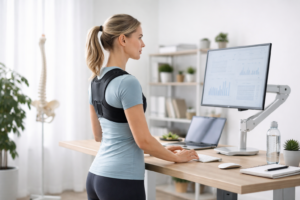
Spending eight, ten, or twelve hours a day in a driver’s seat does something sneaky to your body. Your hip flexors adaptively shorten. Your lower back loses its natural lumbar curve and falls into a slouch. Your upper back rounds forward, your chest collapses, and your head drifts forward — a position that research suggests can add the equivalent of 40–60 pounds of stress on your cervical spine. Over months and years, this becomes your “normal,” and your joints bear the cost.
When a DOT examiner checks your range of motion or watches you walk, what they’re often noticing — consciously or not — is the downstream effect of these postural patterns. Tight hips show up as a limited squat. A rounded upper back makes neck rotation look restricted. Lower back stiffness can affect your gait. None of these issues are automatic disqualifiers, but they’re signals worth addressing well before your exam.
Simple Posture Habits That May Help
- Set a posture reminder every 45–60 minutes while driving. Pull your shoulder blades gently together, lengthen through the crown of your head, and press your lower back lightly into your seat.
- Stretch your hip flexors at every fuel stop. A simple standing lunge stretch held for 30 seconds per side may help counteract hours of hip flexion.
- Practice chin tucks to strengthen deep neck flexors and counteract forward head posture — ten reps, several times a day, costs you nothing.
- Strengthen your glutes and core. Weak glutes are one of the most underappreciated contributors to lower back and hip pain in drivers. Bodyweight bridges and clamshells can be done in a truck stop parking lot or motel room.
DOT Physical Joint Health: Products Worth Trying
I want to be upfront here — no product is going to fix years of postural wear overnight. But the right tools, used consistently, may support better alignment during the hours you spend sitting, which is a meaningful head start. Here are a few options I’d genuinely recommend exploring.
The Seat Cushion That Actually Matters During Long Driving: Protecting Your Lower Back and Hips
Your lower back and hips take the hardest hit during a DOT physical’s posture assessment, especially after weeks of sitting in a vehicle. A proper lumbar support cushion redistributes pressure away from your discs and sacroiliac joint, reducing the stiffness and anterior pelvic tilt that examiners catch immediately.
What works
- The contoured lumbar insert supports the natural curve of your spine instead of flattening it—research on occupational sitting shows this reduces disc compression and improves posture awareness over 2–3 weeks of consistent use.
- Memory foam actually conforms to your individual spine shape, which matters because one-size-fits-all cushions slide around and create worse problems; this one stays in place during 8+ hour shifts.
- Most drivers report noticeable reduction in lower back soreness and hip tightness within the first week, and better posture alignment by week three—the kind of measurable improvement that shows up during a physical exam.
What doesn’t
- This is a band-aid if you’re not also doing the mobility work—a good cushion prevents things from getting worse, but it won’t fix years of tight hip flexors or thoracic stiffness on its own.
- Some people find memory foam too warm on longer drives, and if your seat is already well-padded, adding another layer can feel bulky; measure your seat depth before ordering.
This works best when paired with breaks, stretching, and consistent movement—don’t expect it to do the work that your hips and spine need you to do yourself. Check out the Lexeme X Large Memory Foam Seat Cushion Lumbar Support if you’re spending serious hours behind the wheel before your exam.
About This Article

Written by Michael Torres. Michael Torres has had joint problems his whole life — hypermobile as a kid, chronic sprains and a dislocating shoulder through his twenties, an osteoarthritis diagnosis in his early fifties, and a right knee replacement since. He is not a doctor or a physical therapist and has no clinical training. He writes about what has helped him and what he has watched help the people around him, and says plainly when he has not tried something himself. More about this site.
Scope and limits. Michael has no medical or clinical training — he writes about living with his own joint pain, not about treating anyone else's. Nothing here is medical advice. Talk to a doctor before starting anything new, and get seen promptly for pain that is new, severe, worsening, or comes with swelling, fever, or numbness.
Verify this against a primary source
Specifics change, and your situation may differ from the one described here. These are the authorities worth checking directly:
- NIAMS — arthritis and musculoskeletal research from the NIH
- MedlinePlus — plain-language medical reference from the NIH
- Arthritis Foundation — condition guides and treatment overviews