
You’ve been telling everyone it’s your lower back. You’ve tried stretching your hamstrings, foam rolling your lumbar spine, maybe even sleeping with a pillow between your knees — and yet that deep, nagging ache on one side of your lower back and hip just won’t quit. Sound familiar? If so, there’s a good chance what you’re dealing with isn’t a classic back problem at all. It might be your sacroiliac joint — and if you’ve recently started researching an SI joint pain relief belt, you’re probably already on the right track toward understanding what’s really going on.
What Is the SI Joint and Why Does It Cause So Much Confusion?
The sacroiliac (SI) joint sits right where your spine meets your pelvis — you can actually feel the area if you press your thumbs into those two dimples just above your tailbone. There are two of them, one on each side, and they do something most people don’t realize: they absorb shock and transfer load between your upper and lower body every single time you walk, climb stairs, or shift your weight.
Here’s why SI joint dysfunction gets misdiagnosed so often: the pain it produces can show up almost anywhere in that entire lower quadrant of your body. We’re talking about one-sided lower back pain, hip pain, buttock pain, and even pain that radiates down the leg in a way that mimics sciatica. It’s no wonder so many people spend months treating the wrong thing.
Research suggests that SI joint dysfunction may account for somewhere between 15% and 30% of chronic lower back pain cases. That’s a staggering number when you think about how rarely it gets mentioned in everyday conversations about back health.
How to Tell If Your SI Joint Is the Real Culprit
I want to be clear: only a qualified healthcare provider can give you a proper diagnosis, and I strongly encourage you to see one if you’re dealing with persistent pain. That said, there are some patterns that many people with SI joint dysfunction share. Recognizing them might help you have a more productive conversation with your doctor or physical therapist.
Common Signs That Point to the SI Joint
- Pain that’s mostly on one side, centered in the lower back or upper buttock area
- Discomfort that worsens when rolling over in bed, climbing stairs, or standing up from a chair
- A feeling of instability or “giving way” in your pelvis when walking
- Pain that gets better when you lie down and worse after long periods of sitting or standing
- Tenderness directly over the SI joint when you press on those dimples above the tailbone
SI joint dysfunction is particularly common in people who are pregnant or postpartum, those who’ve experienced a fall or car accident, runners and other athletes who log repetitive one-sided movement, and anyone with a leg length discrepancy. Hormonal changes that loosen pelvic ligaments — like during pregnancy — can leave the SI joint with too much mobility and not enough stability, which is a recipe for real discomfort.
The SI Joint Belt That Actually Stabilizes Without Overheating
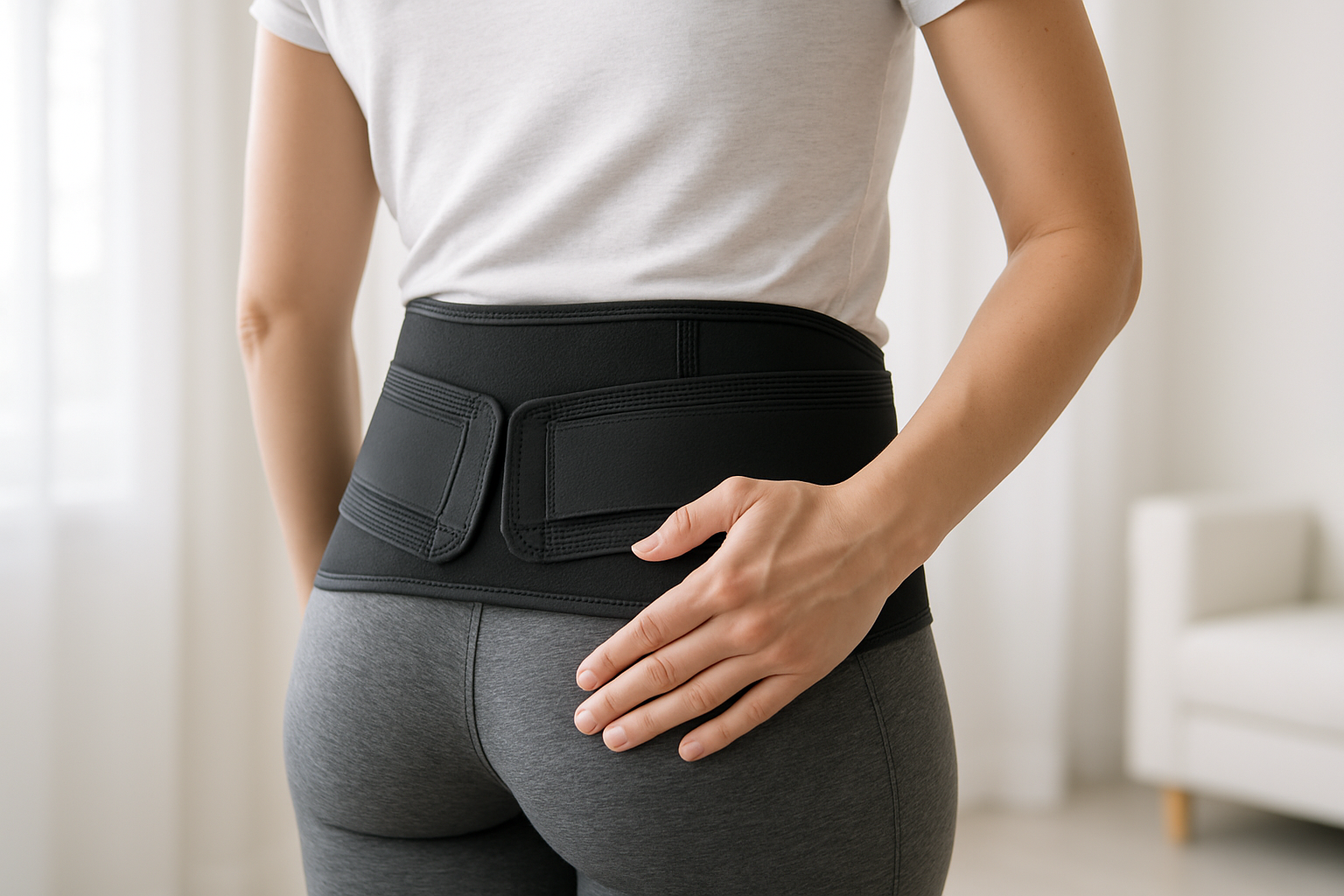
If your SI joint is the problem, a good belt does one specific thing: it compresses and stabilizes that joint space so it stops shifting with every step, reducing the inflammation cycle that keeps the pain coming back. The Vriksasana belt is designed to target exactly that mechanism without the bulk and sweat-trap of heavier braces.
What works
- Research supports SI joint compression as a legitimate pain-reduction strategy—most users notice a measurable drop in daily ache within 3–5 days of consistent wear, especially during movement that usually triggers flare-ups.
- The dual-strap design lets you adjust compression independently on each side, which matters because SI dysfunction is usually one-sided—you’re not forcing uniform pressure where you don’t need it.
- Unlike thicker hip braces, this one is thin enough to wear under most pants and doesn’t trap heat the way neoprene-heavy designs do, so you’re more likely to actually wear it on days when you need it most.
What doesn’t
- A belt is a tool for pain management and inflammation reduction—it’s not a fix for the movement patterns, hip weakness, or postural habits that likely created the problem in the first place, so you’ll need physical therapy or corrective work running parallel.
- If your SI joint pain is driven by nerve irritation or referred pain from your lumbar spine, compression alone won’t touch it—and wearing a belt while ignoring the real cause can delay you getting to the actual solution.
A belt works best when you’re also addressing why the joint became unstable in the first place—it’s a short-term stabilizer, not a long-term answer on its own. If you’re ready to test whether SI compression actually helps your pain, grab the Vriksasana Posture Sacroiliac Hip Belt and give it two weeks of daily wear during activities that typically aggravate things.
About This Article

Written by Michael Torres. Michael Torres has had joint problems his whole life — hypermobile as a kid, chronic sprains and a dislocating shoulder through his twenties, an osteoarthritis diagnosis in his early fifties, and a right knee replacement since. He is not a doctor or a physical therapist and has no clinical training. He writes about what has helped him and what he has watched help the people around him, and says plainly when he has not tried something himself. More about this site.
Scope and limits. Michael has no medical or clinical training — he writes about living with his own joint pain, not about treating anyone else's. Nothing here is medical advice. Talk to a doctor before starting anything new, and get seen promptly for pain that is new, severe, worsening, or comes with swelling, fever, or numbness.
Verify this against a primary source
Specifics change, and your situation may differ from the one described here. These are the authorities worth checking directly:
- NIAMS — arthritis and musculoskeletal research from the NIH
- MedlinePlus — plain-language medical reference from the NIH
- Arthritis Foundation — condition guides and treatment overviews