
You bend down to pick up something off the floor — maybe it’s a laundry basket, maybe it’s your kid’s toy — and suddenly your lower back reminds you, loudly, that it has opinions. If that scenario sounds familiar, you’ve probably already Googled whether a lumbar support belt for back joint health might be worth trying. And honestly? That’s a smart question to ask. As someone who has spent years helping people navigate back pain, I want to give you the real, nuanced answer — not a sales pitch, and not a scare story. Just practical information you can actually use.
What a Lumbar Support Belt Actually Does for Your Back Joints
Let’s start with the basics. Your lumbar spine — the lower five vertebrae of your back — carries an enormous amount of your body’s weight and guides nearly every movement you make. The joints between those vertebrae, called facet joints, along with the surrounding discs and ligaments, are under constant load. When those structures are irritated, inflamed, or weakened, the result is the kind of pain that makes you wince every time you stand up from a chair.
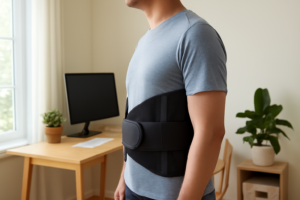
A lumbar support belt works by wrapping around your lower back and abdomen to provide external compression and mild stabilization. Research suggests that this compression may help reduce micro-movements in the lumbar joints that aggravate pain, and many people find that the gentle proprioceptive feedback — basically, the belt reminding your brain where your back is in space — helps them hold better posture during tasks that would otherwise strain the area.
That said, a belt is a tool. Like any tool, its effectiveness depends entirely on using it the right way, at the right time.
When a Lumbar Support Belt May Actually Help
I want to be clear: a lumbar belt is not a cure, and it won’t fix an underlying structural problem on its own. But there are real situations where many people experience meaningful relief when using one appropriately.
During Heavy or Repetitive Lifting
If your job or daily life involves moving heavy objects — construction work, warehouse shifts, helping someone move apartments — a lumbar belt may help reduce the load on your lumbar facet joints and discs during those peak-stress moments. It’s not a substitute for proper lifting technique, but it can be a useful layer of support on top of good mechanics.
During Acute Flare-Ups
When your back is in the middle of an acute flare — those first few days after you’ve tweaked something — many people find that wearing a belt during activity helps them stay functional without making things worse. Think of it as short-term scaffolding while the inflammation settles down.
Post-Activity Recovery Support
Some people with chronic lumbar joint issues use a belt selectively — only during activities they know tend to provoke symptoms, like long drives, grocery shopping, or standing at a work event for hours. That kind of targeted use is very different from wearing it all day, every day.
When a Lumbar Belt Probably Won’t Help — and Might Even Hinder
Here’s the honest part that a lot of product pages won’t tell you. Wearing a lumbar support belt too frequently or as a substitute for building core and back strength can actually work against you over time. Your deep stabilizing muscles — your multifidus, your transverse abdominis — need to be challenged to stay strong. If a belt does their job for them all day, those muscles can gradually become less engaged and more deconditioned. That’s the opposite of what you want for long-term joint health.
A belt is also unlikely to help if your pain is coming from a nerve compression issue that needs medical evaluation, or if your back pain is referred from your hips or sacroiliac joints — common sources of confusion that a physical therapist or physician can help sort out. And if you find yourself completely dependent on a belt just to get through basic daily tasks like walking to the mailbox, that’s a sign you need a rehab program, not just a better belt.
Think of it this way: a belt can be part of a smart strategy, but it shouldn’t be the whole strategy.
The Lumbar Belt That Actually Stabilizes Without Creating Dependency
If your lower back pain flares with specific movements—bending, lifting, or prolonged sitting—a quality support belt can reduce strain on the facet joints and discs while you’re working on the underlying mobility and strength issues. The FEATOL is built for real use, not just symptom theater.
What works
- The rigid stays provide genuine spinal support during high-load activities (lifting, bending) without the neoprene overheating that makes cheaper belts unbearable to wear consistently.
- Research shows proprioceptive feedback—feeling the belt—improves posture awareness and reduces compensatory movement patterns that often worsen back pain over time.
- Most users report noticeable relief within the first week of wear during their worst-pain activities, which matters psychologically and functionally when you’re rebuilding confidence in your back.
What doesn’t
- A belt is a tool for symptom management and movement support, not a cure—if your pain is driven by weak core muscles or poor spinal stability, the belt will feel great while wearing it and then the pain returns when you take it off until you address those causes.
- Prolonged daily use (8+ hours) can atrophy core stability if it becomes a substitute for exercise rather than a bridge to safer movement during the acute phase.
A support belt works best as part of a plan that includes movement practice, strengthening, and addressing whatever triggered the pain in the first place—it’s not a standalone fix. FEATOL Back Brace Support Belt
About This Article

Written by Michael Torres. Michael Torres has had joint problems his whole life — hypermobile as a kid, chronic sprains and a dislocating shoulder through his twenties, an osteoarthritis diagnosis in his early fifties, and a right knee replacement since. He is not a doctor or a physical therapist and has no clinical training. He writes about what has helped him and what he has watched help the people around him, and says plainly when he has not tried something himself. More about this site.
Scope and limits. Michael has no medical or clinical training — he writes about living with his own joint pain, not about treating anyone else's. Nothing here is medical advice. Talk to a doctor before starting anything new, and get seen promptly for pain that is new, severe, worsening, or comes with swelling, fever, or numbness.
Verify this against a primary source
Specifics change, and your situation may differ from the one described here. These are the authorities worth checking directly:
- NIAMS — arthritis and musculoskeletal research from the NIH
- MedlinePlus — plain-language medical reference from the NIH
- Arthritis Foundation — condition guides and treatment overviews