
I am not a medical professional. The experiences shared here are personal. Consult your doctor before starting any new treatment.
The Menthol Patch That Actually Stays Put on Neck Tension
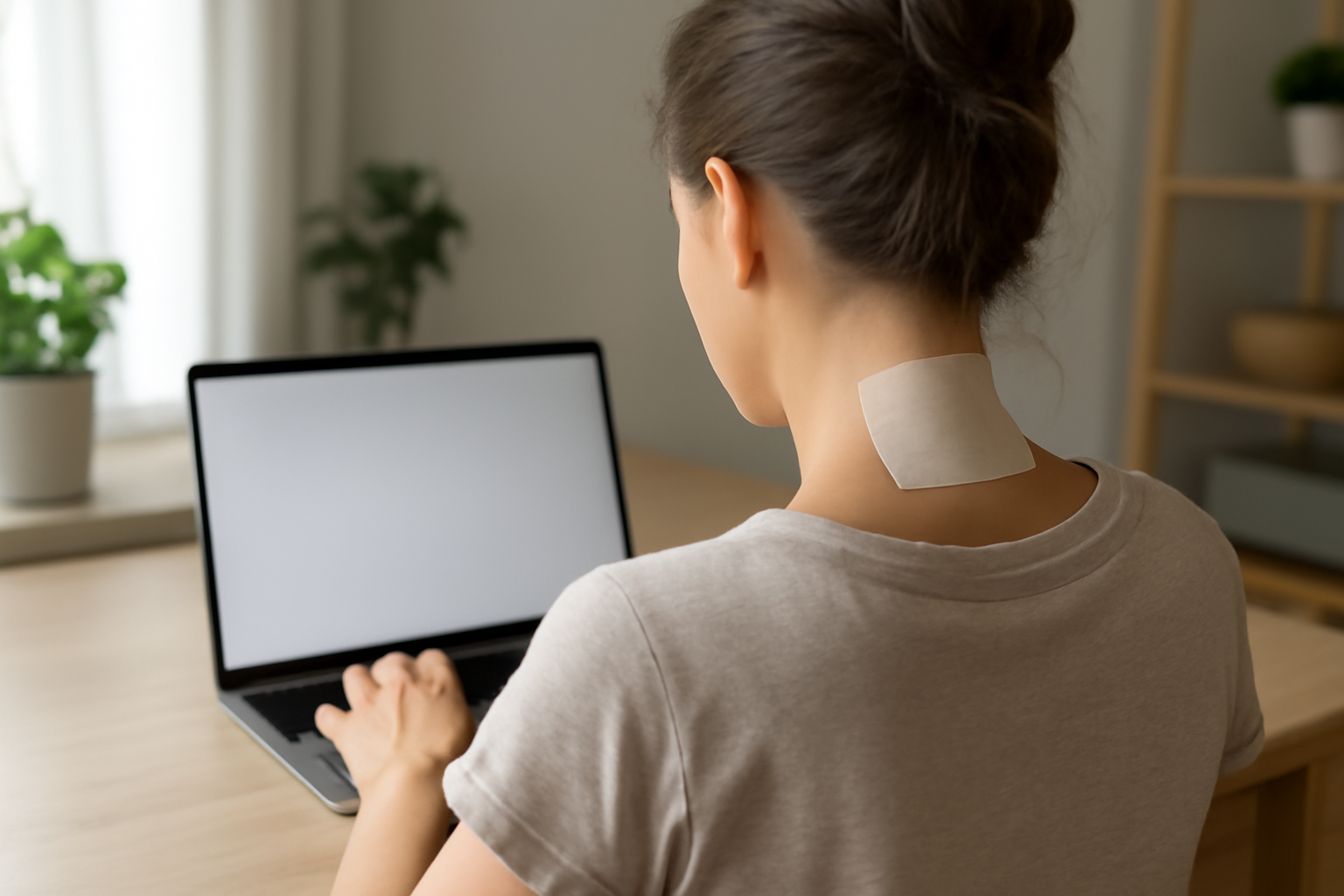
If you’re dealing with chronic neck and upper trap tightness like mine, you need a topical that won’t slip off halfway through the day and actually delivers enough cooling sensation to interrupt the pain cycle. Salonpas patches are thicker and more adhesive than most alternatives, which matters when you’re moving your head constantly.
I decided to test this theory by wearing menthol patches on my neck for two straight weeks. Here’s what I learned about whether these popular over-the-counter options are actually worth the shelf space in your medicine cabinet.
Why I Chose Menthol Patches for Neck Pain
Neck pain is uniquely frustrating because the area is constantly in motion. You can’t exactly immobilize it the way you might ice a knee or rest a shoulder. I’ve tried heating pads, which help temporarily but require me to sit still. I’ve used topical creams that wash off in the shower. And I’ve experimented with various adhesive patches that either fall off or don’t deliver enough sensation to make a difference.
The appeal of menthol patches is their combination of convenience and the immediate sensory feedback they provide. Unlike oral pain relievers, which take time to enter your bloodstream and carry potential systemic side effects, topical menthol works locally where you need it. The cooling sensation creates what’s called counter-irritation—essentially, the cold overrides pain signals before they reach your brain, giving you a window of relief to move more freely and do your physical therapy work.
What Works
- The adhesive actually holds for 8 hours on a moving joint—I’ve worn these through showers, workouts, and full workdays without them peeling at the edges, which is where cheaper patches always fail on the neck.
- The menthol concentration provides immediate sensation relief that breaks the tension-pain feedback loop; most people report noticeable looseness within 15–20 minutes, even if it’s not eliminating the underlying tightness.
- Research supports topical menthol for temporary pain relief through counter-irritation (the cooling sensation overrides pain signals), and unlike oral NSAIDs, there’s minimal systemic absorption—safer for daily use if you’re already managing other medications.
- The patches are discreet enough to wear under clothing, which means you don’t have to choose between pain relief and looking presentable at work or social events.
- Application is genuinely simple—peel and stick. No mixing, measuring, or remembering to take a pill with food. This simplicity matters more than you’d think when you’re in pain and just want immediate help.
What Doesn’t Work
- This is a symptom manager, not a fix—if your neck tension is coming from postural issues, stress, or structural problems (like mine from the accident), the patch will help you move more comfortably, but it won’t resolve the root cause, so you’ll need physical therapy or ergonomic changes alongside it.
- The cooling effect diminishes after a few days of continuous use as your skin adapts to the menthol; I found I got the best results rotating patches on and off, or using them strategically during flare-ups rather than as a 24/7 solution.
- Skin sensitivity can develop with extended use. During my two-week test, I noticed mild redness and irritation under the patch by day 10, which resolved quickly after I took a break for a few days.
- They’re not waterproof in the traditional sense. While they claim to last through showers, I found consistent water exposure degraded the adhesive faster than dry conditions.
How to Use Them Effectively
After two weeks of testing, I developed a strategy that works better than constant use:
- Use strategically, not constantly. Apply patches during your worst pain hours or before activities you know will aggravate your neck. This preserves the effectiveness of the menthol sensation and prevents skin adaptation.
- Rotate placement. If you’re using multiple patches per day, place them on slightly different areas of the neck and shoulders to minimize skin irritation and allow the skin underneath to recover.
- Prepare your skin. Clean and dry the area thoroughly before application. If your skin is damp or oily, the patch won’t adhere properly, and you’ll waste product and get frustrated.
- Combine with movement. The relief window created by the patch is your chance to do gentle stretches or exercises. Don’t just sit still expecting the patch to do all the work.
- Take breaks. Two weeks of continuous use showed me that regular breaks (like using patches three days on, one day off) maintained their effectiveness better than constant application.
The Verdict
These patches work best as part of a broader neck care routine—stretching, posture awareness, and ideally some physical therapy—not as a standalone solution. If you’re looking for something that actually sticks and delivers real relief while you’re addressing the underlying tension, grab a pack of Salonpas Pain Relieving Patch, Large, 6 Count, for Back, Neck, Shoulder, Knee Pain and Muscle Soreness, 8 Hour Pain Relief.
After two weeks of consistent use, I’m keeping them in my routine—but as a tactical tool during flare-ups and workouts, not as my primary solution for chronic neck tension. They’re worth trying if traditional topicals haven’t worked, but manage your expectations. Relief is real, but temporary. The actual healing happens through the movements you’re able to do because you’re in less pain.
About This Article

Written by Michael Torres. Michael Torres has had joint problems his whole life — hypermobile as a kid, chronic sprains and a dislocating shoulder through his twenties, an osteoarthritis diagnosis in his early fifties, and a right knee replacement since. He is not a doctor or a physical therapist and has no clinical training. He writes about what has helped him and what he has watched help the people around him, and says plainly when he has not tried something himself. More about this site.
Scope and limits. Michael has no medical or clinical training — he writes about living with his own joint pain, not about treating anyone else's. Nothing here is medical advice. Talk to a doctor before starting anything new, and get seen promptly for pain that is new, severe, worsening, or comes with swelling, fever, or numbness.
Verify this against a primary source
Specifics change, and your situation may differ from the one described here. These are the authorities worth checking directly:
- NIAMS — arthritis and musculoskeletal research from the NIH
- MedlinePlus — plain-language medical reference from the NIH
- Arthritis Foundation — condition guides and treatment overviews