
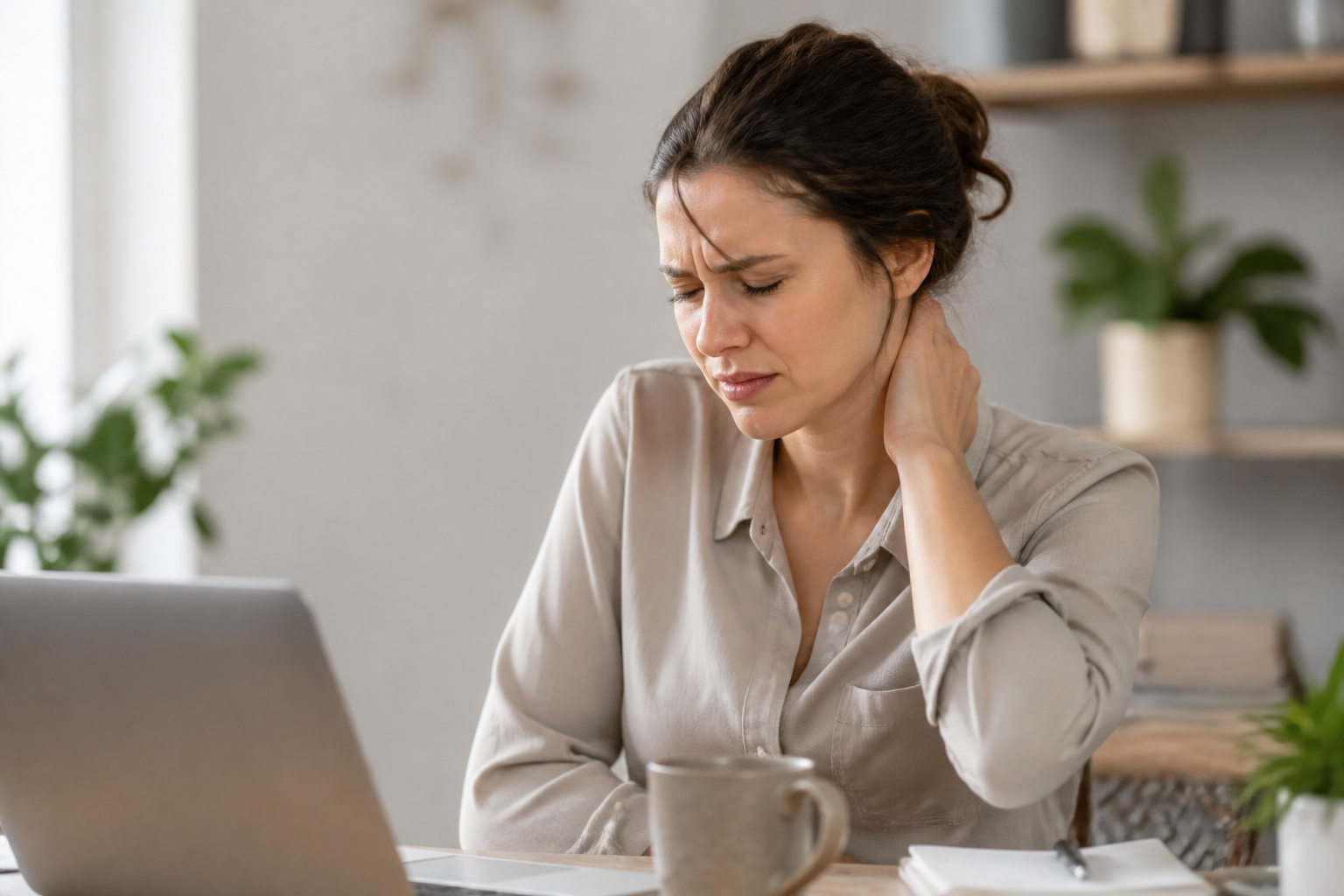

You’re three days away from your period, and suddenly your neck feels like it’s been tied in knots. The tension creeps up from your shoulders, your head feels heavier than usual, and you can’t figure out why. Sound familiar? You’re not alone—and there’s actually solid science behind why neck pain before your period is so common.
For years, I thought I was imagining this connection. My doctor never mentioned it, my friends didn’t seem to experience it quite the same way, and I figured I was just stressed or sitting at my desk wrong. But after diving into the research and talking with countless women in my experience, I realized this is real, it’s cyclical, and it’s completely manageable once you understand what’s happening in your body.
The Hormone-Neck Pain Connection: Why PMS Neck Pain Happens
Let me break down what’s actually happening in your body during the luteal phase of your menstrual cycle—the two weeks leading up to your period.
About 7-10 days before menstruation, estrogen levels begin to drop. This hormonal shift is normal and necessary, but it triggers a cascade of changes throughout your body. Here’s the part that directly affects your neck and shoulders: when estrogen drops, so does serotonin, your body’s natural pain-regulating chemical. This means your pain threshold actually lowers during this window. What wouldn’t normally bother you suddenly feels uncomfortable.
At the same time, your body increases production of prostaglandins—hormone-like compounds that cause uterine muscles to contract. But here’s what many women don’t realize: prostaglandins don’t just affect your uterus. They trigger muscle tension throughout your entire body, particularly in the neck and shoulder muscles. Combined with the increased pain sensitivity from lower estrogen, you get a perfect storm of discomfort.
Additionally, the hormonal shift can affect your sleep quality, increase inflammation slightly, and even influence your posture (many women unconsciously hunch their shoulders when experiencing discomfort). All of these factors compound to create PMS neck pain that seems to appear out of nowhere.
Understanding Neck Pain During Your Menstrual Cycle
One of the most validating aspects of understanding neck pain during the menstrual cycle is recognizing the pattern. This isn’t random or all-in-your-head pain—it’s predictable and tied to specific hormonal phases.
The Pre-Period Window (Days 7-3 Before Menstruation)
This is when most women experience the peak of cyclical neck pain. The combination of lower estrogen, higher prostaglandins, and decreased pain tolerance creates the ideal conditions for muscle tension and referred pain in the neck and shoulders.
During Your Period (Days 1-5)
Interestingly, many women find that once menstruation actually begins, the neck pain starts to improve. This is because prostaglandin levels begin to normalize, and the hormonal environment shifts. This improvement is actually one of the clearest signs that your pain is indeed cyclical and hormonally driven.
Post-Period (Days 6-14)
As estrogen begins to rise again in the follicular phase, most women experience significant relief from neck pain and period-related symptoms. Pain sensitivity normalizes, and muscle tension typically eases.
Neck Pain, Hot Flashes, and Menopause
If you’re approaching or in perimenopause or menopause, the picture becomes more complex. Neck pain and menopause often go hand-in-hand, but for slightly different reasons than premenstrual neck pain.
During menopause, estrogen levels don’t just dip cyclically—they remain consistently low. This sustained low estrogen means your pain threshold stays lower for extended periods. Additionally, the temperature regulation system in your brain becomes disrupted, leading to hot flashes and night sweats.
Here’s where neck pain and hot flashes intersect: during a hot flash, your body experiences a rapid increase in core temperature. Many women respond by tensing their neck and shoulder muscles—either unconsciously bracing for the sensation or as part of the body’s attempt to regulate temperature. This muscular tension, combined with already-lowered pain sensitivity, can create or worsen neck discomfort.
Sleep disruption from night sweats compounds the problem. Your cervical spine muscles don’t get adequate recovery time, leading to chronic tension and pain that can persist throughout the day. If you’re experiencing neck pain during menopause, especially alongside hot flashes and sleep issues, it’s worth addressing all three concerns together with your healthcare provider.
Practical Strategies That Actually Help
Heat Therapy
One of the simplest and most effective interventions is heat. Applying warmth to your neck and shoulders during the luteal phase helps relax muscle tension and increases blood flow. Many women find that a heating pad, hot shower, or warm compress provides noticeable relief within 15-20 minutes.
Magnesium Supplementation
Research suggests that magnesium supplementation may help reduce both PMS symptoms and muscle tension. Magnesium is essential for muscle relaxation, and many women are deficient. Taking 200-400mg of magnesium glycinate daily (especially increasing it during your luteal phase) may help reduce muscle tightness.
Over-the-Counter NSAIDs
Anti-inflammatory medications like ibuprofen can be particularly effective during the luteal phase because they address both the inflammation and prostaglandin production. Taking an NSAID at the first sign of neck pain, rather than waiting until it worsens, many people find more effective relief.
Neck-Specific Stretches and Mobility Work
Gentle stretching can be transformative. Try:
- Neck tilts (gently tilt your right ear toward your right shoulder, hold for 20 seconds, repeat on the left)
- Chin tucks (pull your chin straight back slightly, hold for 5 seconds, repeat 10 times)
- Shoulder rolls (slow, controlled circles forward and backward)
- Upper trapezius stretches (gently pull your head toward one shoulder while the opposite hand pulls your shoulder down)
Posture Awareness
During your luteal phase, pay extra attention to your posture. That forward head position over your desk, or hunching your shoulders—these patterns become more pronounced when you’re experiencing pain. Set hourly reminders to reset your posture, relax your shoulders away from your ears, and align your ears over your shoulders.
The Cervical Pillow That Actually Supports Your Neck During Hormonal Flare-Ups
When hormone-driven neck tension hits, your regular pillow isn’t going to cut it—you need support that keeps your cervical spine aligned while your muscles are already working overtime. A quality cervical pillow addresses the mechanics: it cradles the natural curve of your neck instead of flattening it, which reduces the compensatory tension that makes hormonal neck pain feel so much worse.
What works
- Memory foam cervical pillows are actually backed by research—they reduce neck strain by maintaining proper spinal alignment during sleep, which is when most people’s hormonal tension has a chance to settle (rather than get worse from poor positioning).
- Most people report noticing a difference within 3-5 nights if they’ve been sleeping on a flat pillow or one that’s too thick; the relief isn’t instant, but the reduction in morning stiffness is real and consistent.
- The contoured design matters—it prevents your head from sinking into a position that stretches your neck ligaments overnight, which is especially important during the luteal phase when inflammation is already elevated.
What doesn’t
- This is a pillow, not a pain reliever—it won’t stop the hormonal tension from happening, but it prevents it from getting worse while you sleep, which is a meaningful difference most people underestimate.
- There’s a genuine adjustment period (1-2 weeks) where your neck might feel slightly stiffer as it adapts to proper alignment; if you’ve been sleeping in a forward-head position for years, correct support can feel “wrong” at first.
A pillow is preventive support, not a cure—but preventing your neck from tensioning further at night is honestly where most people see the biggest difference. If you’re dealing with cyclical neck pain, this is worth the investment. Cervical Neck Pillow for Pain Relief with Ergonomic Memory Foam Support
About This Article

Written by Michael Torres. Michael Torres has had joint problems his whole life — hypermobile as a kid, chronic sprains and a dislocating shoulder through his twenties, an osteoarthritis diagnosis in his early fifties, and a right knee replacement since. He is not a doctor or a physical therapist and has no clinical training. He writes about what has helped him and what he has watched help the people around him, and says plainly when he has not tried something himself. More about this site.
Scope and limits. Michael has no medical or clinical training — he writes about living with his own joint pain, not about treating anyone else's. Nothing here is medical advice. Talk to a doctor before starting anything new, and get seen promptly for pain that is new, severe, worsening, or comes with swelling, fever, or numbness.
Verify this against a primary source
Specifics change, and your situation may differ from the one described here. These are the authorities worth checking directly:
- NIAMS — arthritis and musculoskeletal research from the NIH
- MedlinePlus — plain-language medical reference from the NIH
- Arthritis Foundation — condition guides and treatment overviews