
You’re trying to open a jar, and that sharp pain shoots through the base of your thumb—the part where your thumb meets your hand. Or maybe it’s buttons on a shirt, turning a key, or even holding a pen that triggers it. If you live with basal thumb arthritis, you know how quickly everyday tasks become frustrating obstacles. That’s why so many people search for a Push MetaGrip CMC brace review: they’re looking for something that actually works without locking up their whole hand. After 15 years of reading about and living with joint problems myself, I’ve learned that the right support tool can make a real difference—but only when it matches what you actually need. Let me walk you through what the MetaGrip is, how it compares to alternatives, and whether the investment makes sense for your situation.
Understanding the CMC Joint and Why Basal Thumb Arthritis Hurts So Much
Before diving into braces, it helps to understand what’s happening anatomically. The CMC (carpometacarpal) joint sits at the base of your thumb—where it connects to your wrist. It’s a saddle-shaped joint that gives your thumb its incredible range of motion and pinch strength. But that same mobility makes it vulnerable to osteoarthritis, especially as we age or after repetitive strain.
What makes basal thumb arthritis so disabling is that it directly attacks pinch grip—the movement you use hundreds of times a day. Opening jars, fastening buttons, gripping pens, squeezing a toothbrush—all of these load the CMC joint under pressure. When the cartilage degrades and inflammation sets in, pinch tasks become painful and sometimes functionally limited. Unlike knee arthritis, which you can manage by walking less, thumb arthritis is nearly impossible to avoid without changing how you move through the world.
What Makes the Push MetaGrip CMC Thumb Brace Different
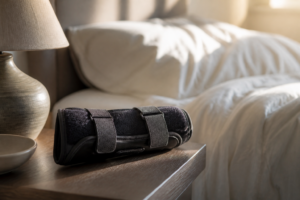
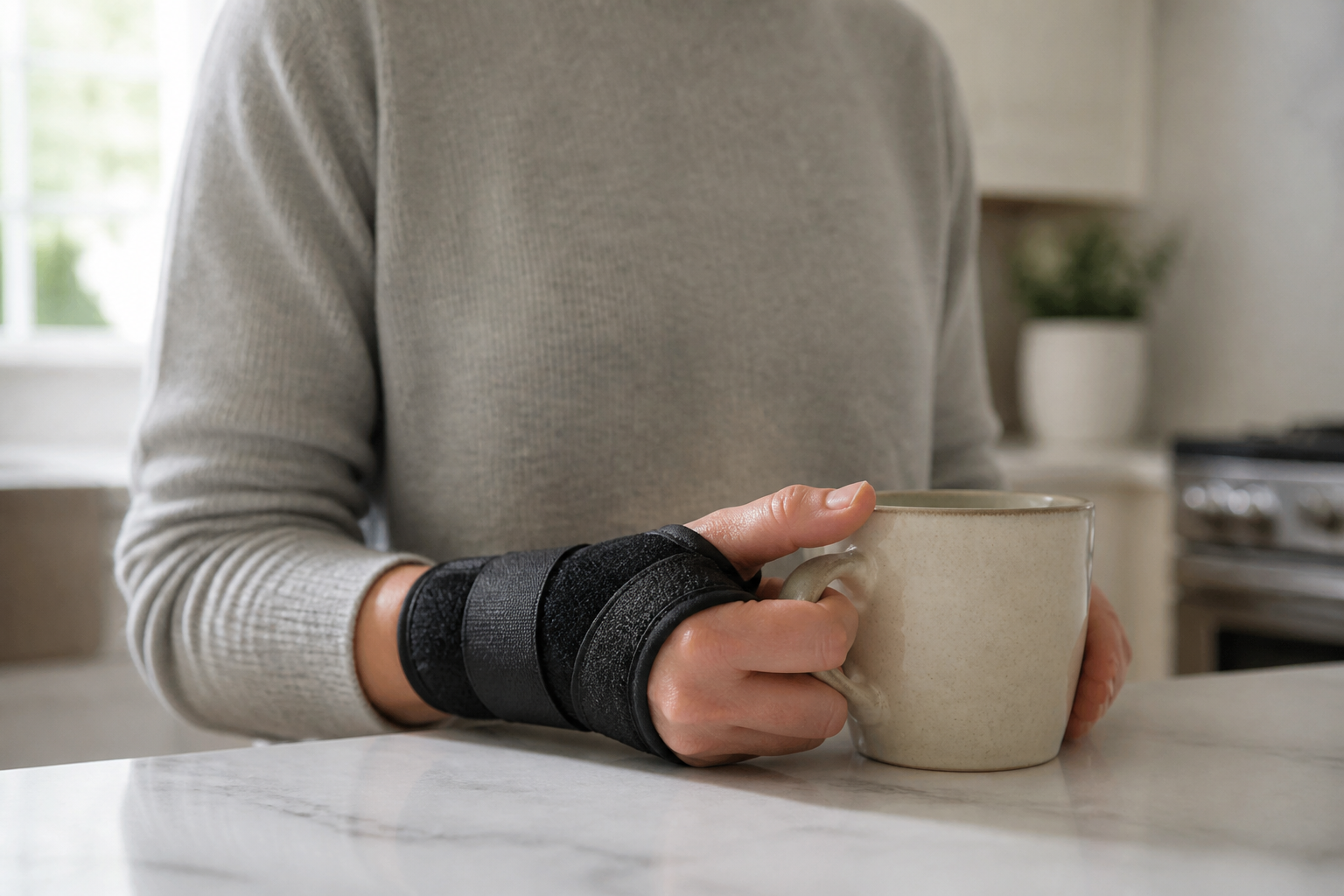
Here’s the core design philosophy that distinguishes a Push MetaGrip thumb brace from most other options on the shelf: it stabilizes only the CMC joint while deliberately leaving your wrist and thumb IP joint (the knuckle) free to move.
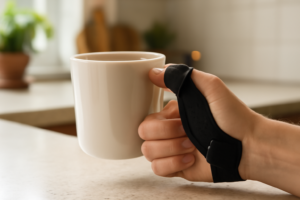
Most traditional thumb spica splints lock up the entire wrist and thumb in one rigid position—which provides support, sure, but at the cost of mobility. If you’re wearing one for several hours, your hand feels increasingly clumsy and stiff. The MetaGrip takes a different approach. It uses a contoured rigid shell that wraps around the base of your thumb and palm to prevent excessive CMC motion (especially the rotation and pinching that aggravates arthritis), while your wrist stays fully mobile and your thumb can still bend at the IP joint. That means you can still type, grip a fork, or write—just with more stability where you need it.
The brace is also hand-specific (you need a left or right) and comes in sizes (small, medium, large). That tailoring matters: a well-fitted brace distributes pressure evenly and stays in place during activity, whereas a generic one-size-fits-most neoprene sleeve can slip and bunch.
The Honest Reality: Build Quality, Fit, and the Break-In Period
Let me be direct about what you’re getting and what comes with it:
- Build quality is high. The MetaGrip uses rigid plastic and quality straps. It looks and feels like a medical device, not a drugstore sleeve.
- The price is higher. A basic neoprene thumb stabilizer costs $15–30. The MetaGrip typically runs $80–120 depending on size and hand. That’s a real difference, and I’m not going to pretend it isn’t.
- There’s a genuine break-in period. Many users report that the first few days feel stiff and uncomfortable as your hand adjusts to the new pressure pattern. That typically settles after a week or two, but it’s something to expect—especially if you’re coming from years of wearing nothing or a soft brace.
- Sizing and fit matter enormously. Get the wrong size and you’ll be uncomfortable or it won’t stay put. Pay careful attention to the sizing guide and don’t guess.
Research on CMC osteoarthritis supports the use of stabilizing braces, and many people do find meaningful pain reduction during pinch tasks when wearing one. But a brace is not a cure. It cannot reverse joint degeneration. What it can do is reduce pain and inflammation flare-ups during activities, which often allows people to stay more active and functional.
Push MetaGrip vs. Other Thumb Braces: How They Compare
To help you decide if the MetaGrip is right for you, here’s how it stacks up against the main alternatives:
Soft Neoprene Thumb Stabilizers
Cost: $15–40 | Support level: Mild to moderate | Comfort: Often high right away
These are the most accessible option and perfect if you have mild symptoms or want to start conservatively. They provide compression and warmth, which many people find soothing. The downside: they don’t actively stabilize the CMC joint the way a rigid brace does, so they may not be enough if your arthritis is moderate to severe or if you need to perform demanding pinch tasks. They also tend to slip during activity and don’t preserve wrist and thumb mobility the way the MetaGrip does.
Thumb Spica Splints
Cost: $40–100 | Support level: High | Mobility: Significantly restricted
These lock up your wrist, thumb CMC, and often part of the forearm. They offer excellent support for severe arthritis or post-injury, but wearing one for hours makes everyday tasks awkward and slow. They’re better suited to nighttime wear or very active days. If you need to work or type, a spica splint becomes impractical quickly.
Custom-Molded Hand Orthoses
Cost: $300–600+ | Support level: Highly individualized | Fit: Optimal
Made by a hand therapist, these are tailored to your exact hand anatomy and your specific functional goals. They’re the gold standard for fit and often provide the best outcomes—but they require a referral, multiple appointments, and considerably more money. Most people don’t need to go this route unless other options have failed or their case is complex.
Is the Push MetaGrip Worth It? Who Should Buy It
Based on the design, research support, and real-world feedback, I’d say the Push MetaGrip CMC brace is worth the cost if:
- You have moderate CMC or basal thumb arthritis and a soft brace isn’t providing enough relief.
- You need to stay mobile and functional throughout the day—typing, writing, cooking—and a full thumb spica is too restrictive.
- You’re willing to wait out the break-in period and commit to proper sizing and fit.
- You’re looking for a longer-term solution before considering injections or other interventions, or as a complement to them.
You probably don’t need it if:
- Your symptoms are very mild and a neoprene sleeve keeps you comfortable.
- You have access to a hand therapist and can pursue a custom orthosis.
- You’re not willing to invest in the higher price point or try something unfamiliar.
What Else Matters: Braces Are One Piece of the Picture
I want to be clear: this review is based on product design and published research on CMC bracing, not a claim of clinical credentials. I’m not a doctor or physical therapist—I’m a long-time joint-health reader and someone who’s lived with joint problems.
A brace alone is rarely the full answer to thumb arthritis. It works best alongside:
- Hand protection techniques: Learning to use your whole hand instead of pinching with your thumb, or using adaptive tools (jar openers, ergonomic pens).
- Hand therapy: A therapist can teach you exercises, activity pacing, and strategies that complement bracing.
- Medical management: Your doctor or hand specialist might recommend anti-inflammatory strategies, heat or cold, or injections depending on severity.
If you have persistent thumb pain, it’s worth talking to your primary care doctor or asking for a hand specialist referral. They can confirm the diagnosis and help you build a plan that includes bracing, therapy, and any other treatments that fit your situation.
What I Recommend
If you’ve struggled with a soft brace, or if pinch tasks are consistently painful despite over-the-counter options, the PUSH MetaGrip CMC Thumb Brace is worth a serious look. It’s engineered specifically for CMC joint stabilization, maintains your wrist and thumb mobility, and has research backing its use for basal thumb arthritis. Yes, it costs more than a drugstore sleeve, but if it reduces pain enough to keep you functional and active, that cost becomes reasonable.
. Make sure you select the right hand (left or right) and check the sizing guide carefully—fit is everything with this brace.
Moving Forward
Thumb arthritis is one of those conditions that’s easy to dismiss—”it’s just my thumb”—until you realize how much it’s quietly stealing your ability to do things you care about. A quality brace like the MetaGrip won’t reverse the arthritis, but it can genuinely reduce pain during activities and give you back some independence. Pair it with good joint-protection habits, and you’ve got a solid foundation for managing your symptoms long-term. Remember, this is general information, not medical advice—if you’re dealing with persistent joint pain, talk to your doctor about what’s right for your specific situation.
About This Article

Written by Michael Torres. Michael Torres has had joint problems his whole life — hypermobile as a kid, chronic sprains and a dislocating shoulder through his twenties, an osteoarthritis diagnosis in his early fifties, and a right knee replacement since. He is not a doctor or a physical therapist and has no clinical training. He writes about what has helped him and what he has watched help the people around him, and says plainly when he has not tried something himself. More about this site.
Scope and limits. Michael has no medical or clinical training — he writes about living with his own joint pain, not about treating anyone else's. Nothing here is medical advice. Talk to a doctor before starting anything new, and get seen promptly for pain that is new, severe, worsening, or comes with swelling, fever, or numbness.
Verify this against a primary source
Specifics change, and your situation may differ from the one described here. These are the authorities worth checking directly:
- NIAMS — arthritis and musculoskeletal research from the NIH
- MedlinePlus — plain-language medical reference from the NIH
- Arthritis Foundation — condition guides and treatment overviews