
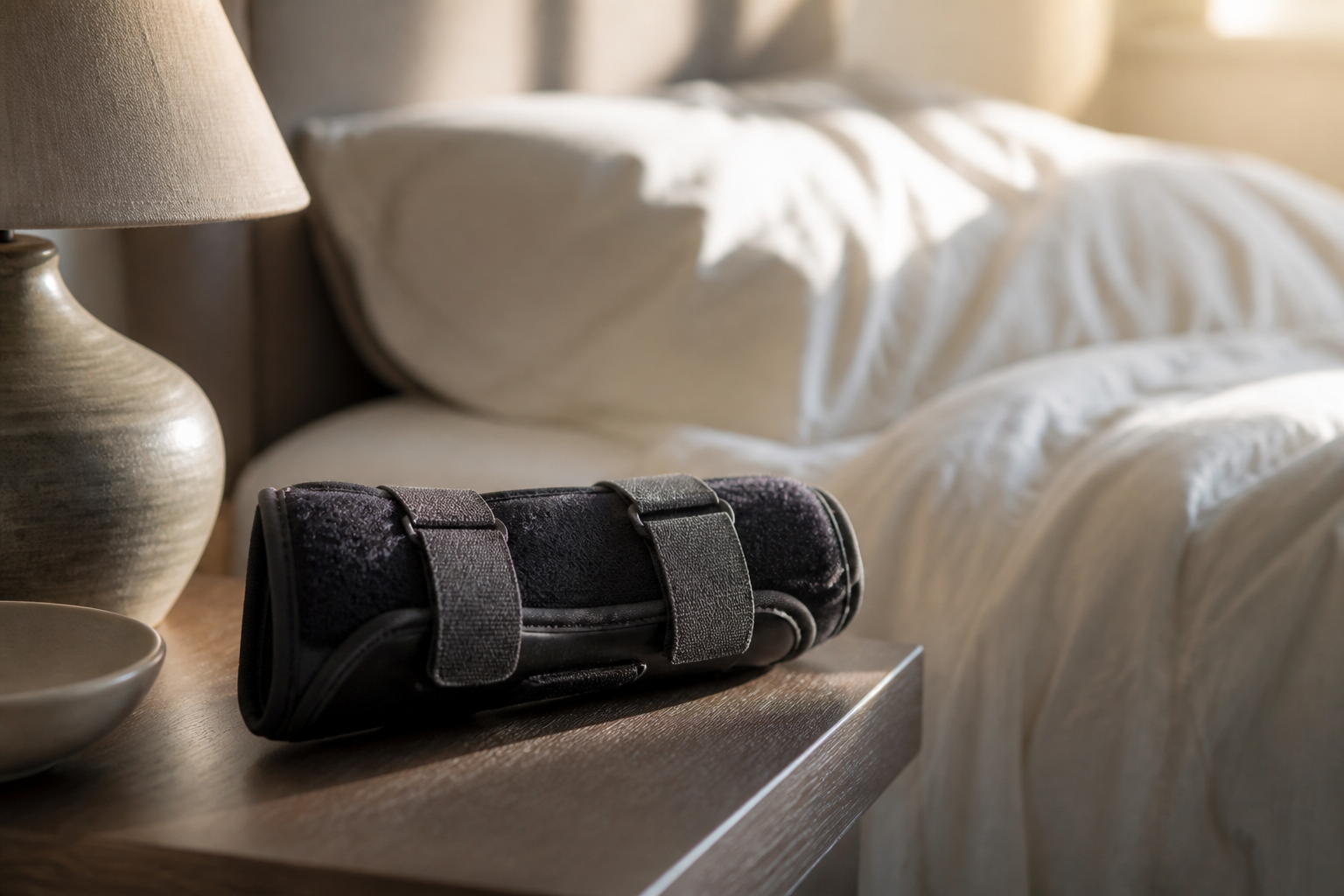

You’ve just twisted your wrist falling off a ladder, or caught it awkwardly during a tennis match. The swelling is coming on fast. Your doctor says it’s a sprain, fits you with a splint, and sends you home with instructions that feel incomplete. That night, as you lie in bed, the question nags at you: should you sleep with a wrist splint on after a sprain?
It’s one of the most common questions I see people wrestling with online—and for good reason. The answer isn’t a simple yes or no. It depends on how fresh the injury is, how your wrist responds to support, and how your healing is progressing. Over the past 15 years of managing my own joint problems and reading the research, I’ve learned that the right call changes as your wrist heals.
A quick note before we dive in: This post is about wrist sprains and strains—acute injuries from impact or overextension. If you’re dealing with carpal tunnel syndrome or repetitive strain, the night-wear strategy is very different (and night splinting is often the cornerstone of treatment). Also, I’m not a doctor, therapist, or licensed clinician. Everything here is general information based on widely available research and lived experience. Your actual doctor, who examined your actual wrist, always takes priority over anything you read online.
The First Days: Why Sleeping With a Wrist Splint Matters
In the immediate aftermath of a sprain—roughly the first 3 to 7 days—wearing your splint at night is usually a smart move. Here’s why:
- You can’t control your movements while sleeping. Without a splint, you might roll onto your injured wrist, bend it sharply, or press weight through it in the middle of the night. That jarring moment when you wake up in sudden pain? That’s your healing tissues getting re-injured just when they’re trying to settle down.
- Swelling peaks overnight. When you lie flat, fluid naturally pools in the injured area more than it does when you’re upright. A wrist splint holds the joint still and can help prevent that overnight swelling from getting out of hand—which in turn means less pain and better sleep quality.
- Rest accelerates early healing. During the first few days, immobilization reduces re-injury risk and allows the inflammatory phase of healing to play out without constant disruption.
So in those first 1–2 weeks after a sprain, sleeping with your splint on is generally protective and wise.
Sleeping With a Wrist Splint On or Off: Knowing When to Transition
Here’s where many people get stuck: they assume that if wearing a splint is good for two weeks, wearing it for two months must be even better. That’s not how joint healing works. After the acute phase passes—usually around 2–3 weeks in—prolonged immobilization can actually slow your recovery.
Why? Because your wrist needs gentle, progressive motion to rebuild strength and restore normal movement patterns. Joints heal best when they’re protected from re-injury but still gently used. Keeping your wrist locked up in a splint at night indefinitely can lead to stiffness, reduced range of motion, and a longer road back to normal function.
So how do you know when it’s time to dial back the night wear?
- Your pain has dropped significantly and is no longer sharp or stabbing.
- Swelling is noticeably reduced (you can tell by comparing wrist to wrist).
- You can gently move your wrist without sharp pain—though mild discomfort is normal.
- Your doctor or physical therapist has given you the green light to reduce splint use.
If you’ve reached this point, the goal shifts: wean off nighttime splint use gradually. Leave it off for a few nights and see how you sleep. If you wake without increased pain or swelling, you’re probably ready to drop it for good at night—though you may still wear it during the day for protection.
Wrist Splint on or Off at Night: The Fit and Comfort Question
Even if you’re still in that early, protective phase where nighttime splinting is wise, there’s a practical trap many people fall into: they put on a splint that fits perfectly at 10 p.m. but is uncomfortably snug by 3 a.m.
Remember: swelling rises overnight. A splint that is appropriately snug when you put it on can become a compression tool that restricts blood flow by the middle of the night. This isn’t just uncomfortable; it’s counterproductive to healing and can cause nerve irritation.
Red flags that your splint is too tight at night:
- Numbness or tingling in your fingers, especially when you wake up
- Your hand or fingers look noticeably swollen or discolored (pale, purple, or mottled)
- You wake up with pain that’s worse than when you fell asleep
- Coldness in your fingers that doesn’t resolve when you loosen the straps
If you notice any of these signs, loosen your splint immediately. You want snug support, not a tourniquet. Many people find that loosening the straps by just one notch before bed—or switching to a softer splint at night—solves the problem.
How Long to Wear a Wrist Splint for a Sprain: A Realistic Timeline
There’s no universal timeline, because sprains vary widely. A mild sprain might need protection for 2–3 weeks; a moderate one for 4–6 weeks; a severe sprain could take 8–12 weeks or longer. Your doctor should have given you a rough estimate based on the severity of your injury.
As a general framework, here’s what many people experience:
- Weeks 1–2: Splint on day and night, except during gentle range-of-motion exercises your doctor or PT prescribes.
- Weeks 2–4: Begin to reduce nighttime wear if pain and swelling are improving. Continue daytime support, especially during activities.
- Weeks 4+: Most people can drop nighttime splinting and switch to lighter bracing or no support during low-risk activities, though daytime protection may continue.
The key is to follow your own healing, not a calendar. If you’re two weeks out and your wrist still feels unstable and swollen, keep wearing the splint at night. If you’re three weeks out and pain-free with good swelling control, you can probably let it go.
What I Recommend: A Transitional Wrist Support Option
Once you’ve moved past the acute phase and are ready to wean off a rigid splint but still want reassurance at night, a softer, adjustable brace can be a helpful middle ground. The FEATOL Carpal Tunnel Wrist Brace Night Support is worth considering if you’re looking for gentle nighttime stability without the bulk of a rigid splint. It’s adjustable, so you can loosen it if overnight swelling becomes an issue, and it’s designed to keep your wrist in a neutral, supported position without locking it into immobilization. This type of brace can ease the transition from rigid splinting to no support at all.
Red Flags: When Your Wrist Needs Professional Attention
Before you settle into a splint-and-wait routine, watch for warning signs that your sprain might be more serious than it seems:
- Pain that doesn’t improve after 2–3 weeks, or gets worse despite splinting and rest.
- Inability to bear any weight through your hand or a feeling that your wrist might “give way” even with support.
- Tenderness in the anatomical snuffbox (the small hollow on the thumb side of your wrist, just below the base of your thumb). This is a classic sign of a possible scaphoid fracture—a serious injury that can be missed on initial X-rays and requires prompt specialist evaluation.
- Persistent numbness or tingling that doesn’t resolve when you loosen your splint.
- Significant swelling or discoloration that spreads up your forearm or down into your hand.
Any of these warrant a follow-up visit with your doctor or a hand specialist. Catching a missed fracture early makes all the difference.
The Bottom Line: Listen to Your Wrist and Your Doctor
So, should you sleep with a wrist splint on after a sprain? In the first 1–2 weeks, the answer is usually yes—it protects you from nocturnal re-injury and helps manage overnight swelling. As your healing progresses and pain and swelling improve, you’ll gradually drop nighttime wear and eventually move to daytime-only support or no support at all. The goal isn’t to immobilize your wrist forever; it’s to protect it long enough for healing to establish itself, then let it move and strengthen.
Pay attention to how your wrist feels and responds. If night splinting feels necessary because you wake in pain without it, keep doing it. If you’re sleeping fine and pain is minimal, it’s probably time to ease off. And if anything feels wrong—persistent pain, ongoing swelling, strange sensations, or weakness—get back to your doctor. The guidelines matter, but your individual healing matters more, and your doctor’s direct assessment of your wrist will always be more relevant than anything you find online.
Wrist sprains heal. The right approach to sleeping with a wrist splint on or off gets you back to normal function sooner than either constant immobilization or no support at all. Be patient, follow your doctor’s lead, and trust the process.
About This Article

Written by Michael Torres. Michael Torres has had joint problems his whole life — hypermobile as a kid, chronic sprains and a dislocating shoulder through his twenties, an osteoarthritis diagnosis in his early fifties, and a right knee replacement since. He is not a doctor or a physical therapist and has no clinical training. He writes about what has helped him and what he has watched help the people around him, and says plainly when he has not tried something himself. More about this site.
Scope and limits. Michael has no medical or clinical training — he writes about living with his own joint pain, not about treating anyone else's. Nothing here is medical advice. Talk to a doctor before starting anything new, and get seen promptly for pain that is new, severe, worsening, or comes with swelling, fever, or numbness.
Verify this against a primary source
Specifics change, and your situation may differ from the one described here. These are the authorities worth checking directly:
- NIAMS — arthritis and musculoskeletal research from the NIH
- MedlinePlus — plain-language medical reference from the NIH
- Arthritis Foundation — condition guides and treatment overviews