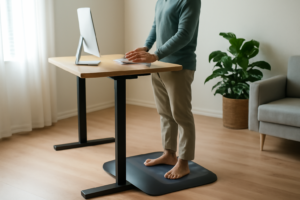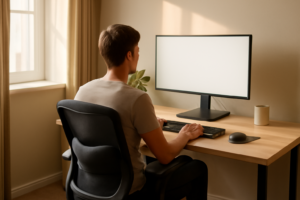


Perfect posture is a myth. Even if you nail every angle of your desk setup — monitor at eye level, elbows at 90 degrees, feet flat on the floor — your joints still weren’t built to hold one position for eight hours straight. What actually protects your joints during a desk job isn’t a static “correct” position, it’s movement. Regular, deliberate movement that keeps fluid and nutrients cycling through your cartilage and keeps your muscles from locking your joints into the same worn groove all day long. That’s the piece most ergonomic advice leaves out, and it’s what I want to walk you through here: a simple daily routine, not just a checklist of desk adjustments.
Why Movement Matters More Than “Perfect” Posture
Cartilage doesn’t have its own blood supply. It gets nutrients through a pumping action — compression and release, load and unload — that happens when a joint actually moves through its range. Sit still in the “correct” ergonomic position for four hours straight, and that cartilage is still getting shortchanged, because it needs the pumping, not just the alignment. This is why I tell people: don’t just fix your setup and call it done. Build movement into the day on a schedule, the same way you’d build in lunch or a coffee break.
The other piece is muscular. Sitting for long stretches lets certain muscle groups — hip flexors, chest, the muscles at the front of your shoulders — shorten and tighten, while the muscles that should be holding you upright (glutes, mid-back, deep neck flexors) go quiet and weak. That imbalance is what actually drags your joints out of alignment over months and years. A great chair won’t fix it. A routine that keeps those muscles firing will.
A Daily Movement Routine for Desk-Bound Joints
Start With a 2-Minute Reset Before You Even Open Your Laptop
Before the workday swallows you, spend two minutes on: 10 slow shoulder rolls backward, 10 gentle neck rotations, a standing hip hinge to touch your toes (bend the knees if you need to) repeated 8–10 times, and a few deep breaths with your arms overhead. This isn’t a workout — it’s waking up joints that have been still all night and telling your nervous system what “neutral” is supposed to feel like before you spend hours out of it.
Build in a Micro-Break Every 30 to 45 Minutes
Set a timer if you have to — most people don’t actually feel the need to move until they’re already stiff, which means the damage is underway. When it goes off: stand up, do 5 wrist circles each direction, 5 ankle pumps per foot, and reach overhead and to each side. Sixty seconds, that’s it. The point isn’t exercise, it’s interrupting the static load before it accumulates. I’ve had people tell me this single habit made a bigger difference than any cushion or gadget they bought.
Use Bigger Joints to Spare the Smaller Ones
This is a habit worth carrying past the desk, too. Carry a bag in the crook of your elbow instead of gripping it with your fingers. Open a heavy door with your shoulder or forearm instead of your wrist. Push up out of your chair using your legs, not by yanking on the armrests with your hands. Every time you route load through a larger, sturdier joint instead of a small one, you’re taking wear and tear off structures that have the least tolerance for it.
Close Out the Day With 5–10 Minutes of Recovery
This is where a foam roller earns its keep. After hours in one position, the muscles around your neck, shoulders, and lower back are usually the ones holding everything tight — and loosening them back up is what lets your joints settle back toward neutral instead of staying pulled out of position overnight. Pair a few minutes of rolling with a couple of static stretches (chest opener, hip flexor stretch, seated spinal twist) and you’ve closed the loop on the day’s sitting.
Don’t Undo It All at Night
One thing people forget: how you sleep matters just as much as how you sit. If you’re a side sleeper, a pillow between your knees keeps your hips and lower back from twisting for eight hours straight. If you sleep on your stomach, know that it holds your neck in prolonged rotation — the same kind of static load you just spent all day trying to break up at your desk. Your recovery routine should carry through to bedtime, not stop when you close the laptop.
The Foam Roller That Actually Fits Into an End-of-Day Routine
A foam roller only helps if you’ll actually reach for it, which is why I’m specific about which one I recommend. The TriggerPoint Grid 1.0 is sized and built for exactly the kind of quick, targeted session you want after a desk day — not a full-body ordeal.
What works
- The raised grid surface targets muscle tissue directly instead of just compressing everything evenly, so you get real release in the upper back and shoulders without the numb, bruised feeling flat foam rollers tend to leave behind.
- At 5.5 inches, it’s small enough to keep at your desk or in a bag, which matters — the roller that lives in a closet doesn’t get used, the one sitting next to your keyboard does.
- The rigid hollow core holds its shape for years instead of compressing flat the way cheaper foam does after a few months of daily use.
What doesn’t
- Rolling is a muscle-release tool, not a joint fix — if your setup or your movement habits don’t change, the same tightness will be back within a day or two.
- Skip rolling directly over an already-inflamed or acutely painful joint; this is for the tight muscle tissue around joints, not the joint itself.
Think of it as the last five minutes of a routine that starts the moment you sit down, not a stand-alone fix. TriggerPoint Grid 1.0 Foam Roller
About This Article

Written by Michael Torres. Michael Torres has had joint problems his whole life — hypermobile as a kid, chronic sprains and a dislocating shoulder through his twenties, an osteoarthritis diagnosis in his early fifties, and a right knee replacement since. He is not a doctor or a physical therapist and has no clinical training. He writes about what has helped him and what he has watched help the people around him, and says plainly when he has not tried something himself. More about this site.
Scope and limits. Michael has no medical or clinical training — he writes about living with his own joint pain, not about treating anyone else's. Nothing here is medical advice. Talk to a doctor before starting anything new, and get seen promptly for pain that is new, severe, worsening, or comes with swelling, fever, or numbness.
Verify this against a primary source
Specifics change, and your situation may differ from the one described here. These are the authorities worth checking directly:
- NIAMS — arthritis and musculoskeletal research from the NIH
- MedlinePlus — plain-language medical reference from the NIH
- Arthritis Foundation — condition guides and treatment overviews