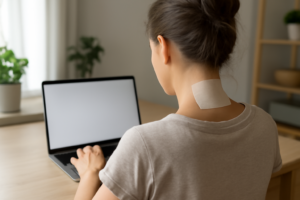


You wake up with that familiar dull ache at the base of your skull. By noon, it’s crept up into a full-blown throbbing headache behind your eyes. You reach for ibuprofen — again — and wonder why this keeps happening. If that scenario sounds painfully familiar, you’re not alone. For millions of people, chronic neck pain migraines are deeply connected, and understanding what your cervical spine is actually trying to tell you can be the first step toward real, lasting relief.
The Cervical Spine–Migraine Connection Nobody Talks About Enough
Here’s something I wish more people knew earlier in their pain journey: your neck and your headaches are almost certainly talking to each other. The cervical spine — the top seven vertebrae that support your head — is home to a complex network of nerves, muscles, and joints. When something goes wrong up there, whether it’s muscle tension, joint inflammation, or poor posture, those signals can travel directly into your head.
This phenomenon is sometimes called a cervicogenic headache, and research suggests it’s more common than most people realize. The upper cervical nerves share pathways with the trigeminal nerve — the main nerve responsible for migraine pain. When your neck is under chronic stress, it can essentially “trigger” that migraine pathway. So if you’ve been treating your headaches without ever addressing your neck, you may only be getting half the answer.
According to the medical community, migraines become classified as chronic when they occur 15 or more days per month for at least three months. If you’re hitting that threshold, it’s worth having a serious conversation with your doctor — but it’s equally worth taking a hard look at what’s happening in your cervical spine every single day.
What Your Neck Is Actually Telling You
Your cervical spine is remarkably good at sending distress signals — we’re just not always trained to listen. Here are some of the most common messages it tries to send, and what they might mean:
- Stiffness in the morning: This may indicate joint inflammation or muscle guarding that builds up overnight, especially if your pillow isn’t supporting proper spinal alignment.
- Pain at the base of the skull: This is often the suboccipital muscles — a group of tiny muscles at the skull base — going into spasm. They’re a major driver of tension-type headaches and migraines.
- Headaches that worsen with screen time: Forward head posture (that chin-jutting position most of us fall into when staring at a screen) dramatically increases the load on your cervical spine and can trigger or worsen head pain.
- Pain that radiates from neck into shoulders or head: This pattern often points to nerve involvement or facet joint irritation in the upper cervical region.
- Headaches that start after sleeping: Your sleeping position and pillow support have more impact on cervical health than most people appreciate.
Practical Steps That May Help Chronic Neck Pain and Migraines
I want to be straightforward with you: there’s no single magic fix. But there are evidence-informed habits and tools that many people find genuinely helpful when they commit to them consistently.
Posture and Movement Habits
Start with your daily posture. If you work at a desk, your monitor should be at eye level, your ears should stack over your shoulders, and you should be taking movement breaks every 45 to 60 minutes. Simple chin tucks — gently drawing your chin straight back while keeping your eyes level — are one of the most effective exercises for resetting forward head posture. Research suggests consistent cervical strengthening and mobility work can meaningfully reduce headache frequency over time.
Temperature Therapy for Acute Relief
Cold therapy is one of the most accessible tools for managing migraine pain in the moment. Applying a cooling compress to the head constricts blood vessels and may help reduce the throbbing sensation that makes migraines so debilitating. Many people find significant short-term comfort from a well-designed migraine relief cap — the kind that wraps around the entire head and stays cold for a sustained period.
Products Worth Trying for Chronic Neck Pain and Migraines
These are tools I’d genuinely suggest to someone dealing with the neck-migraine cycle. None of them replace medical care, but many people find they make a real difference in day-to-day comfort.
Cold Therapy for Cervical Tension: Why a Targeted Migraine Cap Works Better Than Random Ice
If your migraines are rooted in cervical spine tension, cold therapy applied directly to the base of your skull and upper neck can interrupt the pain signal before it escalates—but only if the cold actually stays in contact with the right spots. A well-designed migraine relief cap does what a generic ice pack can’t: it maintains consistent, targeted pressure exactly where your cervical tension triggers pain.
What works
- Gel coverage that wraps the entire base of skull, occipital ridge, and upper cervical area—research supports cold therapy for cervicogenic migraines, but only when applied consistently to the tension site, not just the forehead.
- Stays in place during use without slipping or requiring you to hold it, which means you can actually rest while it works instead of clamping an ice pack to your head one-handed.
- Most people report noticeable relief within 15–20 minutes of onset if used early; the gel retains cold for about 30 minutes, which is the sweet spot for interrupting the migraine cascade before it locks in.
What doesn’t
- This is pain management, not prevention—it works best as an emergency tool when a migraine is starting, not as a daily fix for chronic neck tension that needs actual postural or structural work.
- Some people find the pressure uncomfortable on a throbbing head, and cold therapy isn’t appropriate if you have circulation issues, neuropathy, or sensitivity to temperature changes.
Cold caps work fastest when you use them at the first sign of a migraine, not hours in—if you’re reaching for one regularly, that’s a signal that your cervical spine needs actual assessment and treatment beyond symptom relief. Check out the Migraine Relief Cap with All-Around Gel Coverage if you’re looking for a reliable, hands-free option.
About This Article

Written by Michael Torres. Michael Torres has had joint problems his whole life — hypermobile as a kid, chronic sprains and a dislocating shoulder through his twenties, an osteoarthritis diagnosis in his early fifties, and a right knee replacement since. He is not a doctor or a physical therapist and has no clinical training. He writes about what has helped him and what he has watched help the people around him, and says plainly when he has not tried something himself. More about this site.
Scope and limits. Michael has no medical or clinical training — he writes about living with his own joint pain, not about treating anyone else's. Nothing here is medical advice. Talk to a doctor before starting anything new, and get seen promptly for pain that is new, severe, worsening, or comes with swelling, fever, or numbness.
Verify this against a primary source
Specifics change, and your situation may differ from the one described here. These are the authorities worth checking directly:
- NIAMS — arthritis and musculoskeletal research from the NIH
- MedlinePlus — plain-language medical reference from the NIH
- Arthritis Foundation — condition guides and treatment overviews