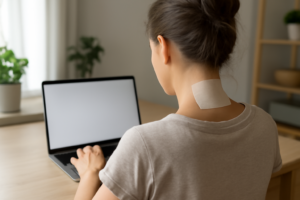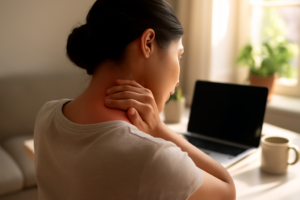


Knowing your neck can trigger migraines is one thing. Actually building a routine that prevents it from happening as often is another. This is the prevention side — a set of daily habits centered on posture, strengthening the muscles that are supposed to be doing the work, sleep, and stress, that many people use to bring down how often cervicogenic headaches show up in the first place, rather than just managing them once they’ve started.
Why Prevention Beats Managing Every Episode
A lot of neck-related migraine advice focuses on what to do once the headache has already started — ice, dark rooms, medication. All useful, but reactive. The habits below are aimed further upstream: reducing how often your cervical spine reaches the tipping point that triggers an episode in the first place. None of them work overnight, but consistency here tends to pay off more than any single tool.
Daily Habits That May Help Prevent Cervical Neck Migraines
Fix Your Posture Before It Fixes You
Forward head posture is one of the biggest contributors to chronic neck tension. For every inch your head moves forward from its neutral position over your shoulders, it effectively adds meaningful load on your cervical spine. Over time, this creates chronic muscle fatigue and joint compression. Try setting a timer every 30 to 45 minutes during your workday to gently retract your chin, roll your shoulders back, and take three slow, deep breaths. It sounds too simple, but many people find this kind of micro-correction practice makes a noticeable difference over weeks.
Strengthen Your Deep Neck Flexors
This is the piece most people skip entirely, and it’s arguably the most important one. Most people with chronic neck pain and headaches have weak deep neck flexor muscles — the small stabilizing muscles at the front of the cervical spine. When these muscles are underactive, the larger, more superficial muscles like your upper trapezius and suboccipitals have to work overtime, which leads to that rock-solid tension at the base of your skull. A simple routine: lying on your back, gently nod your chin (like a tiny “yes” motion) to lengthen the back of your neck, hold 5-10 seconds, and repeat 8-10 times. Building this into a daily 5-minute habit, alongside gentle resistance work as it gets easier, retrains the muscles that should have been doing this job all along.
Prioritize Sleep Position and Pillow Support
Waking up with neck pain is often a direct line to a migraine by mid-morning. Sleeping on your back or side with proper cervical support keeps your spine in better alignment through the night. Stomach sleeping, on the other hand, forces your neck into prolonged rotation, which can irritate the joints and nerves significantly. A supportive, appropriately sized pillow — not too high, not too flat — may help reduce morning tension considerably.
Manage Stress and Hydration
Stress is a well-documented migraine trigger, and it tends to make us hold enormous tension in our neck and shoulders without even realizing it. Gentle yoga, diaphragmatic breathing, and even a 10-minute walk can help regulate your nervous system. Staying well hydrated is equally important — dehydration is a surprisingly common headache trigger, and it also affects the health of your intervertebral discs, which rely on fluid to maintain their cushioning properties.
Putting the Routine Together
If you’re starting from zero, don’t try to adopt all four habits at once. Posture micro-breaks are the easiest to start today — just set the timer. Deep neck flexor work takes the longest to build into a habit but delivers the most durable payoff, since you’re actually correcting the muscular imbalance rather than managing around it. Give the combination 4 to 6 weeks before expecting a real shift in how often headaches show up.
The Cervical Device I Reach For When Neck Tension Triggers a Migraine
Alongside the strengthening and posture work above, targeted cervical traction and support can interrupt a tension cycle that’s already building before it turns into a full migraine. The Halo Rejuvenator addresses the actual joint mechanics that drive neck-based migraines, complementing the muscular work rather than replacing it.
What works
- Gentle cervical traction decompresses the upper spine and reduces pressure on nerves that trigger cervicogenic headaches — most users report noticeable relief within 3–5 sessions of consistent use.
- The device actively supports postural alignment during use, which reinforces the same chin-tuck and deep-flexor patterns you’re practicing on your own.
- Unlike passive ice caps or pressure wraps, this device engages the joint itself, so people with chronic cervicogenic migraines often see cumulative improvement over 2–3 weeks of regular use, not just temporary relief.
What doesn’t
- If your migraines are triggered by hormones, diet, or non-cervical factors, this won’t be a game-changer — it’s specifically for people whose neck tension is the primary driver.
- Results depend on consistent use and proper fit; it works best paired with the deep neck flexor exercises above, not as a substitute for them.
This works best as part of the sustained routine above — the device supports the joints while your own strengthening work builds the muscles that keep them supported long-term. Halo Rejuvenator Cervical Rehabilitation Device
About This Article

Written by Michael Torres. Michael Torres has had joint problems his whole life — hypermobile as a kid, chronic sprains and a dislocating shoulder through his twenties, an osteoarthritis diagnosis in his early fifties, and a right knee replacement since. He is not a doctor or a physical therapist and has no clinical training. He writes about what has helped him and what he has watched help the people around him, and says plainly when he has not tried something himself. More about this site.
Scope and limits. Michael has no medical or clinical training — he writes about living with his own joint pain, not about treating anyone else's. Nothing here is medical advice. Talk to a doctor before starting anything new, and get seen promptly for pain that is new, severe, worsening, or comes with swelling, fever, or numbness.
Verify this against a primary source
Specifics change, and your situation may differ from the one described here. These are the authorities worth checking directly:
- NIAMS — arthritis and musculoskeletal research from the NIH
- MedlinePlus — plain-language medical reference from the NIH
- Arthritis Foundation — condition guides and treatment overviews