

You know that feeling when you’ve had a brutally stressful week — deadlines piling up, tension headaches creeping in, and your shoulders practically touching your ears? By Friday afternoon, you’re hunched over your desk like you’re trying to disappear into it. That’s not just a bad habit or poor ergonomics at play. The connection between stress and joint alignment is very real, and it quietly shapes how your body feels every single day. As someone who has spent decades dealing with chronic tension and joint discomfort in my own body, I want to walk you through what’s actually happening — and more importantly, what you can do about it.
Why Stress and Joint Alignment Are More Connected Than You Think
When your brain perceives stress — whether it’s an overflowing inbox or a difficult conversation — your nervous system triggers a “fight or flight” response. Cortisol and adrenaline flood your body, and your muscles contract. That’s great if you’re running from a threat. But when stress is chronic and low-grade, those muscles never fully release. The result? A body that stays braced, tight, and pulled out of its natural alignment for hours, days, and sometimes weeks at a time.
The muscles most affected tend to be in your neck, upper trapezius, chest, and hip flexors — all of which have a direct influence on spinal alignment and joint positioning. When your chest muscles chronically tighten, they pull your shoulders forward. When your hip flexors stay contracted, your pelvis tilts anteriorly, putting pressure on your lower lumbar joints. Research suggests that prolonged postural distortion caused by muscle tension may contribute to joint wear, nerve compression, and pain patterns that feel completely unrelated to stress on the surface.
The Daily Chain Reaction Stress Sets Off in Your Body
Here’s how a typical stress response plays out physically over the course of a single day — and why it matters for your joints:
Morning: You Wake Up Already Tense
Many people under chronic stress report waking up with stiffness in their neck, upper back, or jaw. If you’ve been clenching your teeth or sleeping in a protective, curled posture, your cervical spine and shoulder joints have been under subtle load all night. You may write it off as “sleeping wrong,” but often, it’s accumulated muscular tension that never fully unwound.
Midday: The Postural Collapse
As stress hormones peak and energy dips in the early afternoon, many people experience what I call postural collapse — the slow forward drift of the head, rounding of the thoracic spine, and dropping of the chest. For every inch your head moves forward from its neutral position, the effective load on your cervical spine nearly doubles. This puts enormous pressure on the facet joints of the neck and can contribute to shoulder impingement over time.
Evening: The Compensation Cycle
By the end of the day, your body has been compensating for misalignment all day long. Lower back muscles overwork to stabilize a tilted pelvis. Hip joints operate at suboptimal angles. Knee alignment may even be subtly affected by how your hips are sitting. This compensation cycle, repeated daily, may accelerate joint fatigue and contribute to chronic discomfort in areas that seem far removed from where you feel your stress.
What Actually Helps: Practical Tools and Strategies Worth Trying
I want to be straightforward with you: no single product or habit will undo the effects of chronic stress on your body overnight. But combining mindful stress management with physical support tools can make a meaningful difference for many people. Here’s what I recommend exploring:
The Posture Corrector That Actually Addresses Stress-Induced Slouching
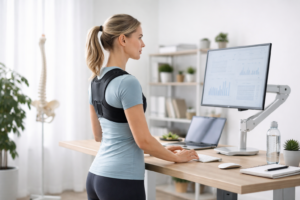
When stress locks your shoulders forward and collapses your chest, a posture corrector can interrupt that pattern and retrain your body’s alignment before it becomes chronic tension. If you’re spending hours a day hunched over work, this type of brace gives your muscles real feedback—and relief—while you’re building awareness of what upright actually feels like.
What works
- The dual-strap design pulls shoulders back without cutting off circulation, which means you can actually wear it for 2–4 hours at a time instead of yanking it off after 20 minutes in discomfort.
- Most people notice reduced upper back and neck tension within 3–5 days of consistent use, especially if they pair it with breaks from their desk—it’s not magic, but the proprioceptive feedback does retrain postural habits.
- Unlike rigid braces, this one adjusts to different body types and doesn’t require complicated fitting; you can slip it on under clothing and wear it during your workday without drawing attention.
What doesn’t
- A posture corrector is a tool, not a cure—if you don’t address the underlying stress, deadlines, or desk setup, you’ll slip back into old patterns the moment you take it off.
- Results are temporary without complementary work like stretching, strengthening, and ergonomic changes; this is support while you rebuild, not a substitute for fixing what stress is actually doing to your body.
Think of this as a reset button, not a permanent fix—your nervous system needs the brace to remember what good posture feels like, but your muscles need the work to hold it on their own. If you’re ready to break the stress-slouch cycle, check out the Duoorra Posture Corrector for Women and Men.
About This Article

Written by Michael Torres. Michael Torres has had joint problems his whole life — hypermobile as a kid, chronic sprains and a dislocating shoulder through his twenties, an osteoarthritis diagnosis in his early fifties, and a right knee replacement since. He is not a doctor or a physical therapist and has no clinical training. He writes about what has helped him and what he has watched help the people around him, and says plainly when he has not tried something himself. More about this site.
Scope and limits. Michael has no medical or clinical training — he writes about living with his own joint pain, not about treating anyone else's. Nothing here is medical advice. Talk to a doctor before starting anything new, and get seen promptly for pain that is new, severe, worsening, or comes with swelling, fever, or numbness.
Verify this against a primary source
Specifics change, and your situation may differ from the one described here. These are the authorities worth checking directly:
- NIAMS — arthritis and musculoskeletal research from the NIH
- MedlinePlus — plain-language medical reference from the NIH
- Arthritis Foundation — condition guides and treatment overviews