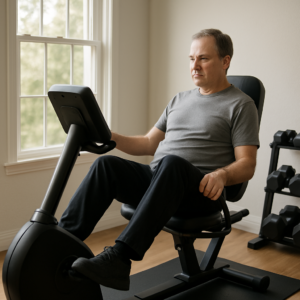

If you’re managing joint pain and keeping an eye on your blood pressure or heart health, the exercise advice you get can feel like it’s pulling in two directions — push harder for your heart, go easier for your joints. The good news is that low-impact exercise is one of the few forms of activity that genuinely serves both goals at once, but it helps to know how to track your numbers alongside your joint routine rather than guessing.
Why Low-Impact Exercise Serves Both Your Joints and Your Heart
Inflammation is the thread connecting joint pain and cardiovascular health. The same inflammatory markers that aggravate joint tissue are also associated with higher blood pressure and vascular stress. That means the low-impact movement that keeps your joints mobile — walking, swimming, cycling — is doing double duty: it supports circulation and heart health while avoiding the high-impact jarring that could aggravate an already-painful joint or spike your heart rate too abruptly.
Building a Routine That Respects Both
The core exercises are the same familiar low-impact options — walking, swimming, cycling, resistance bands — but the approach shifts slightly when blood pressure is part of the picture.
Warm Up Longer Than You Think You Need To
A gradual warm-up matters more when you’re managing blood pressure, since a sudden jump in exertion can cause a sharper spike than it would for someone without cardiovascular concerns. Five to ten minutes of easy movement before increasing intensity gives your heart rate and blood pressure time to adjust gradually rather than abruptly.
Favor Steady-State Over Bursts
Consistent, moderate-effort movement — a steady walk or an even cycling cadence — tends to be gentler on blood pressure than start-stop, high-intensity intervals. This also happens to be easier on joints, which makes steady-state low-impact cardio a genuine overlap between the two goals rather than a compromise.
Watch for Warning Signs, Not Just Joint Pain
Lightheadedness, chest discomfort, or unusual shortness of breath during exercise are reasons to stop and check your blood pressure, not push through — a different threshold than the “work through mild joint stiffness” advice that applies to exercise in general. If any of these happen regularly, that’s a conversation for your doctor before your next session, not after.
Track Before and After, Not Just Occasionally
Checking your blood pressure before and after a handful of sessions gives you actual data on how your body responds to a given routine, rather than going by how you feel. Over a few weeks, that pattern tells you whether your current low-impact routine is appropriately calibrated or whether it’s worth discussing an adjustment with your doctor.
Tools Worth Having: Monitoring and Inflammation Support
Two categories of tools are genuinely useful when you’re managing both joint pain and blood pressure at once: a way to track your numbers, and something that addresses the inflammatory overlap between the two.
Home Blood Pressure Monitoring
If you’re starting or adjusting a low-impact exercise routine, tracking your blood pressure at home is a straightforward, proactive way to see how your body is actually responding — especially useful before and after a handful of sessions.
The Oklar Rechargeable Wrist Blood Pressure Monitor has an LED backlit display, a voice broadcast feature, and 240-reading memory storage for two users — useful if you’re tracking alongside a spouse or family member. The Oklar Wrist BP Monitor in Blue offers the same feature set in a different color. If you prefer a larger display, the MMIZOO Wrist Blood Pressure Monitor with Large LCD has an adjustable cuff and 99×2 sets of memory — a solid, budget-friendly option.
Omega-3 Supplements for the Shared Inflammatory Pathway
Because inflammation is the mechanism connecting joint pain and cardiovascular strain, omega-3s are one of the few supplements that plausibly address both at once rather than just one or the other.
What works
- Omega-3 fatty acids may help support a healthy inflammatory response, which is relevant to both joint comfort and cardiovascular strain — the shared mechanism is what makes this worth pairing with a low-impact routine rather than a generic joint supplement alone.
- Sourced, third-party-tested options reduce the risk of contaminants that matter more when you’re already managing a cardiovascular condition.
What doesn’t
- If you’re on blood thinners or blood pressure medication, talk to your doctor before adding omega-3s — high doses can interact with both, and this is not a substitute for medical guidance on either condition.
- It supports the inflammatory piece, not the mechanical one — you still need the low-impact movement itself for joint strength and cardiovascular conditioning.
Nature’s Bounty Fish Oil Omega-3 (1200mg, 200 Softgels) is a widely available, affordable option. For a higher-potency choice, Sports Research Triple Strength Omega-3 Fish Oil (1250mg) is sourced from wild Alaskan Pollock, is MSC-certified sustainable, non-GMO, and soy-free.
About This Article

Written by Michael Torres. Michael Torres has had joint problems his whole life — hypermobile as a kid, chronic sprains and a dislocating shoulder through his twenties, an osteoarthritis diagnosis in his early fifties, and a right knee replacement since. He is not a doctor or a physical therapist and has no clinical training. He writes about what has helped him and what he has watched help the people around him, and says plainly when he has not tried something himself. More about this site.
Scope and limits. Michael has no medical or clinical training — he writes about living with his own joint pain, not about treating anyone else's. Nothing here is medical advice. Talk to a doctor before starting anything new, and get seen promptly for pain that is new, severe, worsening, or comes with swelling, fever, or numbness.
Verify this against a primary source
Specifics change, and your situation may differ from the one described here. These are the authorities worth checking directly:
- NIAMS — arthritis and musculoskeletal research from the NIH
- MedlinePlus — plain-language medical reference from the NIH
- Arthritis Foundation — condition guides and treatment overviews