
Once you’ve decided to try MSM for joint pain, the next problem shows up fast: the supplement aisle has capsules, powders, topical gels, and a dozen brands claiming “pharmaceutical grade” or “OptiMSM” on the label — and almost none of it means anything without context. This guide is about choosing an MSM product that’s actually worth your money, not about whether MSM works in the first place.
What Does “OptiMSM” or “Pharmaceutical Grade” Actually Mean?
MSM sold in bulk industrial form (used in agriculture and manufacturing) is not the same as MSM sold for human consumption, and low-quality supplement MSM can carry trace impurities from the distillation process. OptiMSM is a specific, patented, distilled form of MSM manufactured by Bergstrom Nutrition that undergoes a four-stage purification process and independent testing. It’s not the only clean source of MSM, but it’s the most widely recognized quality benchmark in the industry, and a lot of reputable brands license it and print “Contains OptiMSM” on their label.
“Pharmaceutical grade” is a marketing term, not a regulated one, in the supplement industry — it sounds official but isn’t backed by an FDA classification the way it would be for an actual drug. Don’t let that phrase alone convince you a product is higher quality. Instead, look for a Certificate of Analysis (COA), a USP verification mark, or a named purification process like OptiMSM.
Powder, Capsules, or Topical Gel: Which Format Should You Buy?
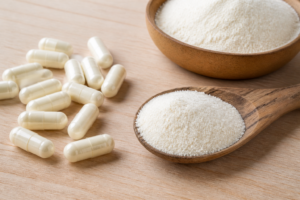
All three formats deliver the same compound, but they suit different situations:
- Powder is the most cost-effective way to hit the 3–6g daily doses used in the studies with the strongest results, and it lets you titrate your dose precisely as you find what works for you. The tradeoff is a mildly bitter, sulfurous taste that some people never get used to, even mixed into juice.
- Capsules are more convenient and taste-free, but hitting a 3g+ daily dose often means swallowing six or more capsules a day, which gets expensive and tedious fast. Capsules make more sense if your target dose is on the lower end (1,000–2,000mg).
- Topical MSM gels and creams are marketed for direct application to a sore joint. The evidence for topical MSM reaching joint tissue in meaningful amounts is much thinner than for oral MSM — most of what you feel from a topical product likely comes from the menthol or other active ingredients often blended in alongside it, not the MSM itself. Treat topical MSM as a nice-to-have addition, not a replacement for an oral supplement if joint support is your actual goal.
Reading an MSM Label: What to Check Before You Buy
- Single ingredient vs. blend. If you specifically want to test MSM’s effect, a single-ingredient product lets you know what’s responsible for any change. Blended “joint formulas” make it impossible to isolate what’s working.
- Dose per serving, not per bottle. Check how many grams you get per scoop or capsule, and multiply by how many you’d need daily to hit a research-aligned dose — some products bury a “3,000mg” claim across six capsules rather than stating it plainly.
- Fillers and flow agents. Magnesium stearate and silicon dioxide in small amounts are common and generally considered fine, but a long list of unnecessary additives in a supplement that should be one ingredient is a signal of a cheaper formulation.
- Third-party testing. A USP, NSF Certified for Sport, or ConsumerLab seal tells you an outside lab has verified label accuracy — meaningful for any supplement, but especially one sold mostly on trust.
Why Purity Matters More for MSM Than for Some Other Supplements
MSM is a simple, single molecule — there’s no complex extraction or standardization process the way there is for, say, a turmeric extract. That actually works in your favor as a buyer: it’s harder for a manufacturer to substitute a cheaper, less effective ingredient and still call it MSM. The main quality difference between brands comes down to purification (removing residual solvents and byproducts from manufacturing) and particle size (finer crystals dissolve more completely in powder form). This is why a distilled, verified source like OptiMSM commands a slightly higher price — you’re paying for the purification step, not a fundamentally different ingredient.
What works
- Single-ingredient powder means no guesswork about what’s actually in the dose you’re taking, and no proprietary blend hiding the real MSM amount.
- A 500g container gets you through months of consistent daily use at research-aligned doses, which matters since MSM needs 8–12 weeks to show whether it’s working.
What doesn’t
- Powder has a mildly bitter, sulfurous taste that doesn’t fully disappear even mixed into juice — if that’s a dealbreaker for you, budget for capsules instead, even at a higher per-dose cost.
- This is a plain powder, not a blend — if you want MSM alongside glucosamine or turmeric in one product, you’ll need to buy and combine them separately.
About This Article

Written by Michael Torres. Michael Torres has had joint problems his whole life — hypermobile as a kid, chronic sprains and a dislocating shoulder through his twenties, an osteoarthritis diagnosis in his early fifties, and a right knee replacement since. He is not a doctor or a physical therapist and has no clinical training. He writes about what has helped him and what he has watched help the people around him, and says plainly when he has not tried something himself. More about this site.
Scope and limits. Michael has no medical or clinical training — he writes about living with his own joint pain, not about treating anyone else's. Nothing here is medical advice. Talk to a doctor before starting anything new, and get seen promptly for pain that is new, severe, worsening, or comes with swelling, fever, or numbness.
Verify this against a primary source
Specifics change, and your situation may differ from the one described here. These are the authorities worth checking directly:
- NIAMS — arthritis and musculoskeletal research from the NIH
- MedlinePlus — plain-language medical reference from the NIH
- Arthritis Foundation — condition guides and treatment overviews