

Disclaimer: I am not a medical professional. This post is based on personal experience and general wellness information only. Always consult your doctor or a licensed physical therapist before beginning any new exercise program, especially if you have an existing neck condition or injury.
Last winter I spent three weeks barely able to turn my head to the left. Driving was a nightmare. Sleeping was worse. I tried YouTube videos, foam rolling, heat packs — nothing gave me lasting relief. Finally, my doctor referred me to a physical therapist, and over three sessions at $90 each, I learned exactly which neck stretches that work are backed by real clinical reasoning — and which popular ones are a complete waste of time, or worse, potentially harmful. That total came to $270 out of my own pocket. Today I’m handing you everything she taught me, free of charge.
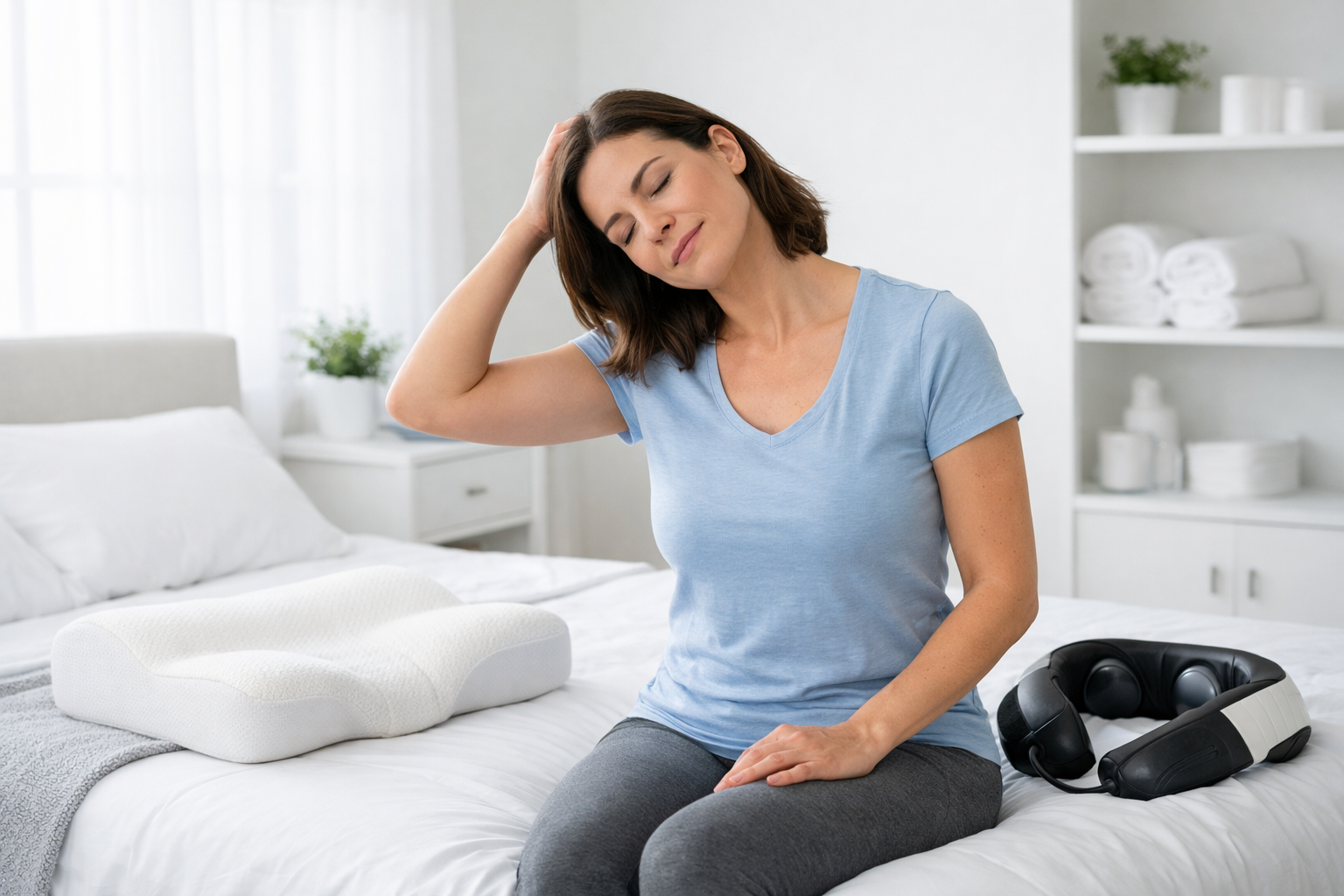
Why Most Neck Stretches You Find Online Fall Short
My physical therapist made one thing crystal clear during our first session: most people stretch the wrong muscles, in the wrong direction, for the wrong amount of time. The cervical spine is a complex structure of seven vertebrae, multiple muscle layers, and a dense network of nerves. A generic “tilt your head side to side” routine pulled from a random wellness site does not address that complexity.
Research published in the Journal of Orthopaedic and Sports Physical Therapy supports this idea. A 2017 systematic review found that targeted cervical and scapular exercises produced significantly greater pain reduction compared to general stretching routines. The key word there is “targeted.” Form, direction, hold duration, and muscle activation sequence all matter enormously when it comes to the cervical spine.
She also pointed out something I had never considered: poor sleeping posture was undoing every bit of progress I made during the day. More on that shortly, but it completely changed how I approach nighttime recovery.
The Neck Stretches That Work According to My Physical Therapist
Here is the actual routine she built for me, explained in the way she explained it to me — with the reasoning behind each move, not just the instructions.
1. Chin Tucks (Cervical Retraction)
This was the very first exercise she showed me, and she called it “the single most important thing you can do for your neck.” Start seated or standing with your spine tall. Without tilting your head up or down, gently draw your chin straight back — like you are trying to make a double chin. Hold for 5 seconds, release, and repeat 10 times. You should feel a mild stretch at the base of your skull and a gentle activation in the deep front neck muscles called the deep cervical flexors.
A 2016 study in the Journal of Physical Therapy Science found that chin tuck exercises significantly reduced forward head posture and associated neck pain after just four weeks of consistent practice. My therapist had me do this three times a day.
2. Levator Scapulae Stretch
This one targets a muscle most people have never heard of — the levator scapulae, which runs from the upper corner of your shoulder blade to the top four cervical vertebrae. When it gets tight, it pulls directly on your neck. Sit upright, place your right hand behind your back (or tuck it under your thigh), then rotate your head 45 degrees to the left and tilt your chin down toward your left armpit. Use your left hand to gently add a small amount of pressure on the back of your head. Hold for 30 seconds, and switch sides. Do this twice per side.
3. Upper Trapezius Stretch
Sit tall and reach your right hand under your chair or behind your back to anchor your right shoulder down. Tilt your left ear toward your left shoulder slowly, keeping your face forward. Hold for 30 seconds. The key my therapist emphasized: do not rotate the head, and do not force it. Gravity alone is enough. Repeat twice on each side, and breathe deeply through the hold to encourage the muscle to release.
4. Cervical Rotation with a Towel Roll
Roll a small hand towel and place it at the base of your skull while lying flat on your back. Gently rotate your head left and right to about 70 percent of your comfortable range — never forcing past the point of mild tension. This encourages joint mobility in the upper cervical segments (C1-C2) without compressing the discs. She had me do 10 slow rotations in each direction, morning and evening.

The Cervical Pillow That Actually Supports—Not Just Cradles—Neck Recovery
After weeks of PT, I realized my pillow was undoing half the work. A proper cervical pillow maintains the natural curve of your neck while you sleep, which is where most of the healing actually happens—and it’s the piece most people get wrong or skip entirely.
What works
- Contoured design fills the gap between your neck and shoulder, preventing the collapse that happens with flat pillows and undoes your stretching work at night.
- Research on cervical pillows shows measurable reduction in morning stiffness and nighttime pain within 2–3 weeks of consistent use—but only if the height actually matches your shoulder width (this matters more than the brand).
- Memory foam versions conform without going flat by morning, holding support through the night in a way traditional pillows or rolled towels simply can’t.
What doesn’t
- A cervical pillow is not a fix—it’s support for the work you’re already doing with stretches and PT. If you’re not doing the stretches, the pillow won’t solve the underlying tension.
- Takes 1–2 weeks to feel natural; your neck may feel “supported but weird” at first because you’re used to slouching. Push through this adjustment period or you’ll abandon it too early.
Sleep support is cumulative—you won’t feel a dramatic difference on night one, but consistency over weeks compounds into real relief. Check the Osteo Cervical Pillow for Neck Pain Relief to see if the height and firmness match your needs.
About This Article

Written by Michael Torres. Michael Torres has had joint problems his whole life — hypermobile as a kid, chronic sprains and a dislocating shoulder through his twenties, an osteoarthritis diagnosis in his early fifties, and a right knee replacement since. He is not a doctor or a physical therapist and has no clinical training. He writes about what has helped him and what he has watched help the people around him, and says plainly when he has not tried something himself. More about this site.
Scope and limits. Michael has no medical or clinical training — he writes about living with his own joint pain, not about treating anyone else's. Nothing here is medical advice. Talk to a doctor before starting anything new, and get seen promptly for pain that is new, severe, worsening, or comes with swelling, fever, or numbness.
Verify this against a primary source
Specifics change, and your situation may differ from the one described here. These are the authorities worth checking directly:
- NIAMS — arthritis and musculoskeletal research from the NIH
- MedlinePlus — plain-language medical reference from the NIH
- Arthritis Foundation — condition guides and treatment overviews