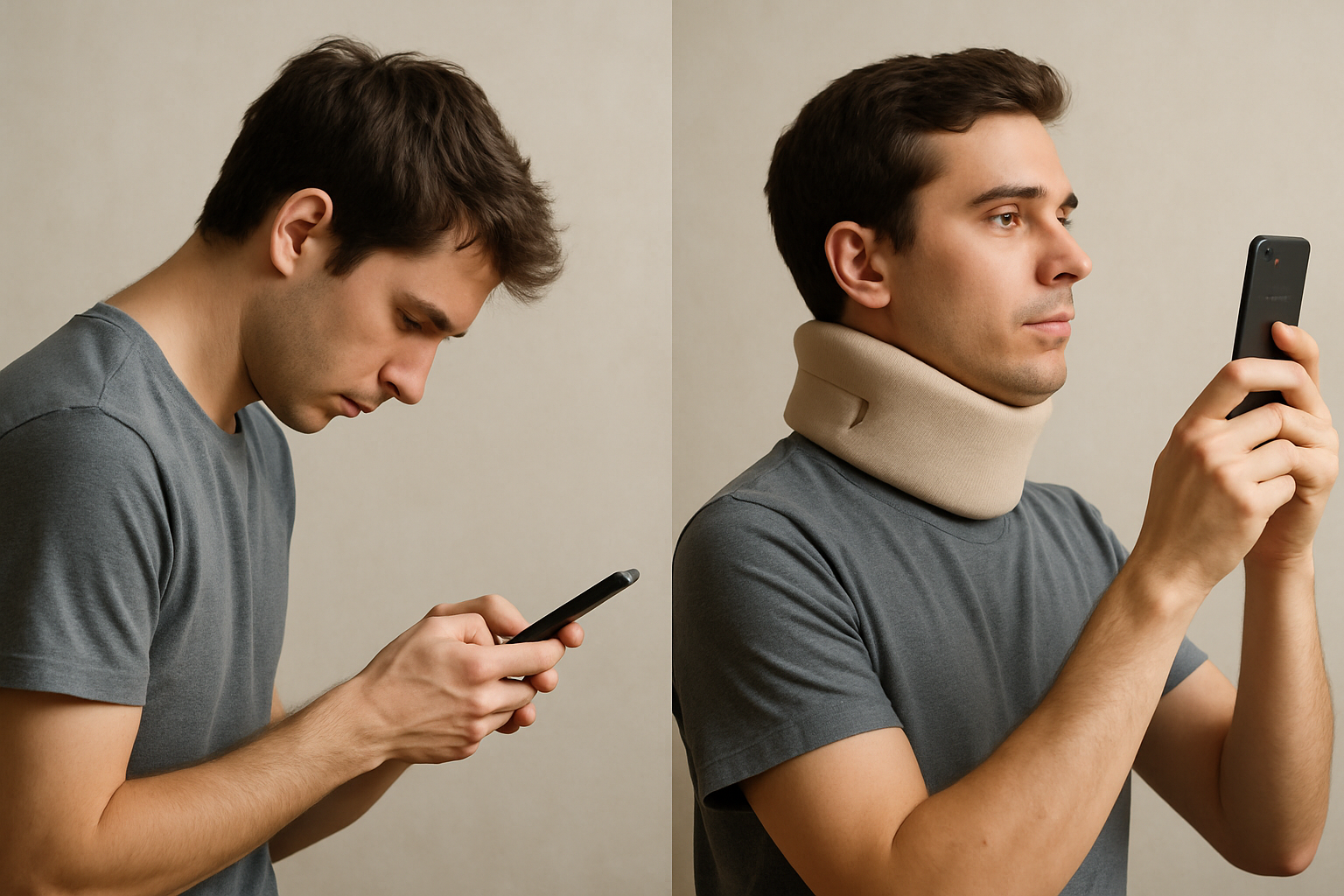

You know that dull, grinding ache that creeps up the back of your neck after an hour of scrolling? Maybe your shoulders feel locked up, your head feels heavy, and there’s a subtle but persistent stiffness every time you try to turn your head. If any of that sounds familiar, you’re dealing with what millions of people now experience daily — and finding a real text neck cervical joint pain fix has become one of the most common things people search for. I get it. As someone who has spent years helping people understand how posture affects their joints, I see this pattern constantly, and I want to walk you through what’s actually happening, why it matters more than most people realize, and what practical steps may genuinely help you feel better.
What Text Neck Is Actually Doing to Your Cervical Joints
Here’s the thing most people don’t fully appreciate: your head weighs somewhere between 10 and 12 pounds when it’s balanced directly over your spine. That’s already a significant load for your cervical vertebrae, discs, and surrounding muscles to manage all day long. But the moment you tilt your head forward — even just 15 degrees to glance at your phone — the effective load on your cervical spine can jump to around 27 pounds. At 45 degrees of forward tilt, research suggests that force climbs to roughly 49 pounds. That’s the equivalent of a small child hanging from your neck for hours at a time.
Over weeks, months, and years, that repeated mechanical stress compresses the intervertebral discs between your cervical vertebrae, strains the posterior ligaments and facet joints, and can gradually alter the natural lordotic curve of your neck. The result isn’t just soreness — it’s accelerated wear on the joint surfaces themselves, and many people find this contributes to headaches, radiating shoulder pain, and even tingling in the arms as nerve roots experience irritation. This isn’t a small quality-of-life annoyance. It’s a legitimate joint health concern.
The Text Neck Cervical Joint Pain Fix Starts With These Habits
Before we talk about tools and supportive products, I want to be clear: no device replaces consistent behavioral change. The foundation of any effective text neck cervical joint pain fix is retraining how you hold your body throughout the day. Here are the habits I encourage people to start with:
- Raise your screen to eye level. Whether it’s your phone, tablet, or laptop, bringing the screen up to your face rather than dropping your face down to the screen is the single most impactful shift you can make. A book stand, monitor riser, or even a stack of thick books works perfectly.
- Practice the chin tuck exercise. This gentle movement — drawing your chin straight back to create a “double chin” — actively strengthens the deep cervical flexor muscles that support proper head alignment. Ten reps, a few times a day, may help retrain your posture over time.
- Set movement reminders. Static posture, even good posture, becomes problematic over long periods. Aim to move your neck through its full range of motion every 30 to 45 minutes. A simple phone reminder can make this effortless to build into your day.
- Strengthen your upper back. Weak rhomboids and middle trapezius muscles allow the shoulders to round forward, which directly pulls the head forward with them. Resistance band rows, face pulls, and prone Y-T-W exercises are excellent starting points.
- Be mindful of your sleep position. How you support your cervical spine at night matters just as much as your daytime posture. Sleeping on your stomach, especially with your head rotated to one side, can compound daytime joint stress significantly.
What Actually Helps: Products Worth Considering
I’m a practical person, and I know that sometimes targeted support tools can make a meaningful difference — especially while you’re actively working to correct your posture and strengthen the supporting muscles. These are the types of products many people find useful, and the specific options I’d point a friend toward.
Cervical Traction for Immediate Relief When Your Neck Joints Are Compressed
Text neck isn’t just about posture—it’s about the actual compression and misalignment happening in your cervical spine right now. A quality inflatable neck traction device creates gentle decompression, which is one of the few interventions that directly addresses the mechanical problem instead of just masking symptoms.
What works
- Research supports cervical traction for reducing nerve compression and improving mobility—most people notice reduced stiffness and that grinding sensation within 3–5 days of consistent 15-minute sessions.
- The inflatable design means you control the pressure and can gradually increase it, which matters because aggressive traction can aggravate things if your neck isn’t ready.
- Unlike rigid collars, this gives you active decompression while sitting at your desk or watching TV—so it fits into the hours you’re actually creating the problem.
What doesn’t
- Traction is a tool, not a fix—if you’re still hunching over your phone for 8 hours a day, you’re fighting a losing battle, and this will only buy you temporary relief.
- Some people with advanced cervical arthritis or instability need medical clearance before using traction, so check with your doctor first if you have a history of neck surgery or significant degeneration.
This works best as part of a bigger picture—traction plus posture changes plus taking regular breaks from your screen—not as a standalone cure. Cervical Neck Traction Device – Inflatable Neck Stretcher Collar (Black Plush)
About This Article

Written by Michael Torres. Michael Torres has had joint problems his whole life — hypermobile as a kid, chronic sprains and a dislocating shoulder through his twenties, an osteoarthritis diagnosis in his early fifties, and a right knee replacement since. He is not a doctor or a physical therapist and has no clinical training. He writes about what has helped him and what he has watched help the people around him, and says plainly when he has not tried something himself. More about this site.
Scope and limits. Michael has no medical or clinical training — he writes about living with his own joint pain, not about treating anyone else's. Nothing here is medical advice. Talk to a doctor before starting anything new, and get seen promptly for pain that is new, severe, worsening, or comes with swelling, fever, or numbness.
Verify this against a primary source
Specifics change, and your situation may differ from the one described here. These are the authorities worth checking directly:
- NIAMS — arthritis and musculoskeletal research from the NIH
- MedlinePlus — plain-language medical reference from the NIH
- Arthritis Foundation — condition guides and treatment overviews