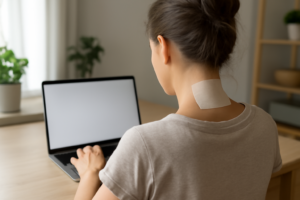


You know that feeling — it’s been a brutal week, your shoulders are practically touching your ears, and somewhere between your third stressful meeting and a sleepless night, a dull ache at the base of your skull has quietly turned into a throbbing headache that won’t quit. If that sounds familiar, you’re not imagining the connection. Stress neck pain relief is one of the most searched health topics for a reason: millions of people are living in this exact cycle of tension, pain, and exhaustion, and most of them don’t fully understand why it keeps happening or what they can actually do about it.
Why Stress and Trauma Are So Hard on Your Neck
Here’s something that took me a long time to truly appreciate, even after 15 years in this field: your nervous system does not distinguish neatly between a physical threat and an emotional one. When you’re under stress — whether it’s a demanding boss, a difficult relationship, financial worry, or even exposure to traumatic news events — your body activates its fight-or-flight response. Cortisol and adrenaline flood your system. Your muscles contract. And some of the first muscles to respond are the ones in your neck, shoulders, and jaw.
Research has increasingly connected psychological stress and trauma to physical pain conditions, including tension headaches and migraines. Studies looking at populations exposed to traumatic events — including terror attacks and community violence — have found higher rates of headache disorders among those affected. This isn’t coincidental. Chronic activation of the stress response keeps your neck muscles in a state of near-constant guarding, compressing the cervical joints, irritating surrounding nerves, and restricting blood flow. Over time, what starts as tightness becomes a genuine structural and neurological problem.
The suboccipital muscles — the small, deep muscles at the base of your skull — are particularly vulnerable. When they stay contracted, they can directly compress the occipital nerves and contribute to that classic pattern of pain that starts in the neck and radiates up over the head, often landing behind the eyes. Sound familiar? That’s the stress-to-headache pipeline in action.
The Physical Mechanics: What’s Actually Happening in Your Cervical Spine
Let’s get a little more specific, because understanding the “why” is genuinely empowering. Your cervical spine is made up of seven vertebrae, stacked like a gentle C-curve. That natural lordotic curve is load-bearing — it’s designed to absorb the weight of your head (which, by the way, weighs around 10 to 12 pounds). When stress causes you to round your shoulders, jut your chin forward, or clench your jaw, that curve flattens or reverses. The muscles and joints now work dramatically harder to hold your head up, and they fatigue quickly.
Add to that the postural habits most of us have developed — looking down at phones, hunching over laptops — and you have a perfect storm. Chronic poor alignment under chronic stress is a recipe for:
- Muscle trigger points in the trapezius, levator scapulae, and sternocleidomastoid
- Facet joint irritation in the upper cervical vertebrae
- Occipital neuralgia and tension-type headaches
- Reduced range of motion and morning stiffness
- Referred pain patterns that can mimic true migraines
Many people also find that trauma — even unresolved emotional trauma from years past — shows up as chronic holding patterns in the body. The body keeps the score, as the saying goes, and the neck and shoulders are often where it keeps the most.
Stress Neck Pain Relief: What Actually Helps
I want to be honest with you here: there’s no single magic fix. But there are several evidence-informed approaches and practical tools that many people find genuinely helpful when used consistently. Think of this as a toolkit rather than a prescription.
Cold Therapy for Stress Headaches: When Ice Actually Breaks the Tension Cycle
When tension headaches hit hard, your instinct is usually to reach for pain relief—but addressing the underlying neck and shoulder tension that triggered the headache in the first place is what actually stops the cycle. A targeted cold therapy cap works differently than a painkiller: it numbs the acute pain while simultaneously relaxing the tight muscles at the base of your skull and upper neck, which is often where stress-induced tension lives.
What works
- Cold application reduces nerve signaling and muscle tension at the same time—research supports this for tension-type headaches, and most people report noticeable relief within 10-15 minutes of consistent application.
- Targeted design matters: a cap that covers the base of the skull and upper neck (not just the forehead) actually addresses the anatomical source of stress-related tension, which generic ice packs miss.
- It’s a non-pharmacological option, which means you can use it alongside other stress management strategies—meditation, stretching, breathing work—without worrying about interactions or cumulative medication use.
What doesn’t
- This is temporary relief, not a fix for the underlying stress response—if you’re not addressing sleep, breathing, or the actual stressor, the tension returns once the cold wears off.
- Some people find prolonged cold uncomfortable or develop mild numbness; if you have nerve sensitivity issues or poor circulation, start with shorter sessions (5-10 minutes) and see how your body responds.
Think of this as a reset tool for acute tension, not a permanent solution—the real work happens when you address what’s actually stressing your nervous system in the first place. If you’re ready to interrupt the tension cycle on tough days, the TheraICE Migraine Relief Cap is designed specifically for this job.
About This Article

Written by Michael Torres. Michael Torres has had joint problems his whole life — hypermobile as a kid, chronic sprains and a dislocating shoulder through his twenties, an osteoarthritis diagnosis in his early fifties, and a right knee replacement since. He is not a doctor or a physical therapist and has no clinical training. He writes about what has helped him and what he has watched help the people around him, and says plainly when he has not tried something himself. More about this site.
Scope and limits. Michael has no medical or clinical training — he writes about living with his own joint pain, not about treating anyone else's. Nothing here is medical advice. Talk to a doctor before starting anything new, and get seen promptly for pain that is new, severe, worsening, or comes with swelling, fever, or numbness.
Verify this against a primary source
Specifics change, and your situation may differ from the one described here. These are the authorities worth checking directly:
- NIAMS — arthritis and musculoskeletal research from the NIH
- MedlinePlus — plain-language medical reference from the NIH
- Arthritis Foundation — condition guides and treatment overviews