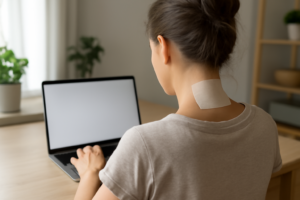


If you already know your migraines are tied to your neck — the trigeminal nerve pathway, the C1-C3 connection, all of it — the next question is the practical one: which specific structural problem in your neck is actually driving it, and what tool actually addresses that particular problem? Let’s get specific about the mechanics, then match each one to the home tools that target it.
Five Structural Neck Problems That May Be Setting Off Your Migraines
1. Forward Head Posture
For every inch your head shifts forward from its natural position, the effective weight on your cervical spine increases substantially. If you’re spending hours a day hunched over a phone or laptop, that chronic tension in your neck and upper traps could absolutely be feeding into your migraine cycle.
2. Cervical Disc Compression
The discs between your cervical vertebrae act as shock absorbers. Over time — through poor posture, old injuries, or simple aging — these discs can lose height and begin to compress surrounding nerves. Many people find that even mild disc compression in the upper cervical spine contributes to headaches that radiate up from the base of the skull.
3. Suboccipital Muscle Tension
The suboccipital muscles sit right at the junction of your skull and your upper neck. They’re tiny, but incredibly prone to holding tension. When they tighten up, they can compress the greater occipital nerve, which runs right through them, and trigger that characteristic pain that starts at the back of the head and works its way forward.
4. Joint Stiffness and Restricted Mobility
Stiff facet joints in the upper cervical spine can limit healthy range of motion and create a pattern of compensatory tension that ripples all the way up into your head. If you’ve ever noticed your neck feels locked up just before a migraine hits, this may be exactly what’s happening.
5. Poor Sleep Position
A pillow that doesn’t properly support your cervical curve can leave your neck in a compromised position for six to eight hours — and you wonder why you’re symptomatic by morning.
Matching the Problem to the Right Home Tool
Here’s where I want to be genuinely helpful rather than just throw a list at you. Different structural problems respond to different tools — these aren’t interchangeable, and picking the wrong one for your specific issue is a common reason people give up on cervical decompression too early. Always check with your healthcare provider before starting any new therapy, especially if you have a diagnosed cervical condition.
For Disc Compression: Inflatable Cervical Traction
Cervical traction gently separates the vertebrae in your neck, which may help reduce disc compression and ease nerve irritation directly.
- The S Cervical Neck Traction Device is an inflatable, adjustable neck stretcher that provides gentle decompression at home. It’s easy to use and adjustable to your comfort level — a good starting point for most people.
- The Elesik Cervical Neck Stretcher and Traction Device also functions as an extender pillow and hammock, giving you multiple ways to decompress depending on how your neck feels that day.
For More Significant Compression: Over-Door Traction
If you want a more structured setup, an over-door system may offer more consistent results for people with more significant cervical compression.
- The comness Cervical Neck Traction Device Over Door is a portable hammock-style neck stretcher that sets up easily and provides targeted decompression — a popular choice for people doing home physical therapy.
For Suboccipital Tension and Joint Stiffness: A Contoured Neck Relaxer
For passive stretching and cervical curve restoration — the specific issue behind suboccipital tension and restricted joint mobility — a contoured neck relaxer is a simple, targeted daily tool.
- The RESTCLOUD Neck and Shoulder Relaxer is a chiropractic-style stretcher that supports cervical spine alignment. Just a few minutes lying on it daily may help reset the natural curve in your neck and ease suboccipital tension.
For Poor Sleep Position: A Supportive Cervical Pillow
If sleep position is your specific issue, no traction device fixes that — you need support that works while you’re unconscious for eight hours. An orthopedic pillow that properly supports your cervical curve directly targets this cause rather than the others on this list.
Gentle Cervical Traction for Disc Decompression Without the Physical Therapy Bill
If your neck tension and migraines are being driven by disc compression or nerve irritation in your upper cervical spine specifically, cervical traction is one of the most evidence-backed tools you can use at home. Unlike stretching alone, traction actually creates space between your vertebrae — and many people notice a meaningful shift in headache frequency and intensity when they use it consistently.
What works
- Research supports cervical traction for reducing nerve compression symptoms and cervicogenic headache pain; the gentle separation of vertebrae creates decompression that stretching alone can’t achieve.
- Most users report noticeable relief within 2-3 weeks of consistent daily use (10-15 minutes), with improvements in both neck stiffness and migraine frequency — not immediate, but real when you stick with it.
- Inflatable devices offer adjustable tension so you can start gentle and gradually increase decompression as your neck adapts, which makes this safer than over-the-door systems that can feel abrupt or uncomfortable.
What doesn’t
- This won’t help if your migraines aren’t actually being triggered by cervical dysfunction — if your neck feels fine and your migraines are purely hormonal or vascular, traction won’t move the needle.
- If you have severe disc degeneration, spinal stenosis, or instability, you need professional assessment before using traction; this is supportive care for mild to moderate compression, not a replacement for imaging and medical clearance.
Cervical traction works best as part of a movement routine — you need to also address posture and strengthen stabilizer muscles, not just decompress and hope.
About This Article

Written by Michael Torres. Michael Torres has had joint problems his whole life — hypermobile as a kid, chronic sprains and a dislocating shoulder through his twenties, an osteoarthritis diagnosis in his early fifties, and a right knee replacement since. He is not a doctor or a physical therapist and has no clinical training. He writes about what has helped him and what he has watched help the people around him, and says plainly when he has not tried something himself. More about this site.
Scope and limits. Michael has no medical or clinical training — he writes about living with his own joint pain, not about treating anyone else's. Nothing here is medical advice. Talk to a doctor before starting anything new, and get seen promptly for pain that is new, severe, worsening, or comes with swelling, fever, or numbness.
Verify this against a primary source
Specifics change, and your situation may differ from the one described here. These are the authorities worth checking directly:
- NIAMS — arthritis and musculoskeletal research from the NIH
- MedlinePlus — plain-language medical reference from the NIH
- Arthritis Foundation — condition guides and treatment overviews