
This content is for informational purposes only and does not substitute for professional medical advice. Always consult a qualified healthcare provider before selecting a knee support device, particularly following injury or surgery.
Once you’ve settled on a sleeve or a brace, the next mistake is easy to make: buying the wrong size. An ill-fitting knee sleeve or brace doesn’t just feel uncomfortable — it actively works against you, either failing to provide meaningful compression or support, or cutting off circulation and making your knee feel worse. Here’s how to actually get the fit right, and the specific signs that tell you your current one doesn’t.
How to Measure Your Knee Correctly (Not Your Leg)
The single most common sizing mistake is measuring the wrong spot. Most sizing charts want the circumference at the midpoint of the kneecap with your leg straight and relaxed — not your calf, not your thigh, and not with your knee bent, which temporarily changes the measurement. Wrap a soft measuring tape around that midpoint, keep it snug but not pulled tight, and record the number in inches or centimeters exactly as the brand’s chart specifies. If you’re between two sizes, sizing down generally gives you more consistent compression for a sleeve; sizing up generally gives you more comfortable range of motion for a hinged brace.
Signs Your Sleeve or Brace Is Too Small
- Numbness, tingling, or a change in skin color below the device after 15-20 minutes of wear — this is a sign of restricted circulation, not “strong compression,” and means you should size up immediately.
- A visible indentation or red line in your skin that doesn’t fade within a few minutes of removing it.
- The fabric or straps digging in hard enough that you’re consciously thinking about the discomfort rather than the joint support.
- Difficulty bending your knee through a normal range of motion because the material is too restrictive.
Signs Your Sleeve or Brace Is Too Large
- It slides down your leg during normal walking, or you find yourself pulling it back up repeatedly through the day.
- You can easily fit more than two fingers underneath the fabric or straps while standing — a sleeve especially should feel snug throughout, not loose in spots.
- For hinged braces specifically, the hinge doesn’t sit directly over the sides of your actual knee joint anymore after a few minutes of movement.
- You’re getting little to no proprioceptive or compressive benefit — if it doesn’t feel like it’s doing anything, it’s very likely too big.
Why Knee Shape Matters as Much as Circumference
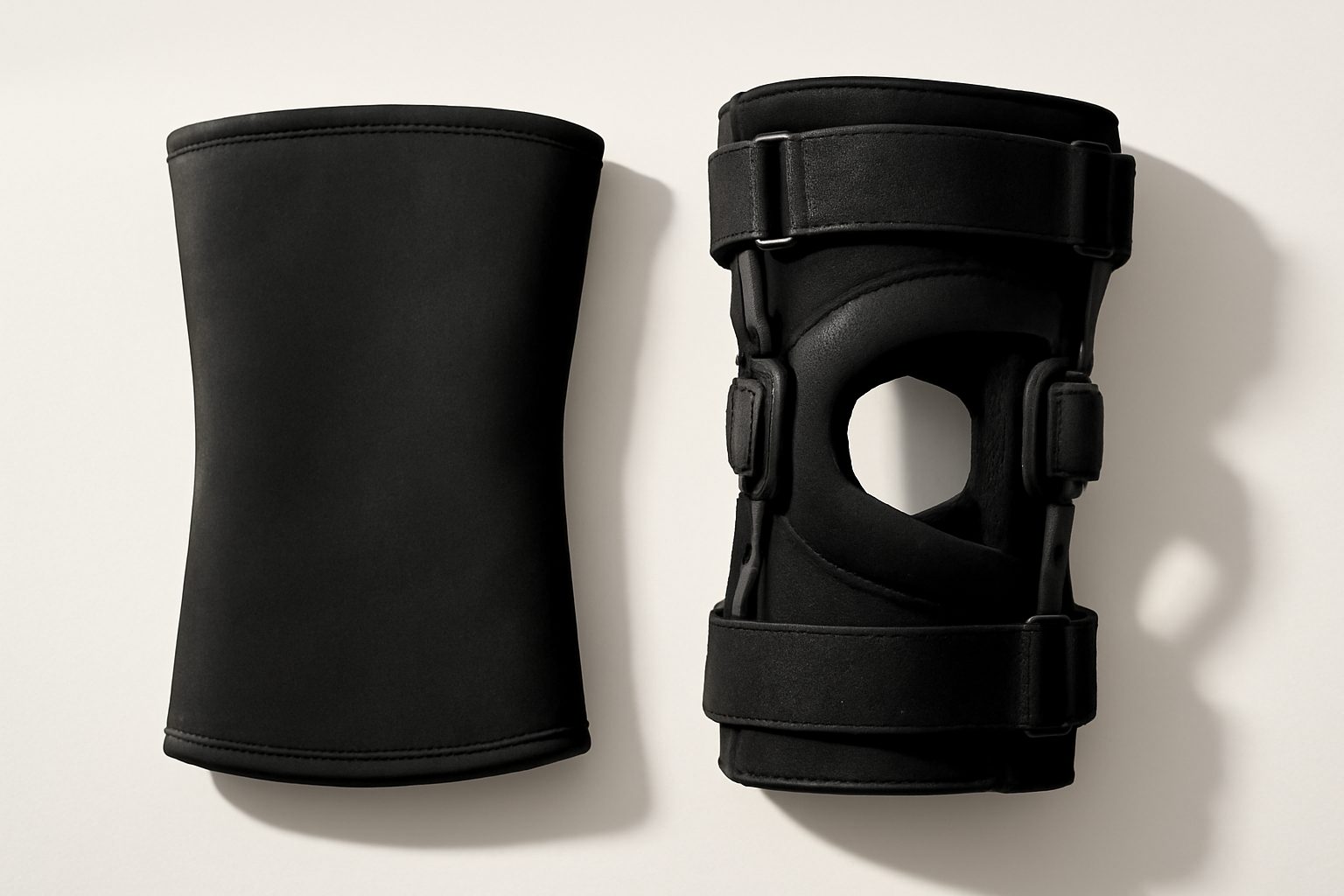
Two people with the same circumference measurement can need different sizes because knee shape varies — some people have a more pronounced kneecap or a wider taper from thigh to calf. If you’re between sizes on the chart and have a noticeably tapered leg shape, an hourglass or contoured-cut sleeve (rather than a straight tube) will generally fit more securely than a straight-cut one in the same size. This is a common reason people size up unnecessarily when the actual fix is switching to a more contoured product.
Fit Considerations Specific to Braces vs. Sleeves
For a compression sleeve, fit is mostly about consistent, even pressure with no gaps or rolling. For a hinged brace, fit is also about hinge alignment — the mechanical hinge needs to track directly over your actual joint line for the range-of-motion control to work as intended. A brace that’s correctly sized but slides even an inch out of position during activity can lose most of its functional benefit. If your brace consistently migrates during use despite correct sizing, check the strap tension first before assuming you need a different size — often it’s an adjustment problem, not a sizing problem.
When to Just Buy Two Sizes and Return One
If your measurement falls right on the line between two sizes on a chart, and the retailer has a reasonable return policy, ordering both sizes and testing them for fit before committing is a completely reasonable approach — cheaper in the long run than guessing wrong and re-ordering, or worse, sticking with a poor fit because returning feels like a hassle.
What works
- A true-to-size chart with clear measurement instructions reduces the trial-and-error that leads most people to buy the wrong size on the first try.
- A two-pack means you can wear one while washing the other, which matters if you’re supposed to be wearing it most of the day.
What doesn’t
- No sleeve fixes a shape mismatch — if your knee tapers significantly and you have a straight-cut sleeve, expect some rolling regardless of size.
Getting the size right the first time saves you from the discomfort — and wasted money — of a device that either does nothing or actively bothers you. Bodyprox Knee Compression Sleeve (2 Pack)
About This Article

Written by Michael Torres. Michael Torres has had joint problems his whole life — hypermobile as a kid, chronic sprains and a dislocating shoulder through his twenties, an osteoarthritis diagnosis in his early fifties, and a right knee replacement since. He is not a doctor or a physical therapist and has no clinical training. He writes about what has helped him and what he has watched help the people around him, and says plainly when he has not tried something himself. More about this site.
Scope and limits. Michael has no medical or clinical training — he writes about living with his own joint pain, not about treating anyone else's. Nothing here is medical advice. Talk to a doctor before starting anything new, and get seen promptly for pain that is new, severe, worsening, or comes with swelling, fever, or numbness.
Verify this against a primary source
Specifics change, and your situation may differ from the one described here. These are the authorities worth checking directly:
- NIAMS — arthritis and musculoskeletal research from the NIH
- MedlinePlus — plain-language medical reference from the NIH
- Arthritis Foundation — condition guides and treatment overviews